

1·0
'- 0·8
s:
-... VI
s 0·6
(5
~ O.t.I-- J.---===-c:::::QV
VI
.0
00.2
Local noon
9
8
7
6
12
13
IL.
15
16
17 18
Time
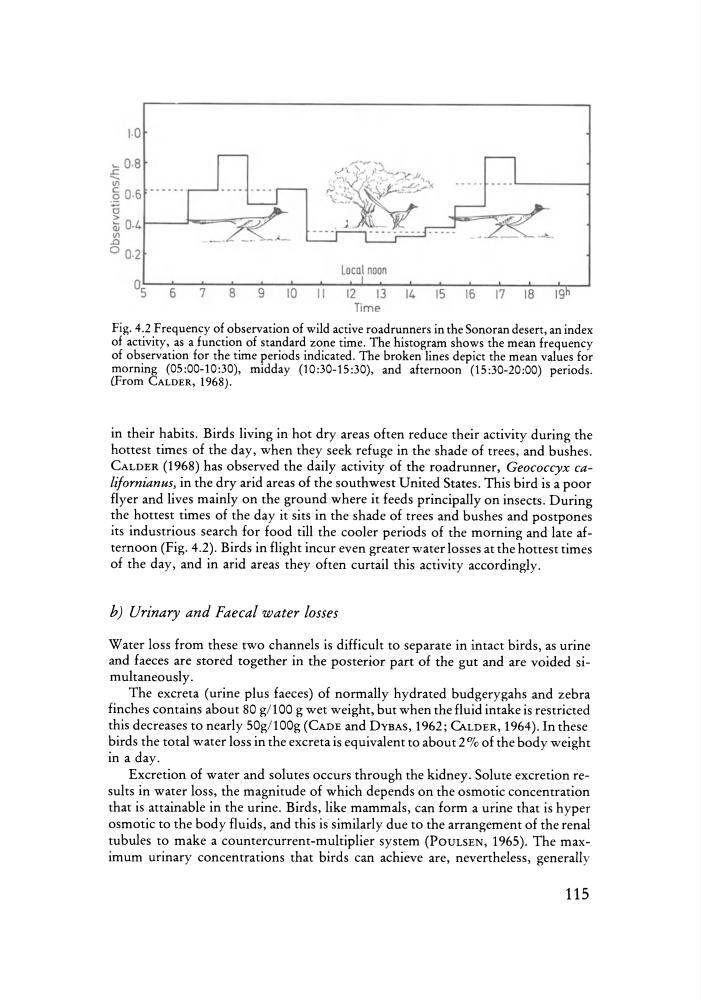
Fig. 4.2 Frequency of observation of wild active roadrunners in the Sonoran desert, an index
of activity, as a function of standard zone time. The histogram shows the mean frequency
of observation for the time periods indicated. The broken lines depict the mean values for
morning (05 :00-10 :30), midday (10 :30-15:30), and afternoon (15:30-20 :00) periods.
(From CALDER, 1968).
in their habits. Birds living in hot dry areas often reduce their activity during the
hottest times of the da y, when they seek refuge in the shade of trees, and bushes.
CALDER (1968) has observed the daily activity of the roadrunner, Geococcyx californianus, in the dry arid areas of the southwest United States. This bird is a poor
flyer and lives mainly on the ground where it feeds principally on insects. During
the hottest times of the day it sits in the shade of trees and bushes and postpones
its industrious search for food till the cooler periods of the morning and late afternoon (Fig. 4.2) . Birds in flight incur even greater water losses at the hottest times
of the da y, and in arid areas they often curtail this activity accordingly.
b) Urinary and Faecal water losses
Water loss from these two channels is difficult to separate in intact birds, as urine
and faeces are stored together in the posterior part of the gut and arc voided simultaneously.
The excreta (urine plus faeces) of normally hydrated budgerygahs and zebra
finches contains about 80 g!l 00 g wet weight, but when the fluid intake is restricted
this decreases to nearly SOg!l OOg (CADE and DYBAS, 1962; CALDER, 1964). In these
birds the total water loss in the excreta is equivalent to about 2 % of the body weight
in a da y.
Excretion of water and solutes occurs through the kidney. Solute excretion results in water loss, the magnitude of which depends on the osmotic concentration
that is attainable in the urine. Birds, like mammals, can form a urine that is hyper
osmotic to the body fluids, and this is similarly due to the arrangement of the renal
tubules to make a countercurrent-multiplier system (POULSEN, 1965). The maximum urinary concentrations that birds can achieve are, nevertheless , generally
115
'- 0·8
s:
-... VI
s 0·6
(5
~ O.t.I-- J.---===-c:::::QV
VI
.0
00.2
Local noon
9
8
7
6
12
13
IL.
15
16
17 18
Time
Fig. 4.2 Frequency of observation of wild active roadrunners in the Sonoran desert, an index
of activity, as a function of standard zone time. The histogram shows the mean frequency
of observation for the time periods indicated. The broken lines depict the mean values for
morning (05 :00-10 :30), midday (10 :30-15:30), and afternoon (15:30-20 :00) periods.
(From CALDER, 1968).
in their habits. Birds living in hot dry areas often reduce their activity during the
hottest times of the da y, when they seek refuge in the shade of trees, and bushes.
CALDER (1968) has observed the daily activity of the roadrunner, Geococcyx californianus, in the dry arid areas of the southwest United States. This bird is a poor
flyer and lives mainly on the ground where it feeds principally on insects. During
the hottest times of the day it sits in the shade of trees and bushes and postpones
its industrious search for food till the cooler periods of the morning and late afternoon (Fig. 4.2) . Birds in flight incur even greater water losses at the hottest times
of the da y, and in arid areas they often curtail this activity accordingly.
b) Urinary and Faecal water losses
Water loss from these two channels is difficult to separate in intact birds, as urine
and faeces are stored together in the posterior part of the gut and arc voided simultaneously.
The excreta (urine plus faeces) of normally hydrated budgerygahs and zebra
finches contains about 80 g!l 00 g wet weight, but when the fluid intake is restricted
this decreases to nearly SOg!l OOg (CADE and DYBAS, 1962; CALDER, 1964). In these
birds the total water loss in the excreta is equivalent to about 2 % of the body weight
in a da y.
Excretion of water and solutes occurs through the kidney. Solute excretion results in water loss, the magnitude of which depends on the osmotic concentration
that is attainable in the urine. Birds, like mammals, can form a urine that is hyper
osmotic to the body fluids, and this is similarly due to the arrangement of the renal
tubules to make a countercurrent-multiplier system (POULSEN, 1965). The maximum urinary concentrations that birds can achieve are, nevertheless , generally
115