

1. Water loss
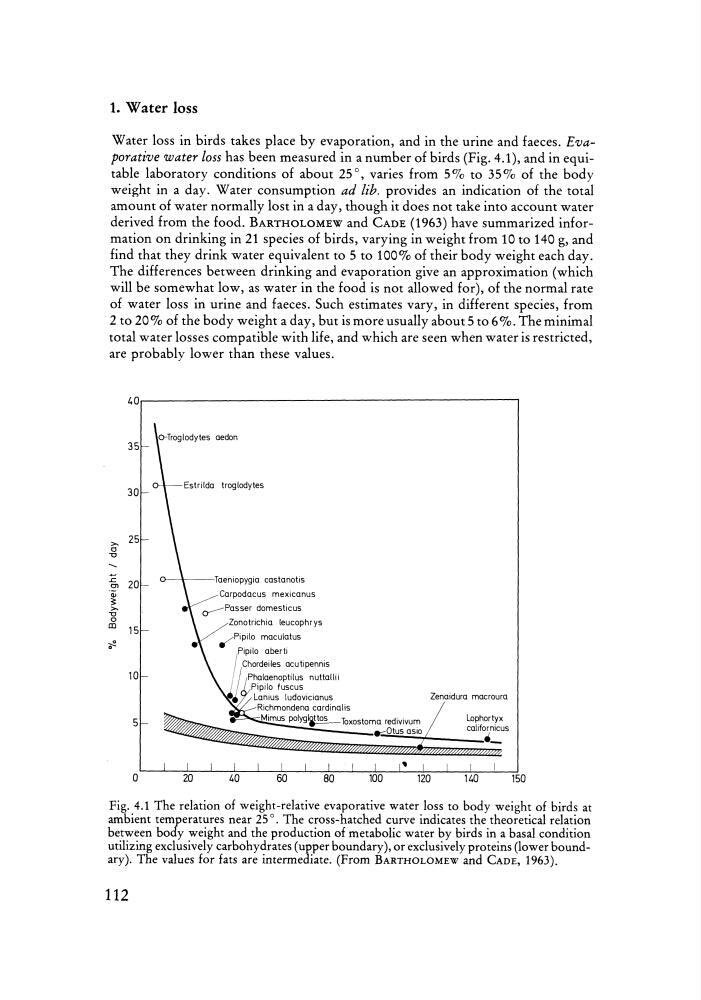
Water loss in birds takes place by evaporation, and in the urine and faeces. Evaporative water loss has been measured in a number of birds (Fig. 4.1), and in equitable laboratory conditions of about 25° , varies from 5% to 35 % of the body
weight in a da y. Water consumption ad lib. provides an indication of th e total
amount of water normally lost in a day, though it does not take into account water
derived from the food . BARTH OLOMEW and CADE (1963) have summarized information on drinking in 21 species of birds, varying in weight from 10 to 140 g, and
find that the y drink water equivalent to 5 to 100% of their body weight each day.
The differences between drinking and evaporation give an approximation (which
will be somewhat low, as water in the food is not allowed for), of the normal rate
of wa ter loss in urine and faeces . Such estimates vary, in diffe rent species, from
2 to 20% of the body weight a day, but is more usually about 5 to 6% . The minimal
total water losses compatible with life, and which are seen when water is restricted ,
are probably lower than these values .
150
140
Zenaiduro mocroura
120
lophortyx
californicus
........~'----'.o--+-- - Taeniopygia castanotis
Carpodacus mexicanus
~Pa s se r domestic us
Zonotrichi a leucophr ys
.--Pipilo maculatus
Plpilo abert i
I
Chordeiles acullpennis
~
Phalaenoptilus nuttalli i
Pipilo fuscus
Lanius ludovicianus
Richmondena cardinalis
Mimus polygl~ Toxostoma redivivum
e;;Otus 0 5 10
o
40
35
30
c-,
25
o
"tl
E 20
en
"ij;
~
c-,
"tl
0
co 15
~
10
5
Fig. 4.1 The relat ion of weight-relative evaporative water loss to bod y wei ght of bird s at
ambient temperatures near 25 0 . The cross -hatched curve indicates the theoretical relation
between body weight and the production of metabolic water by birds in a basal condition
utilizing exclusively carbohydrates (upper boundary), or exclusivel y proteins (lower boundary). The values for fats are int ermediate. (From B A RT H O L O M EW and CADE, 1963).
112
Water loss in birds takes place by evaporation, and in the urine and faeces. Evaporative water loss has been measured in a number of birds (Fig. 4.1), and in equitable laboratory conditions of about 25° , varies from 5% to 35 % of the body
weight in a da y. Water consumption ad lib. provides an indication of th e total
amount of water normally lost in a day, though it does not take into account water
derived from the food . BARTH OLOMEW and CADE (1963) have summarized information on drinking in 21 species of birds, varying in weight from 10 to 140 g, and
find that the y drink water equivalent to 5 to 100% of their body weight each day.
The differences between drinking and evaporation give an approximation (which
will be somewhat low, as water in the food is not allowed for), of the normal rate
of wa ter loss in urine and faeces . Such estimates vary, in diffe rent species, from
2 to 20% of the body weight a day, but is more usually about 5 to 6% . The minimal
total water losses compatible with life, and which are seen when water is restricted ,
are probably lower than these values .
150
140
Zenaiduro mocroura
120
lophortyx
californicus
........~'----'.o--+-- - Taeniopygia castanotis
Carpodacus mexicanus
~Pa s se r domestic us
Zonotrichi a leucophr ys
.--Pipilo maculatus
Plpilo abert i
I
Chordeiles acullpennis
~
Phalaenoptilus nuttalli i
Pipilo fuscus
Lanius ludovicianus
Richmondena cardinalis
Mimus polygl~ Toxostoma redivivum
e;;Otus 0 5 10
o
40
35
30
c-,
25
o
"tl
E 20
en
"ij;
~
c-,
"tl
0
co 15
~
10
5
Fig. 4.1 The relat ion of weight-relative evaporative water loss to bod y wei ght of bird s at
ambient temperatures near 25 0 . The cross -hatched curve indicates the theoretical relation
between body weight and the production of metabolic water by birds in a basal condition
utilizing exclusively carbohydrates (upper boundary), or exclusivel y proteins (lower boundary). The values for fats are int ermediate. (From B A RT H O L O M EW and CADE, 1963).
112