

....
' "
III
8 0
75
History of the Population of the Canal
75
M
Ii
~".,W'"H ~
_...:k:
,--;-:~~~.~.-:-t"""T'"~~~~~~,~~ J.;.c:rease
/. ....• ,., ..... , .. ',',','.', •• '.',',',',',',',' , ot'r.tedJlerrasrean Spec les
(. - .................................................... .
. . . . . . ~ . . . . . . . . . . . . . . .. .. . . .. . . . . .. .. . . . . . . . .. .. . . .. . . ... . . ..
•
..
..
..
•
..
•
•
..
..
..
..
..
..
..
..
..
..
..
..
..
..
..
..
..
..
...
0. . . . . .
..... . . ........................ .... ...................... . .
, , '
,',',' ~ii.fA'H;'):1 ~~ .' ~ . f'iT;'· ,:,',·.·,'.·.·.·
' .' , , . }~i~;~~)«:~:~:. ~:;
.',.,','.'.
S:alt dome
1870
80
90
19 0 0
10
20
30 40
50
60
70
Y EARS
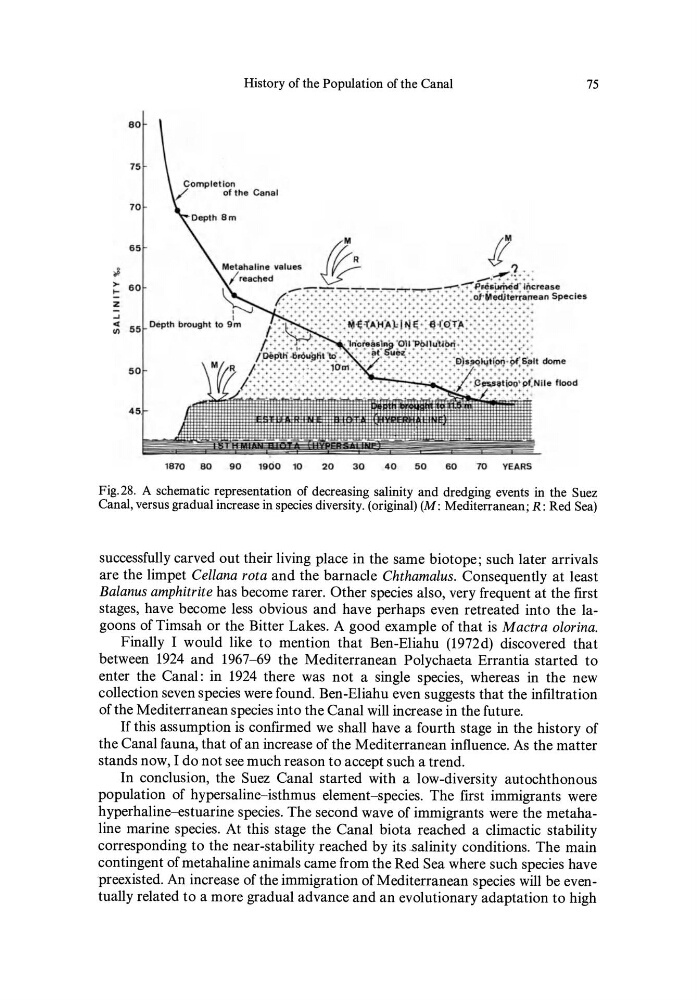
Fig.28. A schematic representation of decreasing salinity and dredging events in the Suez
CanaI, versus gradual increase in species diversity. (original) (M : Mediterranean; R: Red Seal
successfully carved out their living pi ace in the same biotope; such later arrivals
are the limpet Cellana rota and the barnacle Chthamalus. Consequently at least
Balanus amphitrite has become rarer. Other species also, very frequent at the fIrst
stages, have become less obvious and have perhaps even retreated into the lagoons of Timsah or the Bitter Lakes. A good example of that is M actra olorina.
Finally I would like to mention that Ben-Eliahu (1972d) discovered that
between 1924 and 1967-69 the Mediterranean Polychaeta Errantia started to
enter the Canal: in 1924 there was not a single species, whereas in the new
collection seven species were found, Ben-Eliahu even suggests that the infIltration
ofthe Mediterranean species into the Canal will increase in the future.
If this assumption is confirmed we shall have a fourth stage in the history of
the Canal fauna, that of an increase of the Mediterranean influence, As the matter
stands now, I do not see much reason to accept such a trend.
In conclusion, the Suez Canal started with a low-diversity autochthonous
population of hypersaline- isthmus element-species. The fIrst immigrants were
hyperhaline-estuarine species. The second wave of immigrants were the metahaline marine species, At this stage the Canal biota reached a climactic stability
corresponding to the near-stability reached by its .salinity conditions. The main
contingent of metahaline animals came from the Red Sea where such species have
preexisted. An increase of the immigration ofMediterranean species will be eventually related to a more gradual advance and an evolutionary adaptation to high
' "
III
8 0
75
History of the Population of the Canal
75
M
Ii
~".,W'"H ~
_...:k:
,--;-:~~~.~.-:-t"""T'"~~~~~~,~~ J.;.c:rease
/. ....• ,., ..... , .. ',',','.', •• '.',',',',',',',' , ot'r.tedJlerrasrean Spec les
(. - .................................................... .
. . . . . . ~ . . . . . . . . . . . . . . .. .. . . .. . . . . .. .. . . . . . . . .. .. . . .. . . ... . . ..
•
..
..
..
•
..
•
•
..
..
..
..
..
..
..
..
..
..
..
..
..
..
..
..
..
..
...
0. . . . . .
..... . . ........................ .... ...................... . .
, , '
,',',' ~ii.fA'H;'):1 ~~ .' ~ . f'iT;'· ,:,',·.·,'.·.·.·
' .' , , . }~i~;~~)«:~:~:. ~:;
.',.,','.'.
S:alt dome
1870
80
90
19 0 0
10
20
30 40
50
60
70
Y EARS
Fig.28. A schematic representation of decreasing salinity and dredging events in the Suez
CanaI, versus gradual increase in species diversity. (original) (M : Mediterranean; R: Red Seal
successfully carved out their living pi ace in the same biotope; such later arrivals
are the limpet Cellana rota and the barnacle Chthamalus. Consequently at least
Balanus amphitrite has become rarer. Other species also, very frequent at the fIrst
stages, have become less obvious and have perhaps even retreated into the lagoons of Timsah or the Bitter Lakes. A good example of that is M actra olorina.
Finally I would like to mention that Ben-Eliahu (1972d) discovered that
between 1924 and 1967-69 the Mediterranean Polychaeta Errantia started to
enter the Canal: in 1924 there was not a single species, whereas in the new
collection seven species were found, Ben-Eliahu even suggests that the infIltration
ofthe Mediterranean species into the Canal will increase in the future.
If this assumption is confirmed we shall have a fourth stage in the history of
the Canal fauna, that of an increase of the Mediterranean influence, As the matter
stands now, I do not see much reason to accept such a trend.
In conclusion, the Suez Canal started with a low-diversity autochthonous
population of hypersaline- isthmus element-species. The fIrst immigrants were
hyperhaline-estuarine species. The second wave of immigrants were the metahaline marine species, At this stage the Canal biota reached a climactic stability
corresponding to the near-stability reached by its .salinity conditions. The main
contingent of metahaline animals came from the Red Sea where such species have
preexisted. An increase of the immigration ofMediterranean species will be eventually related to a more gradual advance and an evolutionary adaptation to high