

50
The Suez Canal
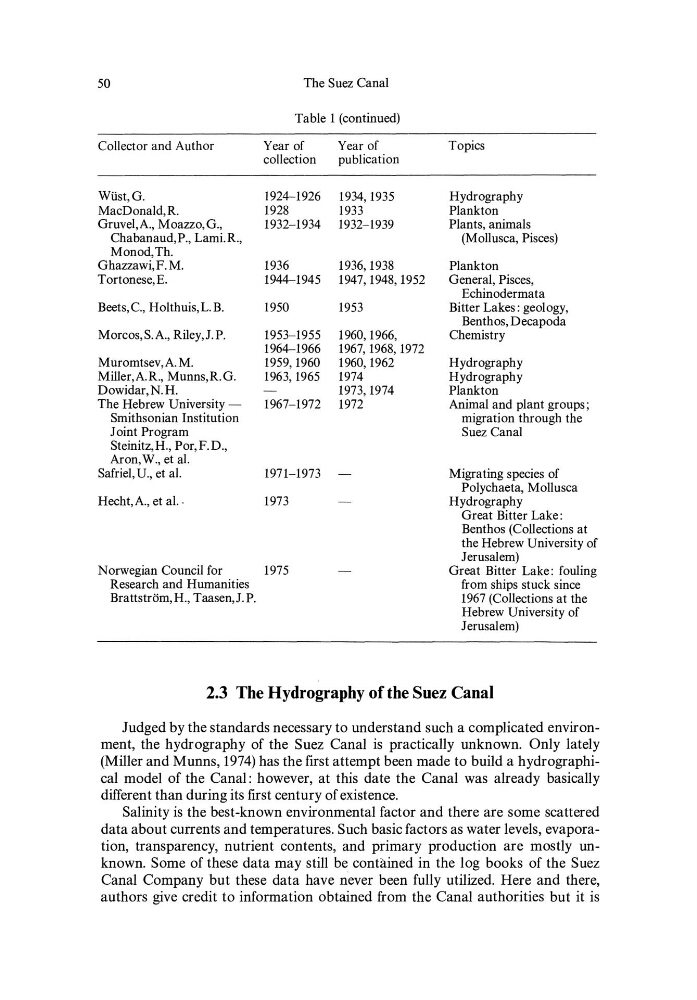
Table 1 (continued)
Collector and Author
Year of
Year of
collection
publication
Wüst,G.
1924-1926 1934,1935
MacDonald, R.
1928
1933
Gruvel,A., Moazzo,G.,
1932-1934 1932-1939
Chabanaud,P., Lami.R.,
Monod,Th.
Ghazzawi,F.M.
1936
1936,1938
Tortonese,E.
1944-1945 1947,1948,1952
Beets,C., Holthuis,L.B.
1950
1953
Morcos,S.A., Riley,J.P.
1953-1955 1960,1966,
1964-1966 1967, 1968, 1972
Muromtsev,A.M.
1959,1960 1960,1962
Miller,A.R., Munns,R.G.
1963,1965 1974
Dowidar,N.H.
1973,1974
The Hebrew University -
1967-1972 1972
Smithsonian Institution
Joint Program
Steinitz,H., Por,F.D.,
Aron, W., et al.
Safriel, u., et al.
1971-1973
Hecht,A., et al..
1973
Norwegian Council for
1975
Research and Humanities
Brattström,H., Taasen,J.P.
Topics
Hydrography
Plankton
Plants, animals
(Mollusca, Pisces)
Plankton
General, Pisces,
Echinodermata
Bitter Lakes: geology,
Benthos, Decapoda
Chemistry
Hydrography
Hydrography
Plankton
Animal and plant groups;
migration through the
Suez Canal
Migrating species of
Polychaeta, Mollusca
Hydrography
Great Bitter Lake:
Benthos (Collections at
the Hebrew University of
Jerusalem)
Great Bitter Lake: fouling
from ships stuck since
1967 (Collections at the
Hebrew University of
Jerusalem)
2.3 The Hydrography of the Suez Canal
Judged by the standards necessary to understand such a complicated environment, the hydrography of the Suez Canal is practically unknown. Only lately
(Miller and Munns, 1974) has the fIrst attempt been made to build a hydrographical model of the Canal: however, at this date the Canal was already basically
different than during its fIrst century of existence.
Salinity is the best-known environmental factor and there are some scattered
data about currents and temperatures. Such basic factors as water levels, evaporation, transparency, nutrient contents, and primary production are mostly unknown. Some of these data may still be contained in the log books of the Suez
Canal Company but these data have never been fully utilized. Here and there,
authors give credit to information obtained from the Canal authorities but it is
The Suez Canal
Table 1 (continued)
Collector and Author
Year of
Year of
collection
publication
Wüst,G.
1924-1926 1934,1935
MacDonald, R.
1928
1933
Gruvel,A., Moazzo,G.,
1932-1934 1932-1939
Chabanaud,P., Lami.R.,
Monod,Th.
Ghazzawi,F.M.
1936
1936,1938
Tortonese,E.
1944-1945 1947,1948,1952
Beets,C., Holthuis,L.B.
1950
1953
Morcos,S.A., Riley,J.P.
1953-1955 1960,1966,
1964-1966 1967, 1968, 1972
Muromtsev,A.M.
1959,1960 1960,1962
Miller,A.R., Munns,R.G.
1963,1965 1974
Dowidar,N.H.
1973,1974
The Hebrew University -
1967-1972 1972
Smithsonian Institution
Joint Program
Steinitz,H., Por,F.D.,
Aron, W., et al.
Safriel, u., et al.
1971-1973
Hecht,A., et al..
1973
Norwegian Council for
1975
Research and Humanities
Brattström,H., Taasen,J.P.
Topics
Hydrography
Plankton
Plants, animals
(Mollusca, Pisces)
Plankton
General, Pisces,
Echinodermata
Bitter Lakes: geology,
Benthos, Decapoda
Chemistry
Hydrography
Hydrography
Plankton
Animal and plant groups;
migration through the
Suez Canal
Migrating species of
Polychaeta, Mollusca
Hydrography
Great Bitter Lake:
Benthos (Collections at
the Hebrew University of
Jerusalem)
Great Bitter Lake: fouling
from ships stuck since
1967 (Collections at the
Hebrew University of
Jerusalem)
2.3 The Hydrography of the Suez Canal
Judged by the standards necessary to understand such a complicated environment, the hydrography of the Suez Canal is practically unknown. Only lately
(Miller and Munns, 1974) has the fIrst attempt been made to build a hydrographical model of the Canal: however, at this date the Canal was already basically
different than during its fIrst century of existence.
Salinity is the best-known environmental factor and there are some scattered
data about currents and temperatures. Such basic factors as water levels, evaporation, transparency, nutrient contents, and primary production are mostly unknown. Some of these data may still be contained in the log books of the Suez
Canal Company but these data have never been fully utilized. Here and there,
authors give credit to information obtained from the Canal authorities but it is