

28
The Historical Background
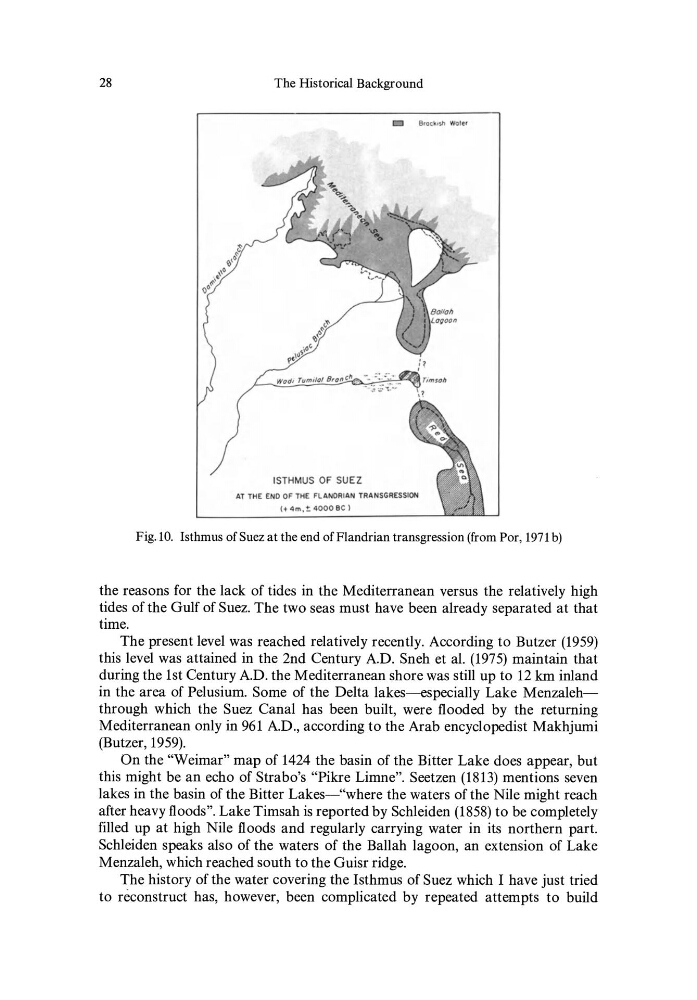
ISTHMUS OF SUEZ
AT THE ENO OF THE FLANORIAN TRANSGRESSION
( t 4rn .:t 4000BC)
Fig.lO. Isthmus ofSuez at the end ofFlandrian transgression (from Por, 1971 b)
the reasons for the lack of tides in the Mediterranean versus the relatively high
tides ofthe Gulf of Suez. The two seas must have been already separated at that
time.
The present level was reached relatively recently. According to Butzer (1959)
this level was attained in the 2nd Century AD. Sneh et al. (1975) maintain that
during the 1st Century AD. the Mediterranean shore was still up to 12 km inland
in the area of Pelusium. Some of the Delta lakes-especially Lake Menzalehthrough which the Suez Canal has been built, were flooded by the retuming
Mediterranean only in 961 AD., according to the Arab encyclopedist Makhjumi
(Butzer, 1959).
On the "Weimar" map of 1424 the basin of the Bitter Lake does appear, but
this might be an echo of Strabo's "Pikre Limne". Seetzen (1813) mentions seven
lakes in the basin of the Bitter Lakes-"where the waters of the Nile might reach
after heavy floods". Lake Timsah is reported by Schleiden (1858) to be completely
filled up at high Nile floods and regularly carrying water in its northern part.
Schleiden speaks also of the waters of the Ballah lagoon, an extension of Lake
Menzaleh, which reached south to the Guisr ridge.
The his tory of the water covering the Isthmus of Suez which I have just tried
to reconstruct has, however, been complicated by repeated attempts to build
The Historical Background
ISTHMUS OF SUEZ
AT THE ENO OF THE FLANORIAN TRANSGRESSION
( t 4rn .:t 4000BC)
Fig.lO. Isthmus ofSuez at the end ofFlandrian transgression (from Por, 1971 b)
the reasons for the lack of tides in the Mediterranean versus the relatively high
tides ofthe Gulf of Suez. The two seas must have been already separated at that
time.
The present level was reached relatively recently. According to Butzer (1959)
this level was attained in the 2nd Century AD. Sneh et al. (1975) maintain that
during the 1st Century AD. the Mediterranean shore was still up to 12 km inland
in the area of Pelusium. Some of the Delta lakes-especially Lake Menzalehthrough which the Suez Canal has been built, were flooded by the retuming
Mediterranean only in 961 AD., according to the Arab encyclopedist Makhjumi
(Butzer, 1959).
On the "Weimar" map of 1424 the basin of the Bitter Lake does appear, but
this might be an echo of Strabo's "Pikre Limne". Seetzen (1813) mentions seven
lakes in the basin of the Bitter Lakes-"where the waters of the Nile might reach
after heavy floods". Lake Timsah is reported by Schleiden (1858) to be completely
filled up at high Nile floods and regularly carrying water in its northern part.
Schleiden speaks also of the waters of the Ballah lagoon, an extension of Lake
Menzaleh, which reached south to the Guisr ridge.
The his tory of the water covering the Isthmus of Suez which I have just tried
to reconstruct has, however, been complicated by repeated attempts to build