

10
The Historical Background
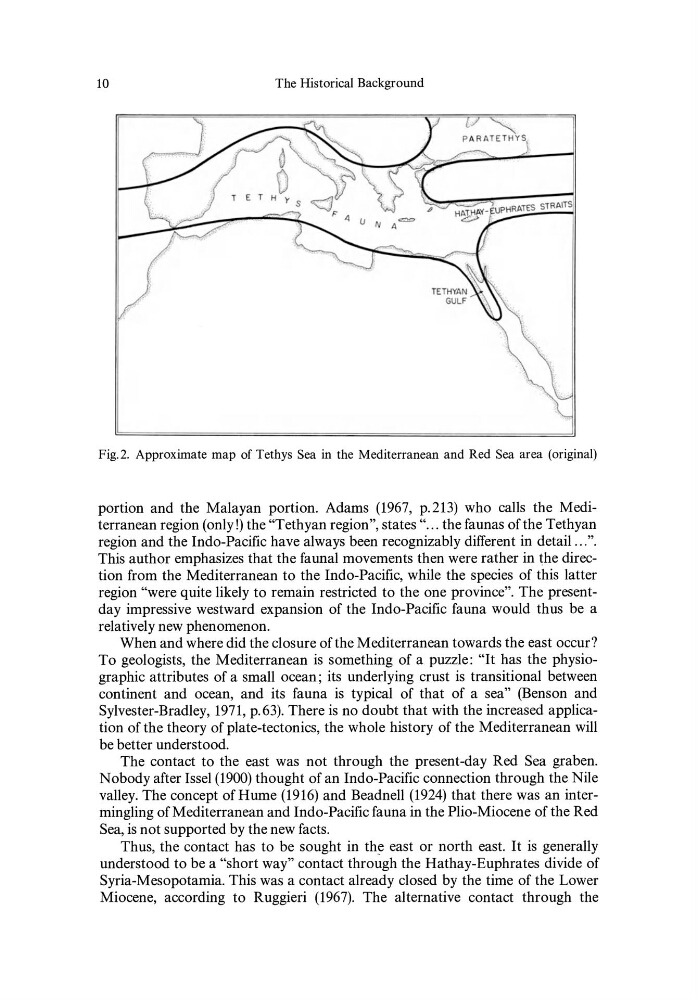
Fig.2. Approximate map of Tethys Sea in the Mediterranean and Red Sea area (original)
portion and the Malayan portion. Adams (1967, p.213) who calls the Mediterranean region (only!) the "Tethyan region", states " ... the faunas ofthe Tethyan
region and the Indo-Pacific have always been recognizably different in detail ... ".
This author emphasizes that the faunal movements then were rather in the directi on from the Mediterranean to the Indo-Pacific, while the species of this latter
region "were quite likely to remain restricted to the one province". The presentday impressive westward expansion of the Indo-Pacific fauna would thus be a
relatively new phenomenon.
When and where did the closure ofthe Mediterranean towards the east occur?
To geologists, the Mediterranean is something of a puzzle: "It has the physiographie attributes of a small ocean; its underlying crust is transitional between
continent and ocean, and its fauna is typical of that of a sea" (Benson and
Sylvester-Bradley, 1971, p.63). There is no doubt that with the increased application of the theory of plate-tectonics, the whole history of the Mediterranean will
be better understood.
The contact to the east was not through the present-day Red Sea graben.
Nobody after Issel (1900) thought of an Indo-Pacific connection through the Nile
valley. The concept of Hume (1916) and Beadnell (1924) that there was an intermingling ofMediterranean and Indo-Pacific fauna in the Plio-Miocene of the Red
Sea, is not supported by the new facts.
Thus, the contact has to be sought in the east or north east. It is generally
understood to be a "short way" contact through the Hathay-Euphrates divide of
Syria-Mesopotamia. This was a contact already closed by the time of the Lower
Miocene, according to Ruggieri (1967). The alternative contact through the
The Historical Background
Fig.2. Approximate map of Tethys Sea in the Mediterranean and Red Sea area (original)
portion and the Malayan portion. Adams (1967, p.213) who calls the Mediterranean region (only!) the "Tethyan region", states " ... the faunas ofthe Tethyan
region and the Indo-Pacific have always been recognizably different in detail ... ".
This author emphasizes that the faunal movements then were rather in the directi on from the Mediterranean to the Indo-Pacific, while the species of this latter
region "were quite likely to remain restricted to the one province". The presentday impressive westward expansion of the Indo-Pacific fauna would thus be a
relatively new phenomenon.
When and where did the closure ofthe Mediterranean towards the east occur?
To geologists, the Mediterranean is something of a puzzle: "It has the physiographie attributes of a small ocean; its underlying crust is transitional between
continent and ocean, and its fauna is typical of that of a sea" (Benson and
Sylvester-Bradley, 1971, p.63). There is no doubt that with the increased application of the theory of plate-tectonics, the whole history of the Mediterranean will
be better understood.
The contact to the east was not through the present-day Red Sea graben.
Nobody after Issel (1900) thought of an Indo-Pacific connection through the Nile
valley. The concept of Hume (1916) and Beadnell (1924) that there was an intermingling ofMediterranean and Indo-Pacific fauna in the Plio-Miocene of the Red
Sea, is not supported by the new facts.
Thus, the contact has to be sought in the east or north east. It is generally
understood to be a "short way" contact through the Hathay-Euphrates divide of
Syria-Mesopotamia. This was a contact already closed by the time of the Lower
Miocene, according to Ruggieri (1967). The alternative contact through the