

Analysis of the Colonizing Success of Lessepsian Migrants
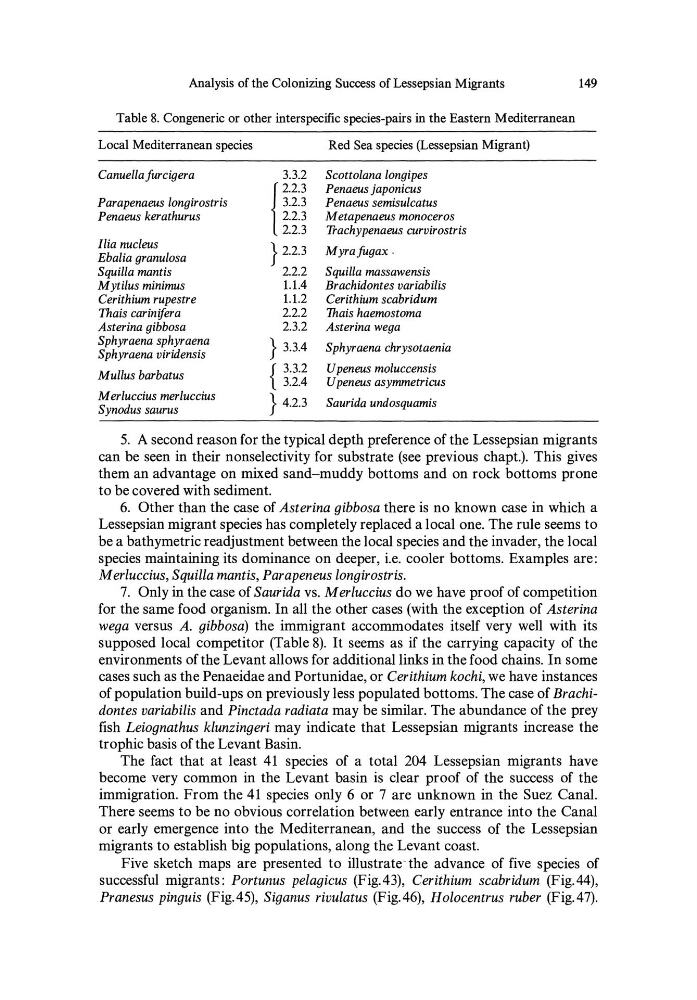
Table 8. Congeneric or other interspecific species-pairs in the Eastem Mediterranean
Local Mediterranean species
Canuella furcigera
Parapenaeus longirostris
Penaeus kerathurus
Ilia nuc/eus
Ebalia granulosa
Squilla mantis
M ytilus minimus
Cerithium rupestre
Thais carinifera
Asterina gibbosa
Sphyraena sphyraena
Sphyraena viridensis
Mullus barbatus
Merluccius merluccius
Synodus saurus
3.3.2
{
2.2.3
3.2.3
2.2.3
2.2.3
} 2.2.3
2.2.2
1.1.4
1.1.2
2.2.2
2.3.2
} 3.3.4
{ 3.3.2
3.2.4
} 4.2.3
Red Sea species (Lessepsian Migrant)
Scottolana longipes
Penaeus japonicus
Penaeus semisulcatus
M etapenaeus monoceros
Jrachypenaeus curvirostris
Myrafugax.
Squilla massawensis
Brachidontes variabilis
Cerithium scabridum
Thais haemostoma
Asterina wega
Sphyraena chrysotaenia
U peneus moluccensis
Upeneus asymmetricus
Saurida undosquamis
149
5. A second reason for the typical depth preference of the Lessepsian migrants
can be seen in their nonselectivity for substrate (see previous chapt.). This gives
them an advantage on mixed sand-muddy bottoms and on rock bottoms prone
to be covered with sediment.
6. Other than the ease of Asterina gibbosa there is no known case in which a
Lessepsian migrant species has complete1y replaced a local one. The rule seems to
be a bathymetric readjustment between the local species and the invader, the loeal
species maintaining its dominance on deeper, Le. cooler bottoms. Examples are:
Merluccius, Squilla mantis, Parapeneus longirostris.
7. Only in the ease of Saurida vs. M erluccius do we have proof of competition
for the same food organism. In all the other cases (with the exception of Asterina
wega versus A. gibbosa) the immigrant accommodates itself very well with its
supposed loeal competitor (Table 8). It seems as if the carrying capacity of the
environments of the Levant allows for additional links in the food chains. In some
cases such as the Penaeidae and Portunidae, or Cerithium kochi, we have instances
of population build-ups on previously less populated bottoms. The case of Brachidontes variabilis and Pinctada radiata may be similar. The abundance of the prey
fish Leiognathus klunzingeri may indieate that Lessepsian migrants increase the
trophic basis ofthe Levant Basin.
The fact that at least 41 species of a total 204 Lessepsian migrants have
become very common in the Levant basin is c1ear proof of the success of the
immigration. From the 41 species only 6 or 7 are unknown in the Suez Canal.
There seems to be no obvious corre1ation between earlyentrance into the Canal
or early emergence into the Mediterranean, and the success of the Lessepsian
migrants to establish big populations, along the Levant coast.
Five sketch maps are presented to illustrate- the advance of five species of
successful migrants: Portunus pelagicus (Fig.43), Cerithium scabridum (Fig.44),
Pranesus pinguis (Fig.45), Siganus rivulatus (Fig.46), Holocentrus ruber (Fig.47).
Table 8. Congeneric or other interspecific species-pairs in the Eastem Mediterranean
Local Mediterranean species
Canuella furcigera
Parapenaeus longirostris
Penaeus kerathurus
Ilia nuc/eus
Ebalia granulosa
Squilla mantis
M ytilus minimus
Cerithium rupestre
Thais carinifera
Asterina gibbosa
Sphyraena sphyraena
Sphyraena viridensis
Mullus barbatus
Merluccius merluccius
Synodus saurus
3.3.2
{
2.2.3
3.2.3
2.2.3
2.2.3
} 2.2.3
2.2.2
1.1.4
1.1.2
2.2.2
2.3.2
} 3.3.4
{ 3.3.2
3.2.4
} 4.2.3
Red Sea species (Lessepsian Migrant)
Scottolana longipes
Penaeus japonicus
Penaeus semisulcatus
M etapenaeus monoceros
Jrachypenaeus curvirostris
Myrafugax.
Squilla massawensis
Brachidontes variabilis
Cerithium scabridum
Thais haemostoma
Asterina wega
Sphyraena chrysotaenia
U peneus moluccensis
Upeneus asymmetricus
Saurida undosquamis
149
5. A second reason for the typical depth preference of the Lessepsian migrants
can be seen in their nonselectivity for substrate (see previous chapt.). This gives
them an advantage on mixed sand-muddy bottoms and on rock bottoms prone
to be covered with sediment.
6. Other than the ease of Asterina gibbosa there is no known case in which a
Lessepsian migrant species has complete1y replaced a local one. The rule seems to
be a bathymetric readjustment between the local species and the invader, the loeal
species maintaining its dominance on deeper, Le. cooler bottoms. Examples are:
Merluccius, Squilla mantis, Parapeneus longirostris.
7. Only in the ease of Saurida vs. M erluccius do we have proof of competition
for the same food organism. In all the other cases (with the exception of Asterina
wega versus A. gibbosa) the immigrant accommodates itself very well with its
supposed loeal competitor (Table 8). It seems as if the carrying capacity of the
environments of the Levant allows for additional links in the food chains. In some
cases such as the Penaeidae and Portunidae, or Cerithium kochi, we have instances
of population build-ups on previously less populated bottoms. The case of Brachidontes variabilis and Pinctada radiata may be similar. The abundance of the prey
fish Leiognathus klunzingeri may indieate that Lessepsian migrants increase the
trophic basis ofthe Levant Basin.
The fact that at least 41 species of a total 204 Lessepsian migrants have
become very common in the Levant basin is c1ear proof of the success of the
immigration. From the 41 species only 6 or 7 are unknown in the Suez Canal.
There seems to be no obvious corre1ation between earlyentrance into the Canal
or early emergence into the Mediterranean, and the success of the Lessepsian
migrants to establish big populations, along the Levant coast.
Five sketch maps are presented to illustrate- the advance of five species of
successful migrants: Portunus pelagicus (Fig.43), Cerithium scabridum (Fig.44),
Pranesus pinguis (Fig.45), Siganus rivulatus (Fig.46), Holocentrus ruber (Fig.47).