

132
The Migrant Biota
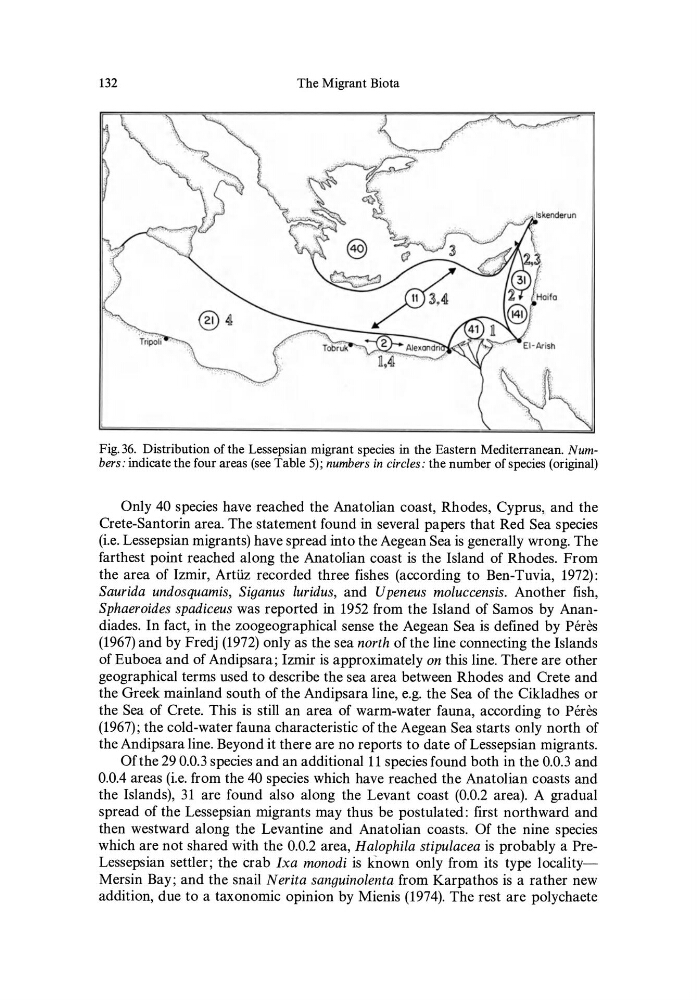
Fig.36. Distribution of the Lessepsian migrant species in the Eastern Mediterranean. Numbers: indicate the four areas (see Table 5); numbers in circles: the number of species (original)
Only 40 species have reached the Anatolian coast, Rhodes, Cyprus, and the
Crete-Santorin area. The statement found in several papers that Red Sea species
(i.e. Lessepsian migrants) have spread into the Aegean Sea is generally wrong. The
farthest point reached along the Anatolian coast is the Island of Rhodes. From
the area of Izmir, Artüz recorded three fishes (according to Ben-Tuvia, 1972):
Saurida undosquamis, Siganus luridus, and U peneus moluccensis. Another fish,
Sphaeroides spadiceus was reported in 1952 from the Island of Samos by Anandiades. In fact, in the zoogeographical sense the Aegean Sea is defined by Peres
(1967) and by Fredj (1972) only as the sea north of the line connecting the Islands
of Euboea and of Andipsara; Izmir is approximately on this line. There are other
geographical terms used to describe the sea area between Rhodes and Crete and
the Greek mainland south of the Andipsara line, e.g. the Sea of the Cikladhes or
the Sea of Crete. This is still an area of warm-water fauna, according to Peres
(1967); the cold-water fauna characteristic of the Aegean Sea starts only north of
the Andipsara line. Beyond it there are no reports to date of Lessepsian migrants.
Oft he 29 0.0.3 species and an additional 11 species found both in the 0.0.3 and
0.0.4 areas (i.e. from the 40 species which have reached the Anatolian coasts and
the Islands), 31 are found also along the Levant coast (0.0.2 area). A gradual
spread of the Lessepsian migrants may thus be postulated: first northward and
then westward along the Levantine and Anatolian coasts. Of the nine species
which are not shared with the 0.0.2 area, Halophila stipulacea is probably a PreLessepsian settler; the crab Ixa monodi is known only from its type localityMersin Bay; and the snail N erita sanguinolenta from Karpathos is a rather new
addition, due to a taxonomie opinion by Mienis (1974). The rest are polychaete
The Migrant Biota
Fig.36. Distribution of the Lessepsian migrant species in the Eastern Mediterranean. Numbers: indicate the four areas (see Table 5); numbers in circles: the number of species (original)
Only 40 species have reached the Anatolian coast, Rhodes, Cyprus, and the
Crete-Santorin area. The statement found in several papers that Red Sea species
(i.e. Lessepsian migrants) have spread into the Aegean Sea is generally wrong. The
farthest point reached along the Anatolian coast is the Island of Rhodes. From
the area of Izmir, Artüz recorded three fishes (according to Ben-Tuvia, 1972):
Saurida undosquamis, Siganus luridus, and U peneus moluccensis. Another fish,
Sphaeroides spadiceus was reported in 1952 from the Island of Samos by Anandiades. In fact, in the zoogeographical sense the Aegean Sea is defined by Peres
(1967) and by Fredj (1972) only as the sea north of the line connecting the Islands
of Euboea and of Andipsara; Izmir is approximately on this line. There are other
geographical terms used to describe the sea area between Rhodes and Crete and
the Greek mainland south of the Andipsara line, e.g. the Sea of the Cikladhes or
the Sea of Crete. This is still an area of warm-water fauna, according to Peres
(1967); the cold-water fauna characteristic of the Aegean Sea starts only north of
the Andipsara line. Beyond it there are no reports to date of Lessepsian migrants.
Oft he 29 0.0.3 species and an additional 11 species found both in the 0.0.3 and
0.0.4 areas (i.e. from the 40 species which have reached the Anatolian coasts and
the Islands), 31 are found also along the Levant coast (0.0.2 area). A gradual
spread of the Lessepsian migrants may thus be postulated: first northward and
then westward along the Levantine and Anatolian coasts. Of the nine species
which are not shared with the 0.0.2 area, Halophila stipulacea is probably a PreLessepsian settler; the crab Ixa monodi is known only from its type localityMersin Bay; and the snail N erita sanguinolenta from Karpathos is a rather new
addition, due to a taxonomie opinion by Mienis (1974). The rest are polychaete