

Dynamic Zoogeography
5
.-0 CoIdwol!:r (IM low solinil)l biofo.
Recruitment oreas:. refugio ancl drecliOM of spreod
WOfTlJNOter and high solinily biotCl.
Aeeruilment Qreal, refuqio (Iod directions 01 spreod
(Temp. {lAd sol. difference$ ore c.onsirJereci in relation
'0 IM ptesenl hyd,o~1 oonc!lriorrs ~ IM rHpe<:live
seo) -
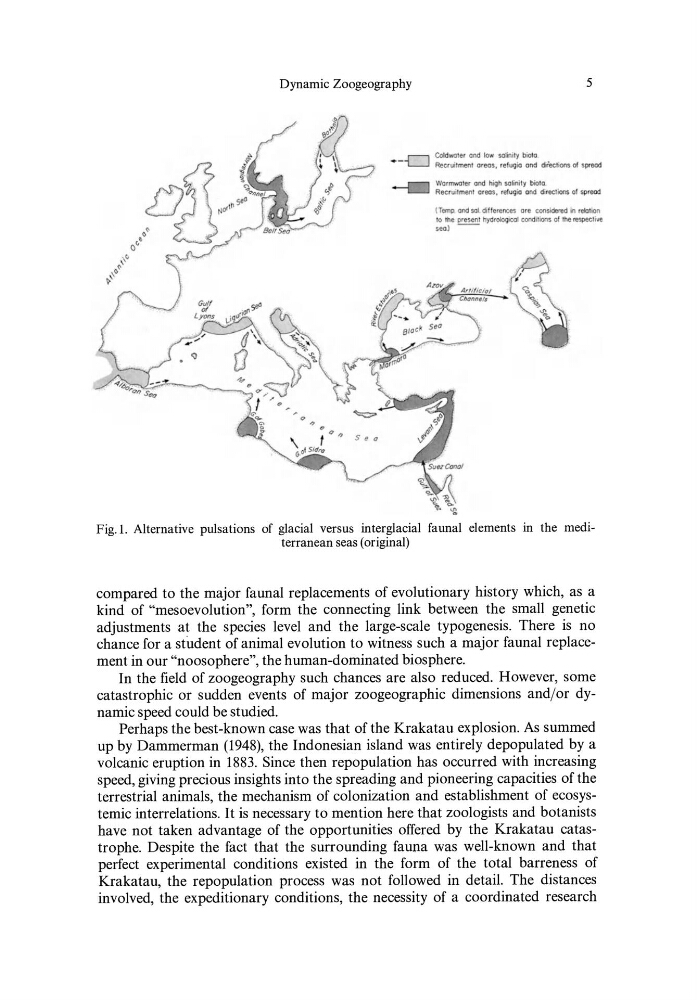
Fig.l. Alternative pulsations of glacial versus interglacial faunal elements m the mediterranean seas (original)
compared to the major faunal replacements of evolutionary history which, as a
kind of "mesoevolution", form the connecting link between the small genetic
adjustments at the species level and the large-scale typogenesis. There is no
chance for a student of animal evolution to witness such a major faunal replacement in oUf "noosophere", the human-dominated biosphere.
In the field of zoogeography such chances are also reduced. However, some
catastrophic or sudden events of major zoogeographie dimensions andj or dynamic speed could be studied.
Perhaps the best-known case was that of the Krakatau explosion. As summed
up by Dammerman (1948), the Indonesian island was entirely depopulated by a
volcanic eruption in 1883. Since then repopulation has occurred with increasing
speed, giving precious insights into the spreading and pioneering capacities of the
terrestrial animals, the mechanism of colonization and establishment of ecosystemic interrelations. It is necessary to mention here that zoologists and botanists
have not taken advantage of the opportunities offered by the Krakatau catastrophe. Despite the fact that the surrounding fauna was well-known and that
perfeet experimental conditions existed in the form of the total barreness of
Krakatau, the repopulation process was not followed in detail. The distances
involved, the expeditionary conditions, the necessity of a coordinated research
5
.-0 CoIdwol!:r (IM low solinil)l biofo.
Recruitment oreas:. refugio ancl drecliOM of spreod
WOfTlJNOter and high solinily biotCl.
Aeeruilment Qreal, refuqio (Iod directions 01 spreod
(Temp. {lAd sol. difference$ ore c.onsirJereci in relation
'0 IM ptesenl hyd,o~1 oonc!lriorrs ~ IM rHpe<:live
seo) -
Fig.l. Alternative pulsations of glacial versus interglacial faunal elements m the mediterranean seas (original)
compared to the major faunal replacements of evolutionary history which, as a
kind of "mesoevolution", form the connecting link between the small genetic
adjustments at the species level and the large-scale typogenesis. There is no
chance for a student of animal evolution to witness such a major faunal replacement in oUf "noosophere", the human-dominated biosphere.
In the field of zoogeography such chances are also reduced. However, some
catastrophic or sudden events of major zoogeographie dimensions andj or dynamic speed could be studied.
Perhaps the best-known case was that of the Krakatau explosion. As summed
up by Dammerman (1948), the Indonesian island was entirely depopulated by a
volcanic eruption in 1883. Since then repopulation has occurred with increasing
speed, giving precious insights into the spreading and pioneering capacities of the
terrestrial animals, the mechanism of colonization and establishment of ecosystemic interrelations. It is necessary to mention here that zoologists and botanists
have not taken advantage of the opportunities offered by the Krakatau catastrophe. Despite the fact that the surrounding fauna was well-known and that
perfeet experimental conditions existed in the form of the total barreness of
Krakatau, the repopulation process was not followed in detail. The distances
involved, the expeditionary conditions, the necessity of a coordinated research