

The Levant Shore-the Core Area ofthe Lessepsian Immigration
125
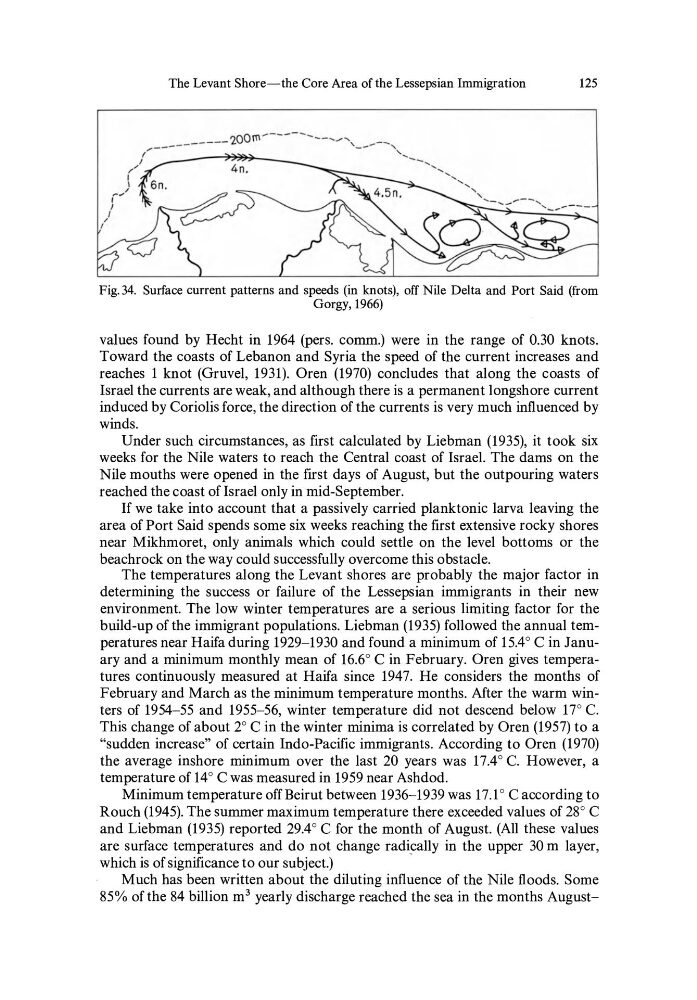
Fig.34. Surface current patterns and speeds (in knots), off Nile Delta and Port Said (from
Gorgy, 1966)
values found by Hecht in 1964 (pers. comm.) were in the range of 0.30 knots.
Toward the coasts of Lebanon and Syria the speed of the current increases and
reaches 1 knot (Gruvel, 1931). Oren (1970) concludes that along the coasts of
Israel the currents are weak, and although there is a permanent longshore current
induced by Coriolis force, the direction of the currents is very much influenced by
winds.
Under such circumstances, as first calculated by Liebman (1935), it took six
weeks for the Nile waters to reach the Central coast of Israel. The dams on the
Nile mouths were opened in the fIrst days of August, but the outpouring waters
reached the coast of Israel only in mid-September.
If we take into account that a passively carried planktonic larva leaving the
area of Port Said spends some six weeks reaching the fIrst extensive rocky shores
near Mikhmoret, only animals which could setde on the level bottoms or the
beachrock on the way could successfully overcome this obstacle.
The temperatur es along the Levant shores are probably the major factor in
determining the success or failure of the Lessepsian immigrants in their new
environment. The low winter temperatures are a serious limiting factor for the
build-up ofthe immigrant populations. Liebman (1935) followed the annual temperatures near Haifa during 1929-1930 and found a minimum of 15.4° C in Januaryand a minimum monthly mean of 16.6° C in February. Oren gives temperatures continuously measured at Haifa since 1947. He considers the months of
February and March as the minimum temperature months. After the warm winters of 1954-55 and 1955- 56, winter temperature did not descend below 17° C.
This change of about 2° C in the winter minima is correlated by Oren (1957) to a
"sudden increase" of certain Indo-Pacmc immigrants. According to Oren (1970)
the average inshore minimum over the last 20 years was 17.4° C. However, a
temperature of 14° C was measured in 1959 near Ashdod.
Minimum temperature off Beirut between 1936-1939 was 17.1 ° C according to
Rouch (1945). The summer maximum temperature there exceeded values of 28° C
and Liebman (1935) reported 29.4° C for the month of August. (All these values
are surface temperatures and do not change radi~ally in the upper 30 m layer,
which is of signifIcance to our subject.)
Much has been written about the diluting influence of the Nile floods. Some
85% of the 84 billion m 3 yearly discharge reached the sea in the months August-
125
Fig.34. Surface current patterns and speeds (in knots), off Nile Delta and Port Said (from
Gorgy, 1966)
values found by Hecht in 1964 (pers. comm.) were in the range of 0.30 knots.
Toward the coasts of Lebanon and Syria the speed of the current increases and
reaches 1 knot (Gruvel, 1931). Oren (1970) concludes that along the coasts of
Israel the currents are weak, and although there is a permanent longshore current
induced by Coriolis force, the direction of the currents is very much influenced by
winds.
Under such circumstances, as first calculated by Liebman (1935), it took six
weeks for the Nile waters to reach the Central coast of Israel. The dams on the
Nile mouths were opened in the fIrst days of August, but the outpouring waters
reached the coast of Israel only in mid-September.
If we take into account that a passively carried planktonic larva leaving the
area of Port Said spends some six weeks reaching the fIrst extensive rocky shores
near Mikhmoret, only animals which could setde on the level bottoms or the
beachrock on the way could successfully overcome this obstacle.
The temperatur es along the Levant shores are probably the major factor in
determining the success or failure of the Lessepsian immigrants in their new
environment. The low winter temperatures are a serious limiting factor for the
build-up ofthe immigrant populations. Liebman (1935) followed the annual temperatures near Haifa during 1929-1930 and found a minimum of 15.4° C in Januaryand a minimum monthly mean of 16.6° C in February. Oren gives temperatures continuously measured at Haifa since 1947. He considers the months of
February and March as the minimum temperature months. After the warm winters of 1954-55 and 1955- 56, winter temperature did not descend below 17° C.
This change of about 2° C in the winter minima is correlated by Oren (1957) to a
"sudden increase" of certain Indo-Pacmc immigrants. According to Oren (1970)
the average inshore minimum over the last 20 years was 17.4° C. However, a
temperature of 14° C was measured in 1959 near Ashdod.
Minimum temperature off Beirut between 1936-1939 was 17.1 ° C according to
Rouch (1945). The summer maximum temperature there exceeded values of 28° C
and Liebman (1935) reported 29.4° C for the month of August. (All these values
are surface temperatures and do not change radi~ally in the upper 30 m layer,
which is of signifIcance to our subject.)
Much has been written about the diluting influence of the Nile floods. Some
85% of the 84 billion m 3 yearly discharge reached the sea in the months August-