

the subunits I-III of cytochrome oxidase, subunit
6 of ATPase, and cytochrome b; later, a further
one was identified as subunit 8 of ATPase. As the
products of the remaining seven protein-coding
sequences were unknown, they were referred to
as VRFs (unassigned reading frames). In 1986 it
became known that all seven VRFs encode polypeptides for complex I of the respiration chain;
they have since been designated "ND" (for
NADH dehydrogenase) [154]. All other mitochondrial proteins originate in the cytoplasm and
are transported into the mitochondria by an as yet
incompletely understood mechanism.
The 12S rRNA for the smaller subunit and the
16S rRNA for the larger subunit of the mitochondrial ribosomes are significantly smaller than
the cytoplasmic rRNAs; 5S and 5.8S rRNAs are
not present. The number of tRNAs is notably
very small and not compatible with the classical
idea of the relationship between the number of
mRNA co dons and tRNA anticodons. According
to the wobble theory, 31 tRNAs with different
anticodons are required for the 61 amino acid
codons. Thus, in the mitochondria a variant of
the wobble mechanism must apply, whereby an
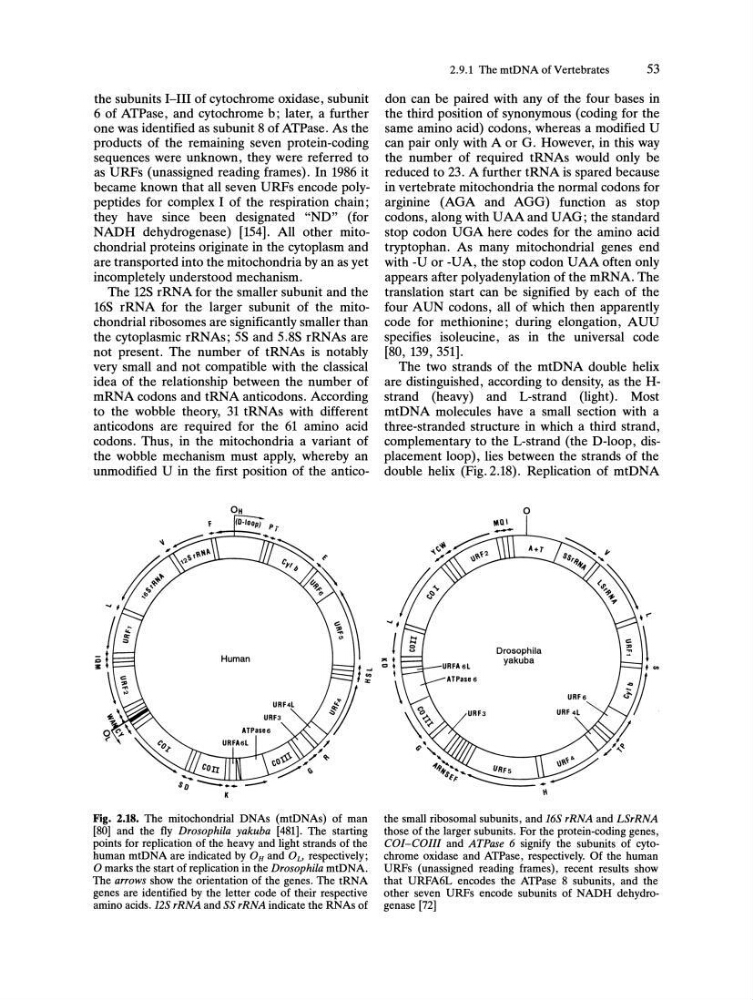
unmodified V in the first position of the anticoFig. 2.18. The mitochondrial DNAs (mtDNAs) of man
[80] and the fly Drosophila yakuba [481]. The starting
points for replication of the heavy and light strands of the
human mtDNA are indicated by OH and OL, respectively;
o marks the start of replication in the Drosophila mtDNA.
The arrows show the orientation of the genes. The tRNA
genes are identified by the letter code of their respective
amino acids. 12S rRNA and SS rRNA indicate the RNAs of
2.9.1 The mtDNA of Vertebrates
53
don can be paired with any of the four bases in
the third position of synonymous (coding for the
same amino acid) codons, whereas a modified V
can pair only with A or G. However, in this way
the number of required tRNAs would only be
reduced to 23. A further tRNA is spared because
in vertebrate mitochondria the normal co dons for
arginine (AGA and AGG) function as stop
codons, along with VAA and VAG; the standard
stop codon VGA here codes for the amino acid
tryptophan. As many mitochondrial genes end
with -V or -VA, the stop codon VAA often only
appears after polyadenylation of the mRNA. The
translation start can be signified by each of the
four AVN codons, all of which then apparently
code for methionine; during elongation, AVV
specifies isoleucine, as in the universal code
[80, 139,351].
The two strands of the mtDNA double helix
are distinguished, according to density, as the Hstrand (heavy) and L-strand (light). Most
mtDNA molecules have a small section with a
three-stranded structure in which a third strand,
complementary to the L-strand (the D-Ioop, displacement loop), lies between the strands of the
double helix (Fig. 2.18). Replication of mtDNA
.... I
I
o
Drosophila
yakuba
the small ribosomal subunits, and 16S rRNA and LSrRNA
those of the larger subunits. For the protein-coding genes,
COl-COllI and ATPase 6 signify the subunits of cytochrome oxidase and ATPase, respectively. Of the human
URFs (unassigned reading frames), recent results show
that URFA6L encodes the ATPase 8 subunits, and the
other seven URFs encode subunits of NADH dehydrogenase [72]
6 of ATPase, and cytochrome b; later, a further
one was identified as subunit 8 of ATPase. As the
products of the remaining seven protein-coding
sequences were unknown, they were referred to
as VRFs (unassigned reading frames). In 1986 it
became known that all seven VRFs encode polypeptides for complex I of the respiration chain;
they have since been designated "ND" (for
NADH dehydrogenase) [154]. All other mitochondrial proteins originate in the cytoplasm and
are transported into the mitochondria by an as yet
incompletely understood mechanism.
The 12S rRNA for the smaller subunit and the
16S rRNA for the larger subunit of the mitochondrial ribosomes are significantly smaller than
the cytoplasmic rRNAs; 5S and 5.8S rRNAs are
not present. The number of tRNAs is notably
very small and not compatible with the classical
idea of the relationship between the number of
mRNA co dons and tRNA anticodons. According
to the wobble theory, 31 tRNAs with different
anticodons are required for the 61 amino acid
codons. Thus, in the mitochondria a variant of
the wobble mechanism must apply, whereby an
unmodified V in the first position of the anticoFig. 2.18. The mitochondrial DNAs (mtDNAs) of man
[80] and the fly Drosophila yakuba [481]. The starting
points for replication of the heavy and light strands of the
human mtDNA are indicated by OH and OL, respectively;
o marks the start of replication in the Drosophila mtDNA.
The arrows show the orientation of the genes. The tRNA
genes are identified by the letter code of their respective
amino acids. 12S rRNA and SS rRNA indicate the RNAs of
2.9.1 The mtDNA of Vertebrates
53
don can be paired with any of the four bases in
the third position of synonymous (coding for the
same amino acid) codons, whereas a modified V
can pair only with A or G. However, in this way
the number of required tRNAs would only be
reduced to 23. A further tRNA is spared because
in vertebrate mitochondria the normal co dons for
arginine (AGA and AGG) function as stop
codons, along with VAA and VAG; the standard
stop codon VGA here codes for the amino acid
tryptophan. As many mitochondrial genes end
with -V or -VA, the stop codon VAA often only
appears after polyadenylation of the mRNA. The
translation start can be signified by each of the
four AVN codons, all of which then apparently
code for methionine; during elongation, AVV
specifies isoleucine, as in the universal code
[80, 139,351].
The two strands of the mtDNA double helix
are distinguished, according to density, as the Hstrand (heavy) and L-strand (light). Most
mtDNA molecules have a small section with a
three-stranded structure in which a third strand,
complementary to the L-strand (the D-Ioop, displacement loop), lies between the strands of the
double helix (Fig. 2.18). Replication of mtDNA
.... I
I
o
Drosophila
yakuba
the small ribosomal subunits, and 16S rRNA and LSrRNA
those of the larger subunits. For the protein-coding genes,
COl-COllI and ATPase 6 signify the subunits of cytochrome oxidase and ATPase, respectively. Of the human
URFs (unassigned reading frames), recent results show
that URFA6L encodes the ATPase 8 subunits, and the
other seven URFs encode subunits of NADH dehydrogenase [72]