

protein and thus brings about a four- to fivefold
increase in the hydrolysis of DAG in the lipoprotein [59, 179]. Whilst membrane binding of mammalian lipoprotein lipase occurs via glycosamino glycan , the locust enzyme does not bind to
heparin and therefore cannot be purified by
bioaffinity chromatography [59].
Various types of cholesterol ester hydrolases
are known in mammals. The lysosomes have an
enzyme with a pH optimum of 4.5, and the cytoplasm of most cells contains a neutral enzyme
with a pH optimum of 7.5. Little is known in
detail about a third type from the mitochondria.
The cytoplasmic cholesterol ester hydrolase of
the vertebrates is very similar to the hormoneregulated lipase of the adipocytes: both are activated by ACTH via a cAMP-dependent protein
kinase and are inhibited by DIPF; they are both
84-90 kDa in size and have a very similar
cleavage-peptide pattern. The cholesterol esterase of the pancreas is identical to the bile saltdependent lipase [113]. Rat testis contains two
chromatographically distinct cholesterol ester
hydrolases which agree in many of their properties, although they show rather different temperature stabilities; whereas one of them, like the corresponding enzyme from the liver and kidney, is
stable up to 37°C, the other is rapidly inactivated
at temperatures above 32 °C. It may be remembered that spermatogenesis in mammalian testis
ceases completely at temperatures above this
approximate limit. The temperature-labile
enzyme in rats who have had the hypophysis
removed is induced by FSH but not by LH and is,
therefore, probably located in the Sertoli cells.
The temperature-stable enzyme, on the other
hand, is FSH- and LH-dependent and is apparently present in both the Sertoli and the Leydig
cells. The unusual properties and specific location
of the temperature-labile enzyme suggests that it
is specifically adapted to a particular biological
function in the testis [38].
17.1.4 Phospholipases
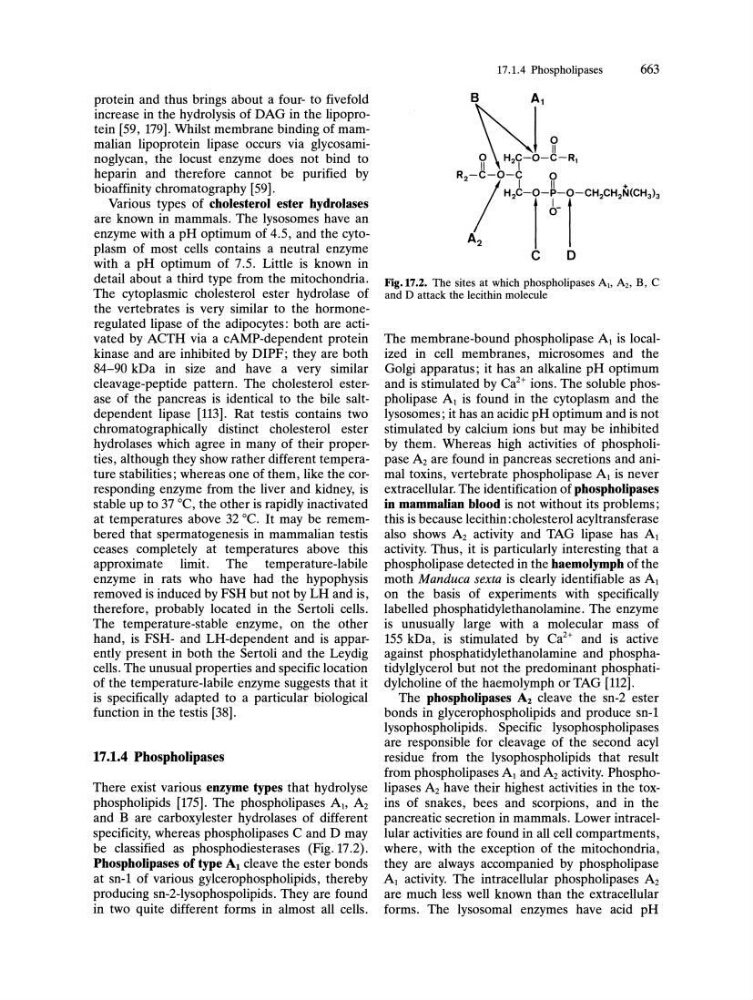
There exist various enzyme types that hydrolyse
phospholipids [175]. The phosphOlipases AI> A2
and Bare carboxylester hydro lases of different
specificity, whereas phospholipases C and D may
be classified as phosphodiesterases (Fig. 17.2).
Phospholipases of type Al cleave the ester bonds
at sn-l of various gylcerophospholipids, thereby
producing sn-2-lysophospolipids. They are found
in two quite different forms in almost all cells.
17.1.4 Phospholipases
663
Fig.17.2. The sites at which phospholipases A" A2, B, C
and D attack the lecithin molecule
The membrane-bound phospholipase Al is localized in cell membranes, micro somes and the
Golgi apparatus; it has an alkaline pH optimum
and is stimulated by Ca2+ ions. The soluble phospholipase Al is found in the cytoplasm and the
lysosomes; it has an acidic pH optimum and is not
stimulated by calcium ions but may be inhibited
by them. Whereas high activities of phospholipase A2 are found in pancreas secretions and animal toxins, vertebrate phospholipase Al is never
extracellular. The identification of phospholipases
in mammalian blood is not without its problems;
this is because lecithin: cholesterol acyltransferase
also shows A2 activity and TAG lipase has Al
activity. Thus, it is particularly interesting that a
phospholipase detected in the haemolymph of the
moth Manduca sexta is clearly identifiable as Al
on the basis of experiments with specifically
labelled phosphatidylethanolamine. The enzyme
is unusually large with a molecular mass of
155 kDa, is stimulated by Ca 2 + and is active
against phosphatidylethanolamine and phosphatidylglycerol but not the predominant phosphatidylcholine of the haemolymph or TAG [112].
The phospholipases A2 cleave the sn-2 ester
bonds in glycerophospholipids and produce sn-l
lysophospholipids. Specific lysophospholipases
are responsible for cleavage of the second acyl
residue from the lysophospholipids that result
from phospholipases Al and A2 activity. Phospholipases A2 have their highest activities in the toxins of snakes, bees and scorpions, and in the
pancreatic secretion in mammals. Lower intracellular activities are found in all cell compartments,
where, with the exception of the mitochondria,
they are always accompanied by phospholipase
Al activity. The intracellular phospholipases Az
are much less well known than the extracellular
forms. The lysosomal enzymes have acid pH