

660
17 Ester Hydrolases, ATPases and Carboanhydrases
s-s
O 00 O-r
q'?
0 0
30ChS~ ~~ ~o
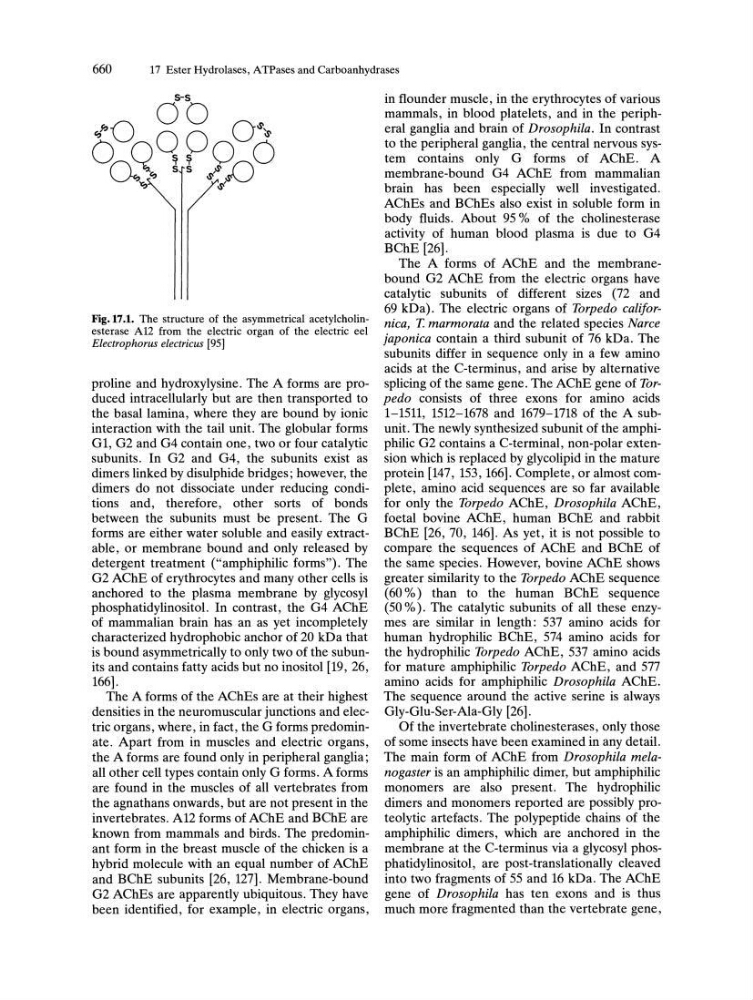
Fig.17.1. The structure of the asymmetrical acetylcholinesterase A12 from the electric organ of the electric eel
Electrophorus electricus [95]
proline and hydroxylysine. The A forms are produced intracellularly but are then transported to
the basal lamina, where they are bound by ionic
interaction with the tail unit. The globular forms
G1, G2 and G4 contain one, two or four catalytic
subunits. In G2 and G4, the subunits exist as
dimers linked by disulphide bridges; however, the
dimers do not dissociate under reducing conditions and, therefore, other sorts of bonds
between the subunits must be present. The G
forms are either water soluble and easily extractable, or membrane bound and only released by
detergent treatment ("amphiphilic forms"). The
G2 AChE of erythrocytes and many other cells is
anchored to the plasma membrane by glycosyl
phosphatidylinositol. In contrast, the G4 AChE
of mammalian brain has an as yet incompletely
characterized hydrophobic anchor of 20 kDa that
is bound asymmetrically to only two of the subunits and contains fatty acids but no inositol [19, 26,
166].
The A forms of the AChEs are at their highest
densities in the neuromuscular junctions and electric organs, where, in fact, the G forms predominate. Apart from in muscles and electric organs,
the A forms are found only in peripheral ganglia;
all other cell types contain only G forms. A forms
are found in the muscles of all vertebrates from
the agnathans onwards, but are not present in the
invertebrates. A12 forms of AChE and BChE are
known from mammals and birds. The predominant form in the breast muscle of the chicken is a
hybrid molecule with an equal number of AChE
and BChE subunits [26, 127]. Membrane-bound
G2 AChEs are apparently ubiquitous. They have
been identified, for example, in electric organs,
in flounder muscle, in the erythrocytes of various
mammals, in blood platelets, and in the peripheral ganglia and brain of Drosophila. In contrast
to the peripheral ganglia, the central nervous system contains only G forms of AChE. A
membrane-bound G4 AChE from mammalian
brain has been especially well investigated.
AChEs and BChEs also exist in soluble form in
body fluids. About 95 % of the cholinesterase
activity of human blood plasma is due to G4
BChE [26].
The A forms of AChE and the membranebound G2 AChE from the electric organs have
catalytic subunits of different sizes (72 and
69 kDa). The electric organs of Torpedo cali/ornica, T. marmorata and the related species Narce
japonica contain a third subunit of 76 kDa. The
subunits differ in sequence only in a few amino
acids at the C-terminus, and arise by alternative
splicing of the same gene. The AChE gene of Torpedo consists of three exons for amino acids
1-1511, 1512-1678 and 1679-1718 of the A subunit. The newly synthesized subunit of the amphiphilic G2 contains a C-terminal, non-polar extension which is replaced by glycolipid in the mature
protein [147, 153,166]. Complete, or almost complete, amino acid sequences are so far available
for only the Torpedo AChE, Drosophila AChE,
foetal bovine AChE, human BChE and rabbit
BChE [26, 70, 146]. As yet, it is not possible to
compare the sequences of AChE and BChE of
the same species. However, bovine AChE shows
greater similarity to the Torpedo AChE sequence
(60 %) than to the human BChE sequence
(50 %). The catalytic subunits of all these enzymes are similar in length: 537 amino acids for
human hydrophilic BChE, 574 amino acids for
the hydrophilic Torpedo AChE, 537 amino acids
for mature amphiphilic Torpedo AChE, and 577
amino acids for amphiphilic Drosophila AChE.
The sequence around the active serine is always
Gly-Glu-Ser-Ala-Gly [26].
Of the invertebrate cholinesterases, only those
of some insects have been examined in any detail.
The main form of AChE from Drosophila melanogaster is an amphiphilic dimer, but amphiphilic
monomers are also present. The hydrophilic
dimers and monomers reported are possibly proteolytic artefacts. The polypeptide chains of the
amphiphilic dimers, which are anchored in the
membrane at the C-terminus via a glycosyl phosphatidylinositol, are post-translationally cleaved
into two fragments of 55 and 16 kDa. The AChE
gene of Drosophila has ten exons and is thus
much more fragmented than the vertebrate gene,