

16.6 Calciferols
The calciferols are referred to as D vitamins
because feeding of these compounds or their sterol precursors alleviates certain deficiency symptoms (rachitis). They are, however, perhaps better categorized as hormones that regulate the calcium balance. This activity, as for that of the classical steroid hormones, involves binding to intracellular receptors and effects on the expression of
certain genes. The biosynthesis of cholecalciferol
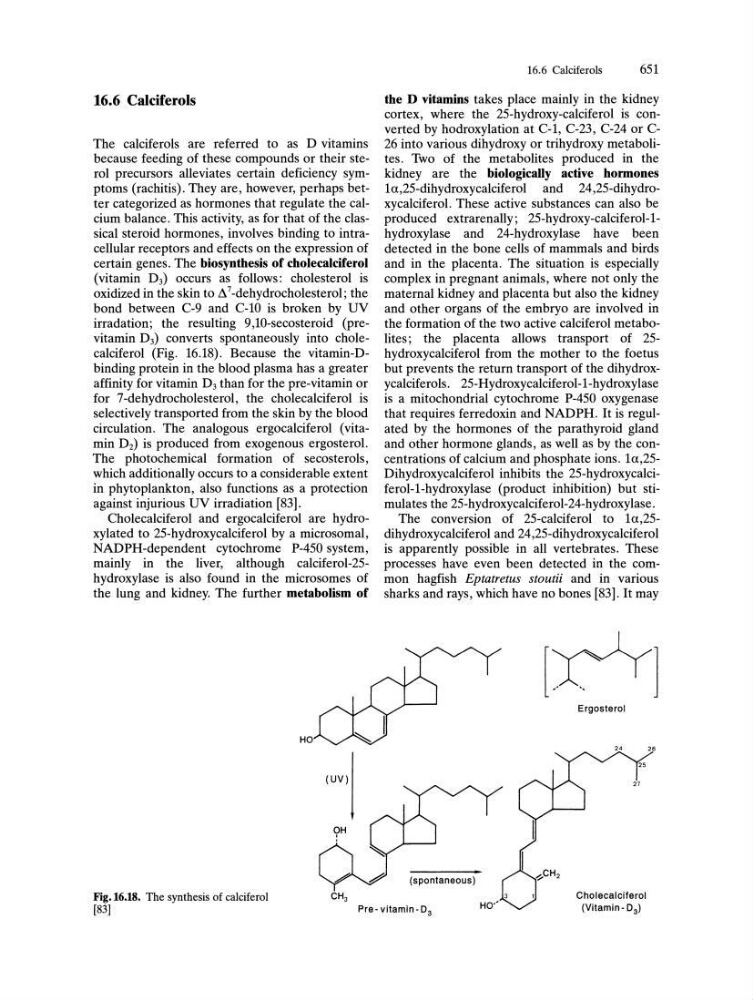
(vitamin D3) occurs as follows: cholesterol is
oxidized in the skin to ~ 7 -dehydrocholesterol; the
bond between C-9 and C-lO is broken by UV
irradation; the resulting 9,1O-secosteroid (previtamin D3) converts spontaneously into cholecalciferol (Fig. 16.18). Because the vitamin-Dbinding protein in the blood plasma has a greater
affinity for vitamin D3 than for the pre-vitamin or
for 7-dehydrocholesterol, the cholecalciferol is
selectively transported from the skin by the blood
circulation. The analogous ergocalciferol (vitamin D2) is produced from exogenous ergosterol.
The photochemical formation of secosterols,
which additionally occurs to a considerable extent
in phytoplankton, also functions as a protection
against injurious UV irradiation [83].
Cholecalciferol and ergocalciferol are hydroxylated to 25-hydroxycalciferol by a microsomal,
NADPH-dependent cytochrome P-450 system,
mainly in the liver, although calciferol-25hydroxylase is also found in the micro somes of
the lung and kidney. The further metabolism of
HO
(UV)
16.6 Calciferols
651
the D vitamins takes place mainly in the kidney
cortex, where the 25-hydroxy-calciferol is converted by hodroxylation at C-l, C-23, C-24 or C26 into various dihydroxy or trihydroxy metabolites. Two of the metabolites produced in the
kidney are the biologically active hormones
la,25-dihydroxycalciferol and 24,25-dihydroxycalciferol. These active substances can also be
produced extrarenally; 25-hydroxy-calciferol-lhydroxylase and 24-hydroxylase have been
detected in the bone cells of mammals and birds
and in the placenta. The situation is especially
complex in pregnant animals, where not only the
maternal kidney and placenta but also the kidney
and other organs of the embryo are involved in
the formation of the two active calciferol metabolites; the placenta allows transport of 25hydroxycalciferol from the mother to the foetus
but prevents the return transport of the dihydroxycalciferols. 25-Hydroxycalciferol-l-hydroxylase
is a mitochondrial cytochrome P-450 oxygenase
that requires ferredoxin and NADPH. It is regulated by the hormones of the parathyroid gland
and other hormone glands, as well as by the concentrations of calcium and phosphate ions. la,25Dihydroxycalciferol inhibits the 25-hydroxycalciferol-l-hydroxylase (product inhibition) but stimulates the 25-hydroxycalciferol-24-hydroxylase.
The conversion of 25-calciferol to la,25dihydroxycalciferol and 24,25-dihydroxycalciferol
is apparently possible in all vertebrates. These
processes have even been detected in the common hagfish Eptatretus stoutii and in various
sharks and rays, which have no bones [83]. It may
Ergosterol
24
26
(spontaneous)
Fig.16.18. The synthesis of calciferol
[83]
Pre-vitamin-D 3
Cholecalciferol
(Vitamin - D 3 )