

626
16 Sterols and Steroids
HO
2,3 - Oxidosqualene
HO
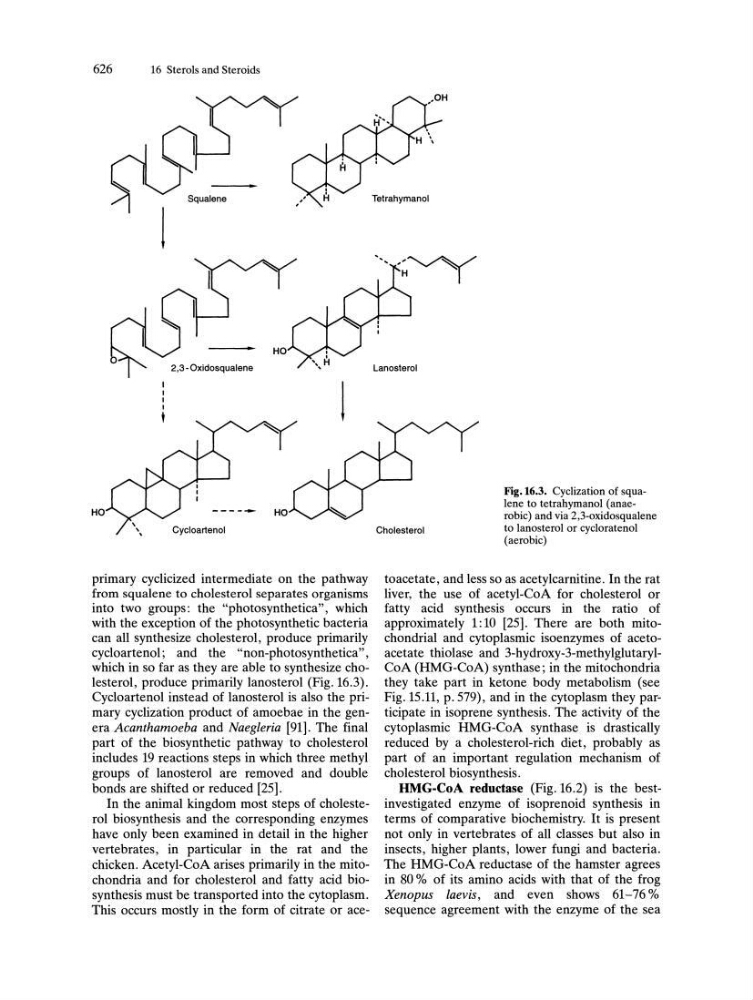
primary cyclicized intermediate on the pathway
from squalene to cholesterol separates organisms
into two groups: the "photosynthetic a" , which
with the exception of the photosynthetic bacteria
can all synthesize cholesterol, produce primarily
cycloartenol; and the "non-photosynthetica" ,
which in so far as they are able to synthesize cholesterol, produce primarily lanosterol (Fig. 16.3).
Cycloartenol instead of lanosterol is also the primary cyclization product of amoebae in the genera Acanthamoeba and Naegleria [91]. The final
part of the biosynthetic pathway to cholesterol
includes 19 reactions steps in which three methyl
groups of lanosterol are removed and double
bonds are shifted or reduced [25].
In the animal kingdom most steps of cholesterol biosynthesis and the corresponding enzymes
have only been examined in detail in the higher
vertebrates, in particular in the rat and the
chicken. Acetyl-CoA arises primarily in the mitochondria and for cholesterol and fatty acid biosynthesis must be transported into the cytoplasm.
This occurs mostly in the form of citrate or aceTetrahymanol
Cholesterol
Fig.16.3. Cyclization of squalene to tetrahymanol (anaerobic) and via 2,3-oxidosqualene
to lanosterol or cycloratenol
(aerobic)
toacetate, and less so as acetylcarnitine. In the rat
liver, the use of acetyl-CoA for cholesterol or
fatty acid synthesis occurs in the ratio of
approximately 1: 10 [25]. There are both mitochondrial and cytoplasmic isoenzymes of acetoacetate thiolase and 3-hydroxy-3-methylglutarylCoA (HMG-CoA) synthase; in the mitochondria
they take part in ketone body metabolism (see
Fig. 15.11, p. 579), and in the cytoplasm they participate in isoprene synthesis. The activity of the
cytoplasmic HMG-CoA synthase is drastically
reduced by a cholesterol-rich diet, probably as
part of an important regulation mechanism of
cholesterol biosynthesis.
HMG-CoA reductase (Fig. 16.2) is the bestinvestigated enzyme of isoprenoid synthesis in
terms of comparative biochemistry. It is present
not only in vertebrates of all classes but also in
insects, higher plants, lower fungi and bacteria.
The HMG-CoA reductase of the hamster agrees
in 80 % of its amino acids with that of the frog
Xenopus laevis, and even shows 61-76 %
sequence agreement with the enzyme of the sea