

48
2 Nucleic Acids and Nuclear Proteins
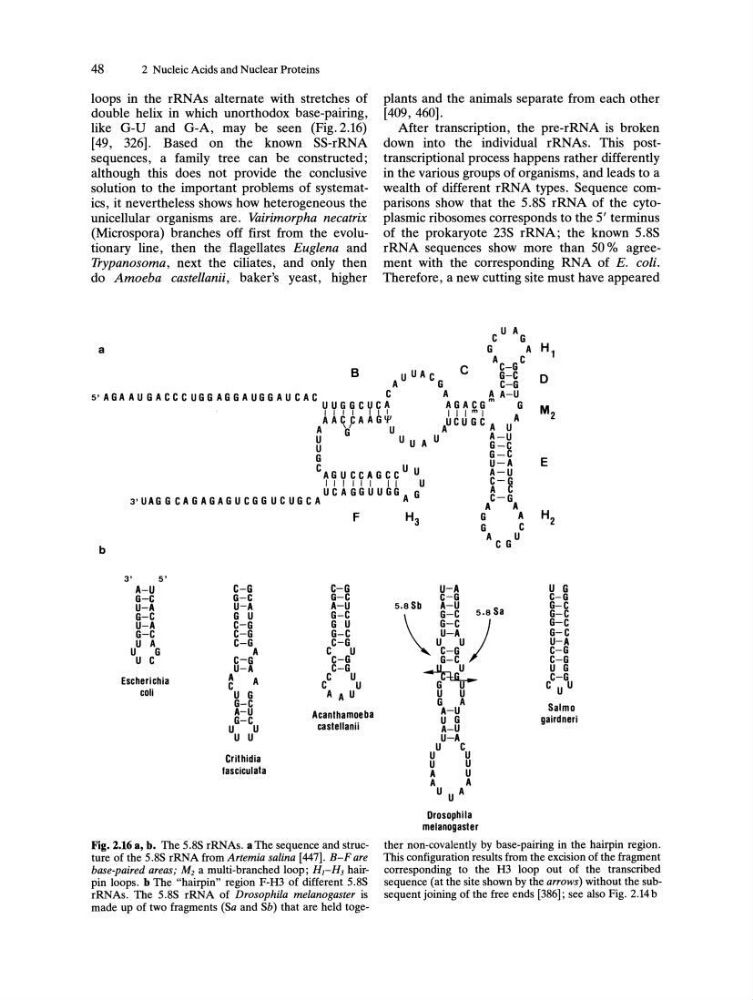
loops in the rRNAs alternate with stretches of
double helix in which unorthodox base-pairing,
like G-U and G-A, may be seen (Fig. 2.16)
[49, 326]. Based on the known SS-rRNA
sequences, a family tree can be constructed;
although this does not provide the conclusive
solution to the important problems of systematics, it nevertheless shows how heterogeneous the
unicellular organisms are. Vairimorpha necatrix
(Microspora) branches off first from the evolutionary line, then the flagellates Euglena and
Trypanosoma, next the ciliates, and only then
do Amoeba castellanii, baker's yeast, higher
a
B
plants and the animals separate from each other
[409,460].
After transcription, the pre-rRNA is broken
down into the individual rRNAs. This posttranscriptional process happens rather differently
in the various groups of organisms, and leads to a
wealth of different rRNA types. Sequence comparisons show that the 5.8S rRNA of the cytoplasmic ribosomes corresponds to the 5' terminus
of the prokaryote 23S rRNA; the known 5.8S
rRNA sequences show more than 50 % agreement with the corresponding RNA of E. coli.
Therefore, a new cutting site must have appeared
C U AG
G
A H1
AC_GC
U U A c e
G-C
A
G
C-G
D
5' A G A AUG A C C C U G GAG G AUG G A U C A C
C
A
A A-U
UUGGCUCA
AGACG m
G
b
I I I I
T I I
I I I m I
A
AACFAAG~
AUCUGCA U
A
G
U
U
U U A U
A-U
U
G-C
G
G-C
U-A
CAGUCCAGCCUU
A-U
I I I I I I
I I
U
~-g
3'UAGGCAGAGAGUCGGUCUGCAUCAGGUUGGA G
C-G
A A
3'
5'
A-U
G-C
U-A
G-C
U-A
G-C
U A
U G
U C
Escherichia
coli
C-G
G-C
U-A
G U
C-G
C-G
C-G A
C-G
U-A
A A
C
U G
G-C
A-U
G-C
U U
U U
Crithidia
lasciculata
F
H3
G
A
G
C
C-G
G-C
A-U
G-C
G U
G-C
C-G
C U
C-G
C-G
C U
C
U
A A U
Acanthamoe ba
castellanii
U-A
C-G
A C G U
5.88b
A-U
\
g=~ )5.88a
U-A
U U
C-G
G-C
~ U U
G A
A-U
U G
A-U
U-A
U C
U
U
U
U
A
U
A
A
U U A
Drosophila
melanogaster
E
U G
C-G
G-C
G-C
G-C
G-C
U-A
C-G
C-G
U G
C-G
C U U
8almo
gairdneri
Fig. 2.16 a, b. The S.8S rRNAs. a The sequence and structure of the S.8S rRNA from Artemia salina [447]. B-F are
base-paired areas; M2 a multi-branched loop; H)-H3 hairpin loops. b The "hairpin" region F-H3 of different S.8S
rRNAs. The S.8S rRNA of Drosophila melanogaster is
made up of two fragments (Sa and Sb) that are held together non-covalently by base-pairing in the hairpin region.
This configuration results from the excision of the fragment
corresponding to the H3 loop out of the transcribed
sequence (at the site shown by the arrows) without the subsequent joining of the free ends [386]; see also Fig. 2.14 b
2 Nucleic Acids and Nuclear Proteins
loops in the rRNAs alternate with stretches of
double helix in which unorthodox base-pairing,
like G-U and G-A, may be seen (Fig. 2.16)
[49, 326]. Based on the known SS-rRNA
sequences, a family tree can be constructed;
although this does not provide the conclusive
solution to the important problems of systematics, it nevertheless shows how heterogeneous the
unicellular organisms are. Vairimorpha necatrix
(Microspora) branches off first from the evolutionary line, then the flagellates Euglena and
Trypanosoma, next the ciliates, and only then
do Amoeba castellanii, baker's yeast, higher
a
B
plants and the animals separate from each other
[409,460].
After transcription, the pre-rRNA is broken
down into the individual rRNAs. This posttranscriptional process happens rather differently
in the various groups of organisms, and leads to a
wealth of different rRNA types. Sequence comparisons show that the 5.8S rRNA of the cytoplasmic ribosomes corresponds to the 5' terminus
of the prokaryote 23S rRNA; the known 5.8S
rRNA sequences show more than 50 % agreement with the corresponding RNA of E. coli.
Therefore, a new cutting site must have appeared
C U AG
G
A H1
AC_GC
U U A c e
G-C
A
G
C-G
D
5' A G A AUG A C C C U G GAG G AUG G A U C A C
C
A
A A-U
UUGGCUCA
AGACG m
G
b
I I I I
T I I
I I I m I
A
AACFAAG~
AUCUGCA U
A
G
U
U
U U A U
A-U
U
G-C
G
G-C
U-A
CAGUCCAGCCUU
A-U
I I I I I I
I I
U
~-g
3'UAGGCAGAGAGUCGGUCUGCAUCAGGUUGGA G
C-G
A A
3'
5'
A-U
G-C
U-A
G-C
U-A
G-C
U A
U G
U C
Escherichia
coli
C-G
G-C
U-A
G U
C-G
C-G
C-G A
C-G
U-A
A A
C
U G
G-C
A-U
G-C
U U
U U
Crithidia
lasciculata
F
H3
G
A
G
C
C-G
G-C
A-U
G-C
G U
G-C
C-G
C U
C-G
C-G
C U
C
U
A A U
Acanthamoe ba
castellanii
U-A
C-G
A C G U
5.88b
A-U
\
g=~ )5.88a
U-A
U U
C-G
G-C
~ U U
G A
A-U
U G
A-U
U-A
U C
U
U
U
U
A
U
A
A
U U A
Drosophila
melanogaster
E
U G
C-G
G-C
G-C
G-C
G-C
U-A
C-G
C-G
U G
C-G
C U U
8almo
gairdneri
Fig. 2.16 a, b. The S.8S rRNAs. a The sequence and structure of the S.8S rRNA from Artemia salina [447]. B-F are
base-paired areas; M2 a multi-branched loop; H)-H3 hairpin loops. b The "hairpin" region F-H3 of different S.8S
rRNAs. The S.8S rRNA of Drosophila melanogaster is
made up of two fragments (Sa and Sb) that are held together non-covalently by base-pairing in the hairpin region.
This configuration results from the excision of the fragment
corresponding to the H3 loop out of the transcribed
sequence (at the site shown by the arrows) without the subsequent joining of the free ends [386]; see also Fig. 2.14 b