

46
2 Nucleic Acids and Nuclear Proteins
Table 2.4. Number of rRNA, 5S rRNA and tRNA genes in
the haploid genome of some animals [135, 140, 159,242,
272, 340, 398, 417]
Species
rRNA
5S-RNA tRNA
Plasmodium berghei
4
Tetrahymena
1
150
pyriformis
(Micronucleus)
Caenorhabditis
55
300
briggsae
Schistosoma mansoni 100
Urechis caupo
290
Mytilus edulis
220
Drosophila
100- 240
100-200 590-900
melanogaster
Sciara coprophila
45
Sarcophaga bullata
144
Lytechinus variegatus 260
Squalus acanthias
960
Carassius auratus
240- 280
Necturus maculosus 2700-4000
Xenopus laevis
500- 760 24000
6500-7800
Xenopus borealis
500
9000
Gallus domesticus
190- 200
Rattus norwegicus
150- 170
830
6500
Homo sapiens
50- 200 2000
1310
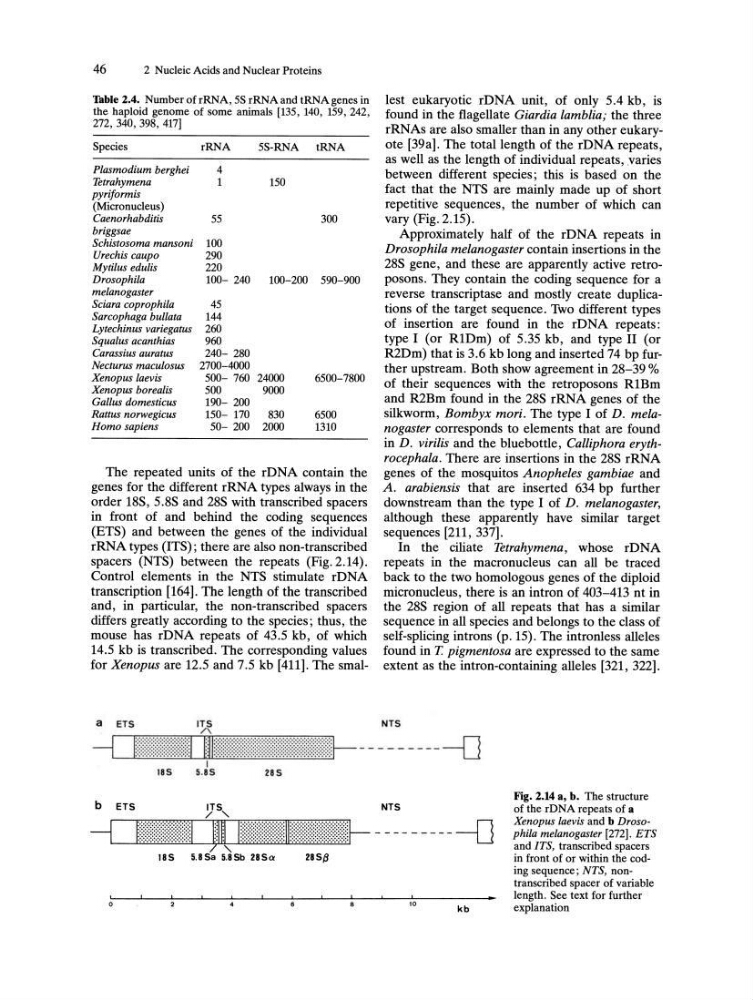
The repeated units of the rDNA contain the
genes for the different rRNA types always in the
order 18S, 5.8S and 28S with transcribed spacers
in front of and behind the coding sequences
(ETS) and between the genes of the individual
rRNA types (ITS); there are also non-transcribed
spacers (NTS) between the repeats (Fig. 2.14).
Control elements in the NTS stimulate rDNA
transcription [164]. The length of the transcribed
and, in particular, the non-transcribed spacers
differs greatly according to the species; thus, the
mouse has rDNA repeats of 43.5 kb, of which
14.5 kb is transcribed. The corresponding values
for Xenopus are 12.5 and 7.5 kb [411]. The smallest eukaryotic rDNA unit, of only 5.4 kb, is
found in the flagellate Giardia Lamblia; the three
rRNAs are also smaller than in any other eukaryote [39a]. The total length of the rDNA repeats,
as well as the length of individual repeats, yaries
between different species; this is based on the
fact that the NTS are mainly made up of short
repetitive sequences, the number of which can
vary (Fig. 2.15).
Approximately half of the rDNA repeats in
Drosophila melanogaster contain insertions in the
28S gene, and these are apparently active retroposons. They contain the coding sequence for a
reverse transcriptase and mostly create duplications of the target sequence. Two different types
of insertion are found in the rDNA repeats:
type I (or RIDm) of 5.35 kb, and type II (or
R2Dm) that is 3.6 kb long and inserted 74 bp further upstream. Both show agreement in 28-39 %
of their sequences with the retroposons RIBm
and R2Bm found in the 28S rRNA genes of the
silkworm, Bombyx mori. The type I of D. meLanogaster corresponds to elements that are found
in D. virilis and the bluebottle, Calliphora erythrocephaLa. There are insertions in the 28S rRNA
genes of the mosquitos Anopheles gambiae and
A. arabiensis that are inserted 634 bp further
downstream than the type I of D. melanogaster,
although these apparently have similar target
sequences [211, 337].
In the ciliate Tetrahymena, whose rDNA
repeats in the macronucleus can all be traced
back to the two homologous genes of the diploid
micronucleus, there is an intron of 403-413 nt in
the 28S region of all repeats that has a similar
sequence in all species and belongs to the class of
self-splicing introns (p. 15). The intronless alleles
found in T. pigmentosa are expressed to the same
extent as the intron-containing alleles [321, 322].
a ETS
ITS
NTS
/ \
b ETS
o
ITS
NTS
/ "
~::f:fff::f{1 JI~llff:fffIllf:f::f:ffff+- ----------0
185
5.8Sa 5.8Sb 28Sa
28S{3
10
kb
Fig. 2.14 a, b. The structure
of the rDNA repeats of a
Xenopus laevis and b Drosophila melanogaster [272]. ETS
and ITS, transcribed spacers
in front of or within the coding sequence; NTS, nontranscribed spacer of variable
length. See text for further
explanation
2 Nucleic Acids and Nuclear Proteins
Table 2.4. Number of rRNA, 5S rRNA and tRNA genes in
the haploid genome of some animals [135, 140, 159,242,
272, 340, 398, 417]
Species
rRNA
5S-RNA tRNA
Plasmodium berghei
4
Tetrahymena
1
150
pyriformis
(Micronucleus)
Caenorhabditis
55
300
briggsae
Schistosoma mansoni 100
Urechis caupo
290
Mytilus edulis
220
Drosophila
100- 240
100-200 590-900
melanogaster
Sciara coprophila
45
Sarcophaga bullata
144
Lytechinus variegatus 260
Squalus acanthias
960
Carassius auratus
240- 280
Necturus maculosus 2700-4000
Xenopus laevis
500- 760 24000
6500-7800
Xenopus borealis
500
9000
Gallus domesticus
190- 200
Rattus norwegicus
150- 170
830
6500
Homo sapiens
50- 200 2000
1310
The repeated units of the rDNA contain the
genes for the different rRNA types always in the
order 18S, 5.8S and 28S with transcribed spacers
in front of and behind the coding sequences
(ETS) and between the genes of the individual
rRNA types (ITS); there are also non-transcribed
spacers (NTS) between the repeats (Fig. 2.14).
Control elements in the NTS stimulate rDNA
transcription [164]. The length of the transcribed
and, in particular, the non-transcribed spacers
differs greatly according to the species; thus, the
mouse has rDNA repeats of 43.5 kb, of which
14.5 kb is transcribed. The corresponding values
for Xenopus are 12.5 and 7.5 kb [411]. The smallest eukaryotic rDNA unit, of only 5.4 kb, is
found in the flagellate Giardia Lamblia; the three
rRNAs are also smaller than in any other eukaryote [39a]. The total length of the rDNA repeats,
as well as the length of individual repeats, yaries
between different species; this is based on the
fact that the NTS are mainly made up of short
repetitive sequences, the number of which can
vary (Fig. 2.15).
Approximately half of the rDNA repeats in
Drosophila melanogaster contain insertions in the
28S gene, and these are apparently active retroposons. They contain the coding sequence for a
reverse transcriptase and mostly create duplications of the target sequence. Two different types
of insertion are found in the rDNA repeats:
type I (or RIDm) of 5.35 kb, and type II (or
R2Dm) that is 3.6 kb long and inserted 74 bp further upstream. Both show agreement in 28-39 %
of their sequences with the retroposons RIBm
and R2Bm found in the 28S rRNA genes of the
silkworm, Bombyx mori. The type I of D. meLanogaster corresponds to elements that are found
in D. virilis and the bluebottle, Calliphora erythrocephaLa. There are insertions in the 28S rRNA
genes of the mosquitos Anopheles gambiae and
A. arabiensis that are inserted 634 bp further
downstream than the type I of D. melanogaster,
although these apparently have similar target
sequences [211, 337].
In the ciliate Tetrahymena, whose rDNA
repeats in the macronucleus can all be traced
back to the two homologous genes of the diploid
micronucleus, there is an intron of 403-413 nt in
the 28S region of all repeats that has a similar
sequence in all species and belongs to the class of
self-splicing introns (p. 15). The intronless alleles
found in T. pigmentosa are expressed to the same
extent as the intron-containing alleles [321, 322].
a ETS
ITS
NTS
/ \
b ETS
o
ITS
NTS
/ "
~::f:fff::f{1 JI~llff:fffIllf:f::f:ffff+- ----------0
185
5.8Sa 5.8Sb 28Sa
28S{3
10
kb
Fig. 2.14 a, b. The structure
of the rDNA repeats of a
Xenopus laevis and b Drosophila melanogaster [272]. ETS
and ITS, transcribed spacers
in front of or within the coding sequence; NTS, nontranscribed spacer of variable
length. See text for further
explanation