

572
15 Lipids
H3C,/CH3
CH
I
CH 2
I
HC-NH2
I
COOH
Leucine
H3C, P H 3
CH
I
HC-NH 2
I
COOH
Valine
H3C
I
H2C, /CH3
CH
I
H9-NH2
COOH
Isoleucine
H3C,/CH3
CH
I
----- 9 H2 - - - -
CO-SCoA
Isovaleryl-CoA
H3C, /CH 3
- - - -
CH
I
CO-SCoA
Isobutyryl-CoA
H3C
I
H2C, PH3
CH
iso-FA
(odd)
iso-FA
(even)
- - - _
I
- - - _
anteiso-FA
CO-SCoA
(odd)
2-Methylbutyryl- CoA
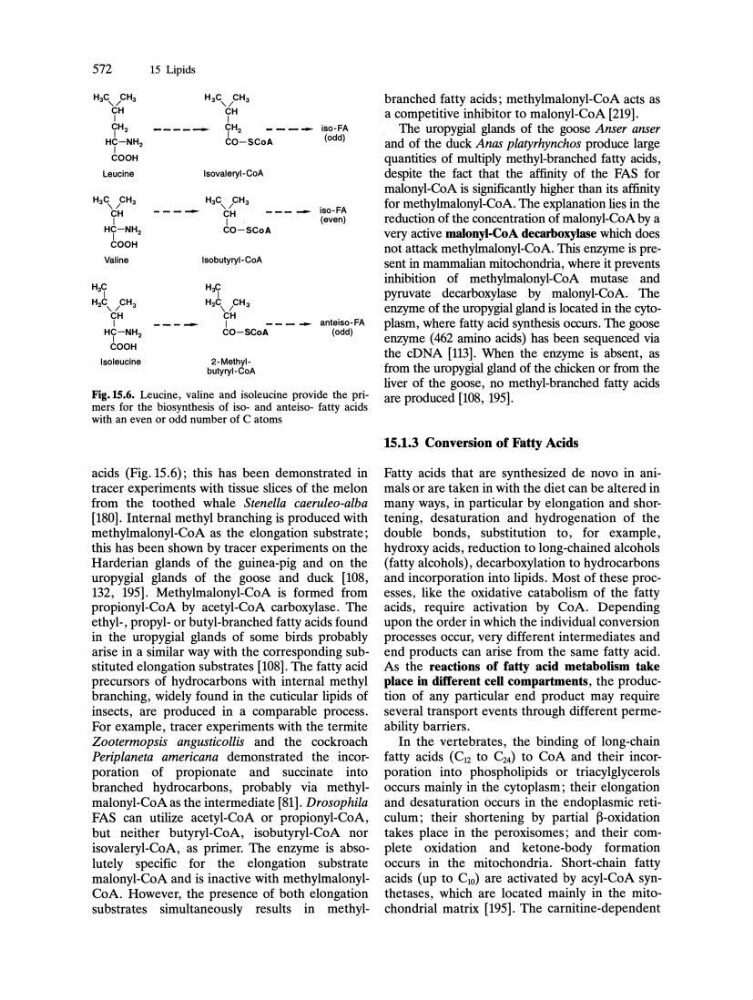
Fig.lS.6. Leucine, valine and isoleucine provide the primers for the biosynthesis of iso- and anteiso- fatty acids
with an even or odd number of C atoms
acids (Fig. 15.6); this has been demonstrated in
tracer experiments with tissue slices of the melon
from the toothed whale Stenella caeruleo-alba
[180]. Internal methyl branching is produced with
methylmalonyl-CoA as the elongation substrate;
this has been shown by tracer experiments on the
Harderian glands of the guinea-pig and on the
uropygial glands of the goose and duck [108,
132, 195]. Methylmalonyl-CoA is formed from
propionyl-CoA by acetyl-CoA carboxylase. The
ethyl-, propyl- or butyl-branched fatty acids found
in the uropygial glands of some birds probably
arise in a similar way with the corresponding substituted elongation substrates [108]. The fatty acid
precursors of hydrocarbons with internal methyl
branching, widely found in the cuticular lipids of
insects, are produced in a comparable process.
For example, tracer experiments with the termite
Zootermopsis angusticollis and the cockroach
Periplaneta americana demonstrated the. incorporation of propionate and succinate into
branched hydrocarbons, probably via methylmalonyl-CoA as the intermediate [81]. Drosophila
FAS can utilize acetyl-CoA or propionyl-CoA,
but neither butyryl-CoA, isobutyryl-CoA nor
isovaleryl-CoA, as primer. The enzyme is absolutely specific for the elongation substrate
malonyl-CoA and is inactive with methylmalonylCoA. However, the presence of both elongation
substrates simultaneously results in methylbranched fatty acids; methylmalonyl-CoA acts as
a competitive inhibitor to malonyl-CoA [219].
The uropygial glands of the goose Anser anser
and of the duck Anas platyrhynchos produce large
quantities of multiply methyl-branched fatty acids,
despite the fact that the affinity of the FAS for
malonyl-CoA is significantly higher than its affinity
for methylmalonyl-CoA. The explanation lies in the
reduction of the concentration of malonyl-CoA by a
very active maionyl·CoA decarboxylase which does
not attack methylmalonyl-CoA. This enzyme is present in mammalian mitochondria, where it prevents
inhibition of methylmalonyl-CoA mutase and
pyruvate decarboxylase by malonyl-CoA. The
enzyme of the uropygial gland is located in the cytoplasm, where fatty acid synthesis occurs. The goose
enzyme (462 amino acids) has been sequenced via
the cDNA [113]. When the enzyme is absent, as
from the uropygial gland of the chicken or from the
liver of the goose, no methyl-branched fatty acids
are produced [108, 195].
15.1.3 Conversion of Fatty Acids
Fatty acids that are synthesized de novo in animals or are taken in with the diet can be altered in
many ways, in particular by elongation and shortening, desaturation and hydrogenation of the
double bonds, substitution to, for example,
hydroxy acids, reduction to long-chained alcohols
(fatty alcohols), decarboxylation to hydrocarbons
and incorporation into lipids. Most of these processes, like the oxidative catabolism of the fatty
acids, require activation by CoA. Depending
upori the order in which the individual conversion
processes occur, very different intermediates and
end products can arise from the same fatty acid.
As the reactions of fatty acid metabolism take
place in different cell compartments, the production of any particular end product may require
several transport events through different permeability barriers.
In the vertebrates, the binding of long-chain
fatty acids (Cu to C24) to CoA and their incorporation into phospholipids or triacylglycerols
occurs mainly in the cytoplasm; their elongation
and desaturation occurs in the endoplasmic reticulum; their shortening by partial ~-oxidation
takes place in the peroxisomes; and their complete oxidation and ketone-body formation
occurs in the mitochondria. Short-chain fatty
acids (up to ClO) are activated by acyl-CoA synthetases, which are located mainly in the mitochondrial matrix [195]. The carnitine-dependent