

The regulatory elements may be found more than
once in a gene; the ovalbumin locus of the chicken,
for example, carries many copies of the sequence to
which the progesterone receptor can bind.
The protein-coding sequence of about 180 bp,
termed a homeobox, was discovered in 1984 as
homologous regions in various genes of Drosophila melanogaster that are involved in the growth
and differentiation of body segments during
embryo development; in particular, it involves
the genes "fushi tarazu" (ftz) , ''Antennapedia''
(Antp) and "bithorax" (btx). Homeobox sequences have since been identified in many different
eukaryotes. The homeodomain encoded by the
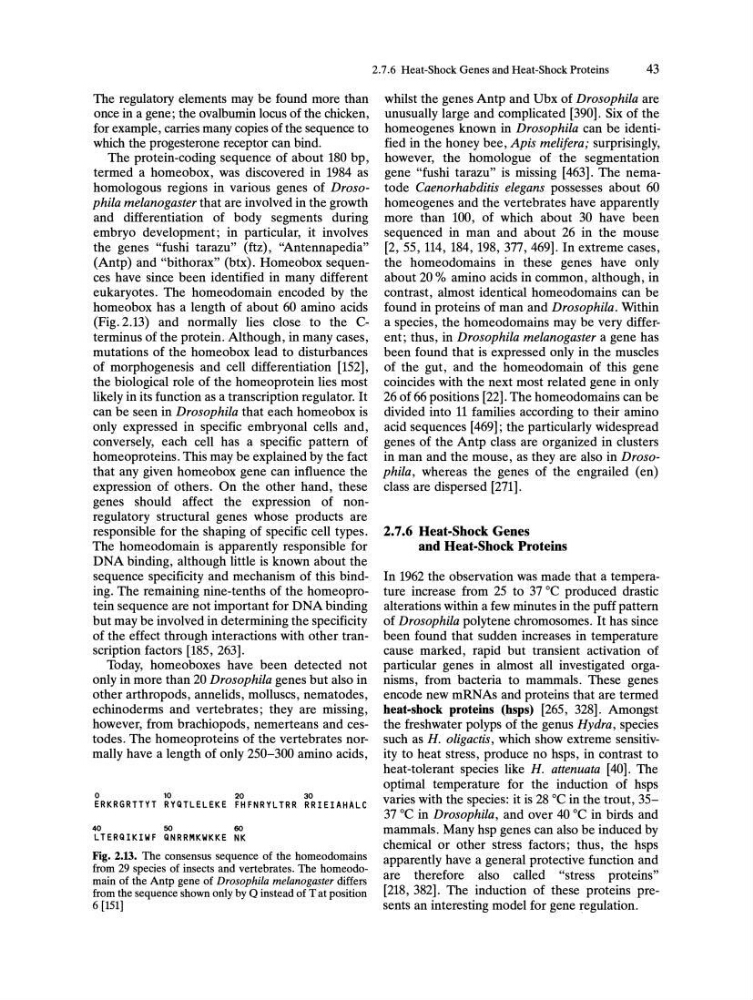
homeobox has a length of about 60 amino acids
(Fig.2.13) and normally lies close to the Cterminus of the protein. Although, in many cases,
mutations of the homeobox lead to disturbances
of morphogenesis and cell differentiation [152]'
the biological role of the homeoprotein lies most
likely in its function as a transcription regulator. It
can be seen in Drosophila that each homeobox is
only expressed in specific embryonal cells and,
conversely, each cell has a specific pattern of
homeoproteins. This may be explained by the fact
that any given homeobox gene can influence the
expression of others. On the other hand, these
genes should affect the expression of nonregulatory structural genes whose products are
responsible for the shaping of specific cell types.
The hom eo domain is apparently responsible for
DNA binding, although little is known about the
sequence specificity and mechanism of this binding. The remaining nine-tenths of the homeoprotein sequence are not important for DNA binding
but may be involved in determining the specificity
of the effect through interactions with other transcription factors [185, 263].
Today, homeoboxes have been detected not
only in more than 20 Drosophila genes but also in
other arthropods, annelids, molluscs, nematodes,
echinoderms and vertebrates; they are missing,
however, from brachiopods, nemerteans and cestodes. The homeoproteins of the vertebrates normally have a length of only 250-300 amino acids,
o
10
20
30
ERKRGRTTYT RYQTLELEKE FHFNRYLTRR RRIEIAHALC
40
50
60
LTERQIKIWF QNRRMKWKKE NK
Fig. 2.13. The consensus sequence of the homeodomains
from 29 species of insects and vertebrates. The homeodomain of the Antp gene of Drosophila melanogaster differs
from the sequence shown only by Q instead of T at position
6 [151]
2.7.6 Heat-Shock Genes and Heat-Shock Proteins
43
whilst the genes Antp and Ubx of Drosophila are
unusually large and complicated [390]. Six of the
homeogenes known in Drosophila can be identified in the honey bee, Apis melifera; surprisingly,
however, the homologue of the segmentation
gene "fushi tarazu" is missing [463]. The nematode Caenorhabditis elegans possesses about 60
homeogenes and the vertebrates have apparently
more than 100, of which about 30 have been
sequenced in man and about 26 in the mouse
[2, 55, 114, 184, 198, 377, 469]. In extreme cases,
the homeodomains in these genes have only
about 20 % amino acids in common, although, in
contrast, almost identical homeodomains can be
found in proteins of man and Drosophila. Within
a species, the homeodomains may be very different; thus, in Drosophila melanogaster a gene has
been found that is expressed only in the muscles
of the gut, and the homeodomain of this gene
coincides with the next most related gene in only
26 of 66 positions [22]. The homeodomains can be
divided into 11 families according to their amino
acid sequences [469]; the particularly widespread
genes of the Antp class are organized in clusters
in man and the mouse, as they are also in Drosophila, whereas the genes of the engrailed (en)
class are dispersed [271].
2.7.6 Heat-Shock Genes
and Heat-Shock Proteins
In 1962 the observation was made that a temperature increase from 25 to 37°C produced drastic
alterations within a few minutes in the puff pattern
of Drosophila polytene chromosomes. It has since
been found that sudden increases in temperature
cause marked, rapid but transient activation of
particular genes in almost all investigated organisms, from bacteria to mammals. These genes
encode new mRNAs and proteins that are termed
heat-shock proteins (hsps) [265, 328]. Amongst
the freshwater polyps of the genus Hydra, species
such as H. oligactis, which show extreme sensitivity to heat stress, produce no hsps, in contrast to
heat-tolerant species like H. attenuata [40]. The
optimal temperature for the induction of hsps
varies with the species: it is 28°C in the trout, 3537°C in Drosophila, and over 40 °c in birds and
mammals. Many hsp genes can also be induced by
chemical or other stress factors; thus, the hsps
apparently have a general protective function and
are therefore also called "stress proteins"
[218, 382]. The induction of these proteins presents an interesting model for gene regulation.
once in a gene; the ovalbumin locus of the chicken,
for example, carries many copies of the sequence to
which the progesterone receptor can bind.
The protein-coding sequence of about 180 bp,
termed a homeobox, was discovered in 1984 as
homologous regions in various genes of Drosophila melanogaster that are involved in the growth
and differentiation of body segments during
embryo development; in particular, it involves
the genes "fushi tarazu" (ftz) , ''Antennapedia''
(Antp) and "bithorax" (btx). Homeobox sequences have since been identified in many different
eukaryotes. The homeodomain encoded by the
homeobox has a length of about 60 amino acids
(Fig.2.13) and normally lies close to the Cterminus of the protein. Although, in many cases,
mutations of the homeobox lead to disturbances
of morphogenesis and cell differentiation [152]'
the biological role of the homeoprotein lies most
likely in its function as a transcription regulator. It
can be seen in Drosophila that each homeobox is
only expressed in specific embryonal cells and,
conversely, each cell has a specific pattern of
homeoproteins. This may be explained by the fact
that any given homeobox gene can influence the
expression of others. On the other hand, these
genes should affect the expression of nonregulatory structural genes whose products are
responsible for the shaping of specific cell types.
The hom eo domain is apparently responsible for
DNA binding, although little is known about the
sequence specificity and mechanism of this binding. The remaining nine-tenths of the homeoprotein sequence are not important for DNA binding
but may be involved in determining the specificity
of the effect through interactions with other transcription factors [185, 263].
Today, homeoboxes have been detected not
only in more than 20 Drosophila genes but also in
other arthropods, annelids, molluscs, nematodes,
echinoderms and vertebrates; they are missing,
however, from brachiopods, nemerteans and cestodes. The homeoproteins of the vertebrates normally have a length of only 250-300 amino acids,
o
10
20
30
ERKRGRTTYT RYQTLELEKE FHFNRYLTRR RRIEIAHALC
40
50
60
LTERQIKIWF QNRRMKWKKE NK
Fig. 2.13. The consensus sequence of the homeodomains
from 29 species of insects and vertebrates. The homeodomain of the Antp gene of Drosophila melanogaster differs
from the sequence shown only by Q instead of T at position
6 [151]
2.7.6 Heat-Shock Genes and Heat-Shock Proteins
43
whilst the genes Antp and Ubx of Drosophila are
unusually large and complicated [390]. Six of the
homeogenes known in Drosophila can be identified in the honey bee, Apis melifera; surprisingly,
however, the homologue of the segmentation
gene "fushi tarazu" is missing [463]. The nematode Caenorhabditis elegans possesses about 60
homeogenes and the vertebrates have apparently
more than 100, of which about 30 have been
sequenced in man and about 26 in the mouse
[2, 55, 114, 184, 198, 377, 469]. In extreme cases,
the homeodomains in these genes have only
about 20 % amino acids in common, although, in
contrast, almost identical homeodomains can be
found in proteins of man and Drosophila. Within
a species, the homeodomains may be very different; thus, in Drosophila melanogaster a gene has
been found that is expressed only in the muscles
of the gut, and the homeodomain of this gene
coincides with the next most related gene in only
26 of 66 positions [22]. The homeodomains can be
divided into 11 families according to their amino
acid sequences [469]; the particularly widespread
genes of the Antp class are organized in clusters
in man and the mouse, as they are also in Drosophila, whereas the genes of the engrailed (en)
class are dispersed [271].
2.7.6 Heat-Shock Genes
and Heat-Shock Proteins
In 1962 the observation was made that a temperature increase from 25 to 37°C produced drastic
alterations within a few minutes in the puff pattern
of Drosophila polytene chromosomes. It has since
been found that sudden increases in temperature
cause marked, rapid but transient activation of
particular genes in almost all investigated organisms, from bacteria to mammals. These genes
encode new mRNAs and proteins that are termed
heat-shock proteins (hsps) [265, 328]. Amongst
the freshwater polyps of the genus Hydra, species
such as H. oligactis, which show extreme sensitivity to heat stress, produce no hsps, in contrast to
heat-tolerant species like H. attenuata [40]. The
optimal temperature for the induction of hsps
varies with the species: it is 28°C in the trout, 3537°C in Drosophila, and over 40 °c in birds and
mammals. Many hsp genes can also be induced by
chemical or other stress factors; thus, the hsps
apparently have a general protective function and
are therefore also called "stress proteins"
[218, 382]. The induction of these proteins presents an interesting model for gene regulation.