

well as sterols, hydrocarbons and carotinoids.
The precursors of the yolk proteins in vertebrates
and invertebrates (vitellogenins) aid in lipid
transport. There are also specific transport proteins, e.g. for steroid hormones and vitamin D, in
the blood of vertebrates and arthropods. Cellular
lipid-binding proteins have so far mostly been
investigated in the mammals, but are certainly
ubiquitous in their distribution. The fatty acidbinding proteins (FABPs) of the mammals are
small proteins of 12-15 kDa that bind fatty acids
and acyl-CoA thioester with high affinity. They
are found in all tissues that are able to metabolize
fatty acids, e.g. the liver, gut wall, fat tissue, milk
glands, and heart and skeletal muscle. There are
tissue-specific isoforms of FABPs which are
encoded by different genes. I-FABP occurs only
in the gut wall, L-FABP occurs in the liver and in
the gut wall, and H-FABP (or M-FABP) has its
highest concentration in heart muscle but also
occurs in skeletal muscle, brain and other tissues.
The protein super-family of the FABPs further
includes the adipocyte-FABP, the cellular retinoland retinoic acid-binding proteins, the mammaryderived growth factor, and the myelin protein P2.
Thus, this protein family not only is responsible
for intracellular fatty acid transport but also is
involved, via the binding of prostaglandins and
retinoids, in the regulation of cell growth and differentiation. However, other known lipid-binding
proteins do not belong to this super-family, e.g.
an FABP that occurs together with H-FABP
in the kidney, the acyl-CoA-binding protein
(ACBP) of the liver, and membrane-bound
FABPs that are probably involved in fatty acid
transport across cell membranes [96, 117, 268].
FABPs similar to those of the mammals have also
been found in the chicken and various teleosts
[47, 231, 255]. The flight muscles of the migratory
locus Schistocerca gregaria contain an FABP
which is comparable with mammalian H-FABP in
many properties but is present at a much higher
concentration in accordance with the extremely
high rate of fatty acid oxidation during extended
flight [87].
The lipids are extraordinarily variable in their
structural and functional characters, and this
leads to problems in their classification and
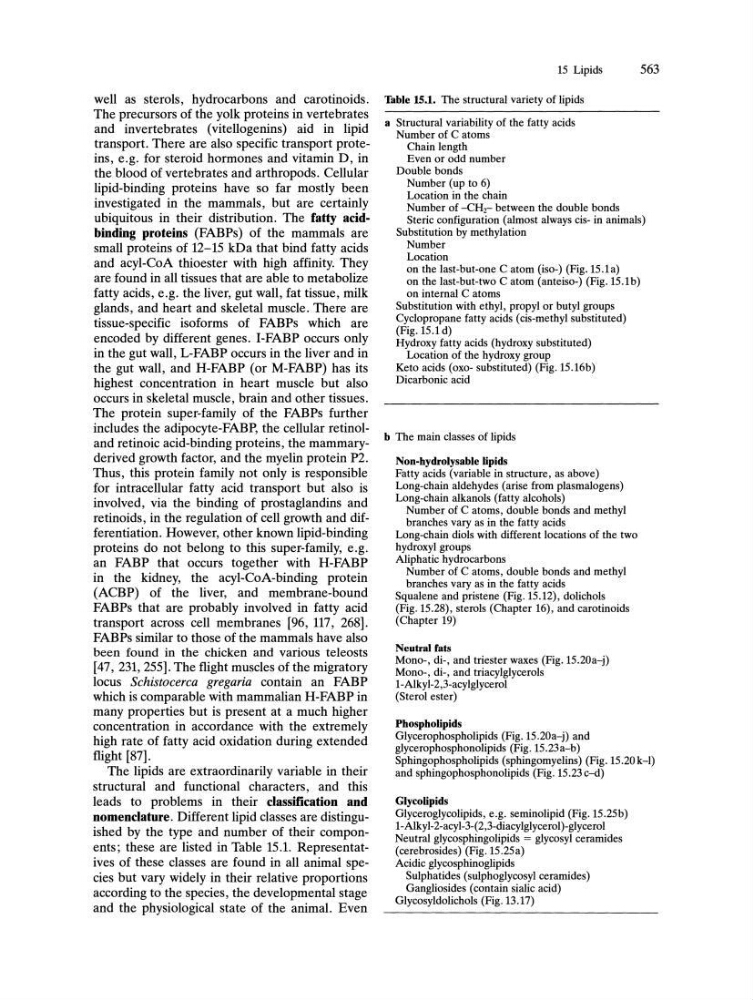
nomenclature. Different lipid classes are distinguished by the type and number of their components; these are listed in Table 15.1. Representatives of these classes are found in all animal species but vary widely in their relative proportions
according to the species, the developmental stage
and the physiological state of the animal. Even
15 Lipids
563
Table 15.1. The structural variety of lipids
a Structural variability of the fatty acids
Number of C atoms
Chain length
Even or odd number
Double bonds
Number (up to 6)
Location in the chain
Number of -CH2- between the double bonds
Steric configuration (almost always cis- in animals)
Substitution by methylation
Number
Location
on the last-but-one C atom (iso-) (Fig. 15.1a)
on the last-but-two C atom (anteiso-) (Fig. 15.1b)
on internal C atoms
Substitution with ethyl, propyl or butyl groups
Cyclopropane fatty acids (cis-methyl substituted)
(Fig. 15.1 d)
Hydroxy fatty acids (hydroxy substituted)
Location of the hydroxy group
Keto acids (oxo- substituted) (Fig. 15.16b)
Dicarbonic acid
b The main classes of lipids
Non-hydrolysable lipids
Fatty acids (variable in structure, as above)
Long-chain aldehydes (arise from plasmalogens)
Long-chain alkanols (fatty alcohols)
Number of C atoms, double bonds and methyl
branches vary as in the fatty acids
Long-chain diols with different locations of the two
hydroxyl groups
Aliphatic hydrocarbons
Number of C atoms, double bonds and methyl
branches vary as in the fatty acids
Squalene and pristene (Fig. 15.1Z), dolichols
(Fig. 15.Z8), sterols (Chapter 16), and carotinoids
(Chapter 19)
Neutral fats
Mono-, di-, and triester waxes (Fig. 15.Z0a-j)
Mono-, di-, and triacylglycerols
1-Alkyl-Z,3-acylglycerol
(Sterol ester)
Phospholipids
Glycerophospholipids (Fig. 15.Z0a-j) and
glycerophosphonolipids (Fig. 15.Z3a-b)
Sphingophospholipids (sphingomyelins) (Fig. 15.Z0k-l)
and sphingophosphonolipids (Fig. 15.Z3 c-d)
Glycolipids
Glyceroglycolipids, e.g. serninolipid (Fig. 15.Z5b)
1-Alkyl-Z-acyl-3-(Z,3-diacylglycerol)-glycerol
Neutral glycosphingolipids = glycosyl ceramides
(cerebrosides) (Fig. 15.Z5a)
Acidic glycosphinoglipids
Sulphatides (sulphoglycosyl ceramides)
Gangliosides (contain sialic acid)
Glycosyldolichols (Fig. 13.17)