

542
14 Glycolysis
Table 14.6. The distribution of L- and D-specific lactate
dehydrogenases in animals [9, 67, 144, 224]
L-specific LD H
Cnidaria
Nematoda
Echinodermata
Trematoda
Cestoda
Cephalopoda
Polychaeta e.g.
(Arenicola marina)
Clitellata
Crustacea Malacostraca
Insecta (inc. Tracheata)
Tunicata
Vertrebrata
D-specific LDH
Rhizopoda
Acanthocephala
Gastropoda
Bivalvia
Polychaeta e.g.
(Nereis virens)
Crustacea
(excl. Malacostraca)
Chelicerata
14.11.1 Lactate Dehydrogenases
of Vertebrates
The vertebrate LDHs are tetramers of about
140 kDa which appear as tissue-specific isoenzymes with different catalytic properties. In the
mammals (whose LDHs are a well-known model
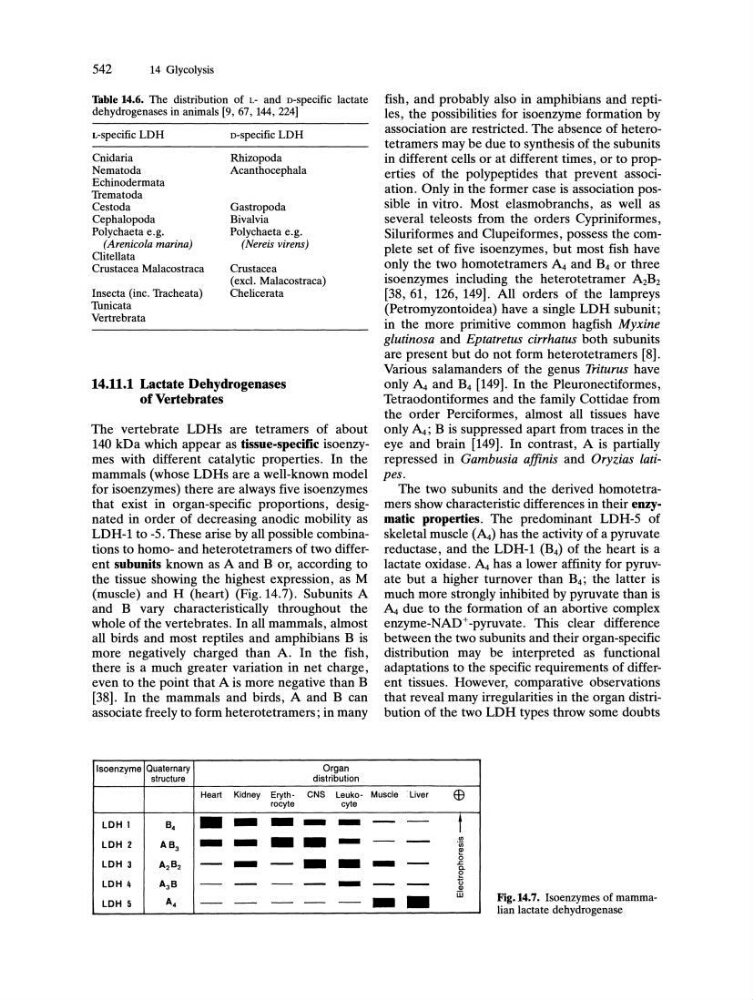
for isoenzymes) there are always five isoenzymes
that exist in organ-specific proportions, designated in order of decreasing anodic mobility as
LDH-1 to -5. These arise by all possible combinations to homo- and heterotetramers of two different subunits known as A and B or, according to
the tissue showing the highest expression, as M
(muscle) and H (heart) (Fig. 14.7). Subunits A
and B vary characteristically throughout the
whole of the vertebrates. In all mammals, almost
all birds and most reptiles and amphibians B is
more negatively charged than A. In the fish,
there is a much greater variation in net charge,
even to the point that A is more negative than B
[38]. In the mammals and birds, A and B can
associate freely to form heterotetramers; in many
Isoenzyme Quaternary
Organ
structure
distribution
Heart Kidney Eryth· eNS Leukorocyte
cyte
LDH 1
B,
- - - - -
LDH 2
AB3
-- -- -
LDH 3
A2B2
-- -- -LDH 4
A3 B
- - -- -- -- -
LDH 5
A,
-- - - -- -- - -
fish, and probably also in amphibians and reptiles, the possibilities for isoenzyme formation by
association are restricted. The absence of heterotetramers may be due to synthesis of the subunits
in different cells or at different times, or to properties of the polypeptides that prevent association. Only in the former case is association possible in vitro. Most elasmobranchs, as well as
several teleosts from the orders Cypriniformes,
Siluriformes and Clupeiformes, possess the complete set of five isoenzymes, but most fish have
only the two homotetramers A4 and B4 or three
isoenzymes including the heterotetramer A2B2
[38, 61, 126, 149]. All orders of the lampreys
(Petromyzontoidea) have a single LDH subunit;
in the more primitive common hagfish Myxine
glutinosa and Eptatretus cirrhattts both subunits
are present but do not form heterotetramers [8].
Various salamanders of the genus Triturus have
only A4 and B4 [149]. In the Pleuronectiformes,
Tetraodontiformes and the family Cottidae from
the order Perciformes, almost all tissues have
only A4; B is suppressed apart from traces in the
eye and brain [149]. In contrast, A is partially
repressed in Gambusia affinis and Oryzias latipes.
The two subunits and the derived homotetramers show characteristic differences in their enzymatic properties. The predominant LDH-5 of
skeletal muscle (A4) has the activity of a pyruvate
reductase, and the LDH-1 (B4) of the heart is a
lactate oxidase. ~ has a lower affinity for pyruvate but a higher turnover than B4; the latter is
much more strongly inhibited by pyruvate than is
A4 due to the formation of an abortive complex
enzyme-NAD+-pyruvate. This clear difference
between the two subunits and their organ-specific
distribution may be interpreted as functional
adaptations to the specific requirements of different tissues. However, comparative observations
that reveal many irregularities in the organ distribution of the two LDH types throw some doubts
Muscle • Liver
-- --- -- ---
-EB
t
OJ
Ow
~
0
.r:
0.
e
ti
Fig. 14. 7. Isoenzymes of mammalian lactate dehydrogenase