

534
14 Glycolysis
14.9 Gluconeogenesis
The glucose transported to cells via the blood is
important for the energy metabolism of all cells
and for some, e.g. erythrocytes, cells of the mammalian brain and the retinal cells of birds, it is
indispensable. Glucose is also required in the
structural metabolism of all cells for the biosynthesis of glycolipids and glycoproteins. In the vertebrates, the blood-sugar level is maintained constant by the activity of the liver, usually by glycogen formation and degradation, and during periods of starvation it is maintained by gluconeogenesis from amino acids, lactate or glycerol. Gluconeogenesis is the reverse of glycolysis, minus
the non-reversible reactions of PK and PFK, for
which other reactions are substituted. In the vertebrate liver and kidney, during gluconeogenesis
from pyruvate, lactate or alanine, the reverse of
the PK reaction is achieved by the combined
actions of pyruvate carboxylase (PC) and phosphoenolpyruvate carboxykioase (PEPCK), and
the reverse of the PFK reaction is achieved by the
hydrolytic activity of fructose-1,6-bisphosphatase
(see Figs. 14.1 and 18.2). The PC is a purely mitochondrial enzyme, whereas PEPCK shows wide
species-specific differences in its compartmentalization; in the rat and mouse it is almost exclusively cytoplasmic but in the other vertebrates it is
predominantly mitochondrial (p.692). Thus,
whilst glycolysis is restricted to the cytoplasm,
gluconeogenesis requires the interaction of two
cell compartments [100]. Serine is important
amongst the glucose-forming (glucoplastic)
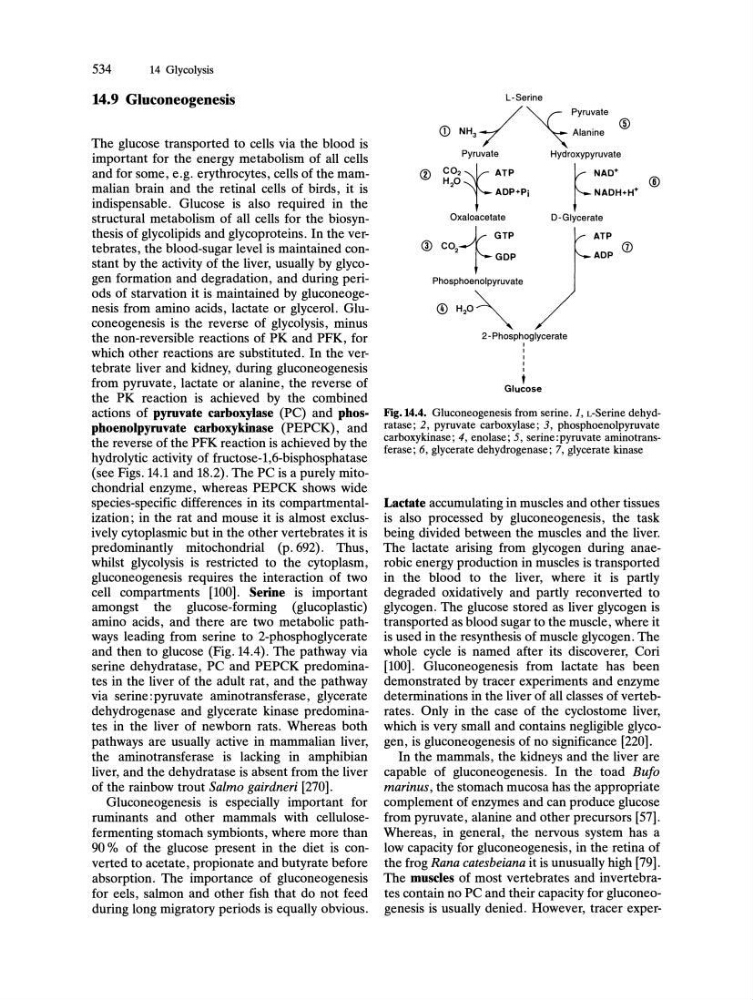
amino acids, and there are two metabolic pathways leading from serine to 2-phosphoglycerate
and then to glucose (Fig. 14.4). The pathway via
serine dehydratase, PC and PEPCK predominates in the liver of the adult rat, and the pathway
via serine: pyruvate aminotransferase, glycerate
dehydrogenase and glycerate kinase predominates in the liver of newborn rats. Whereas both
pathways are usually active in mammalian liver,
the aminotransferase is lacking in amphibian
liver, and the dehydratase is absent from the liver
of the rainbow trout Salmo gairdneri [270].
Gluconeogenesis is especially important for
ruminants and other mammals with cellulosefermenting stomach symbionts, where more than
90 % of the glucose present in the diet is converted to acetate, propionate and butyrate before
absorption. The importance of gluconeogenesis
for eels, salmon and other fish that do not feed
during long migratory periods is equally obvious.
®
@
L-Serine
CD
/~PYru •• "
NH3
Alanine
®
Pyruvate
Hyd roxypyruvate
ca,t ATP ~ NAD'
H 2 O
AOP+Pj
NAOH+H+
Oxaloacetate
D -G Iycerate
CO 2
-t
GTP GOP
Phosphoenolpyruvate
® H,a~
2 - Phosphoglycerate
I
I
I
I
I
t
Glucose
ATP
AOP
CD
®
Fig.14.4. Gluconeogenesis from serine. 1, L-Serine dehydratase; 2, pyruvate carboxylase; 3, phosphoenolpyruvate
carboxykinase; 4, enolase; 5, serine: pyruvate aminotransferase; 6, glycerate dehydrogenase; 7, glycerate kinase
Lactate accumulating in muscles and other tissues
is also processed by gluconeogenesis, the task
being divided between the muscles and the liver.
The lactate arising from glycogen during anaerobic energy production in muscles is transported
in the blood to the liver, where it is partly
degraded oxidatively and partly reconverted to
glycogen. The glucose stored as liver glycogen is
transported as blood sugar to the muscle, where it
is used in the resynthesis of muscle glycogen. The
whole cycle is named after its discoverer, Cori
[100]. Gluconeogenesis from lactate has been
demonstrated by tracer experiments and enzyme
determinations in the liver of all classes of vertebrates. Only in the case of the cyclostome liver,
which is very small and contains negligible glycogen, is gluconeogenesis of no significance [220].
In the mammals, the kidneys and the liver are
capable of gluconeogenesis. In the toad Bufo
marinus, the stomach mucosa has the appropriate
complement of enzymes and can produce glucose
from pyruvate, alanine and other precursors [57].
Whereas, in general, the nervous system has a
low capacity for gluconeogenesis, in the retina of
the frog Rana catesbeiana it is unusually high [79].
The muscles of most vertebrates and invertebrates contain no PC and their capacity for gluconeogenesis is usually denied. However, tracer exper-