

522
14 Glycolysis
14.3 lIexokioases
The typical hexokinases of the animal kingdom
transfer a phosphate residue from ATP to the C-6
of different hexoses; they are active, for example,
with glucose, fructose, mannose, glucosamine
and deoxyglucose, but hardly at all with
galactose. C-6-phosphorylating enzymes with a
narrower specificity have so far been found in several invertebrates; an N-acetylglucosamine
kinase is found in the liver and other tissues of the
mammals [203]. C-1-phosphorylating fructokinases and galactokinases appear to be more common, but have been relatively little investigated.
A galactokinase isolated from the ciliate Tetrahymena thermophila was found to be very similar to
the corresponding enzymes of yeast and mammalian liver [131].
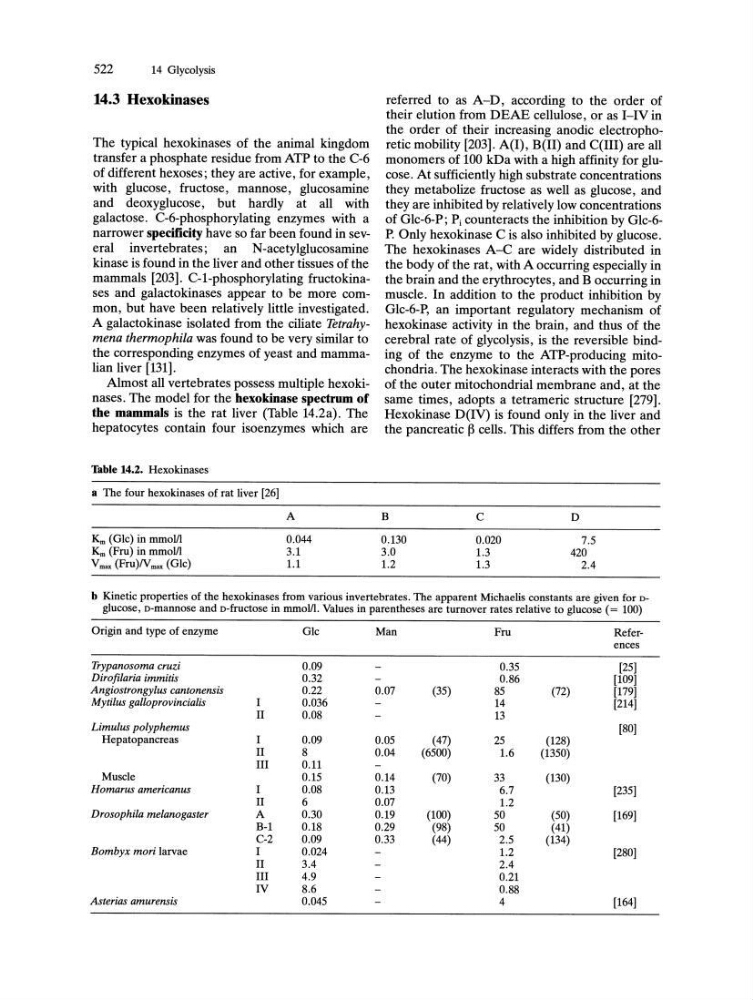
Almost all vertebrates possess multiple hexokinases. The model for the hexokinase spectrum of
the mammals is the rat liver (Table 14.2a). The
hepatocytes contain four isoenzymes which are
'lllble 14.2. Hexokinases
a The four hexokinases of rat liver [26]
Km (Glc) in mmolll
Km (Fru) in mmolll
V max (Fru)N max (Glc)
A
0.044
3.1
1.1
referred to as A-D, according to the order of
their elution from DEAE cellulose, or as I-IV in
the order of their increasing anodic electrophoretic mobility [203]. A(I), B(II) and C(III) are all
monomers of 100 kDa with a high affinity for glucose. At sufficiently high substrate concentrations
they metabolize fructose as well as glucose, and
they are inhibited by relatively low concentrations
of Glc-6-P; Pi counteracts the inhibition by Glc-6P. Only hexokinase C is also inhibited by glucose.
The hexokinases A-C are widely distributed in
the body of the rat, with A occurring especially in
the brain and the erythrocytes, and B occurring in
muscle. In addition to the product inhibition by
Glc-6-P, an important regulatory mechanism of
hexokinase activity in the brain, and thus of the
cerebral rate of glycolysis, is the reversible binding of the enzyme to the ATP-producing mitochondria. The hexokinase interacts with the pores
of the outer mitochondrial membrane and, at the
same times, adopts a tetrameric structure [279).
Hexokinase D(IV) is found only in the liver and
the pancreatic ~ cells. This differs from the other
B
0.130
3.0
1.2
c
0.020
1.3
1.3
D
7.5
420
2.4
b Kinetic properties of the hexokinases from various invertebrates. The apparent Michaelis constants are given for 0glucose, o-mannose and o-fructose in mmolll. Values in parentheses are turnover rates relative to glucose (= 100)
Origin and type of enzyme
Glc
Man
Fru
References
Trypanosoma cruzi
0.09
0.35
[25]
Dirofilaria immitis
0.32
0.86
[109]
Angiostrongylus cantonensis
0.22
0.07
(35)
85
(72)
[179]
Mytilus galloprovincialis
I
0.036
14
[214]
II
0.08
13
Limulus polyphemus
[80]
Hepatopancreas
I
0.09
0.05
(47)
25
(128)
II
8
0.04
(6500)
1.6
(1350)
III
0.11
Muscle
0.15
0.14
(70)
33
(130)
Homarus americanus
I
0.08
0.13
6.7
[235]
II
6
0.07
1.2
Drosophila melanogaster
A
0.30
0.19
(100)
50
(50)
[169]
B-1
0.18
0.29
(98)
50
(41)
C-2
0.09
0.33
(44)
2.5
(134)
Bombyx mori larvae
I
0.024
1.2
[280]
II
3.4
2.4
III
4.9
0.21
IV
8.6
0.88
Asterias amurensis
0.045
4
[164]