

14.1 The Pathway from Hexose to Pyruvate
515
Glucose
. . . . . . . . . . . . . . . . . . . . . . . . . . . . . . . . . . . . . . , ! . . . . . . . . . . . . . . . . . . . . . . . . . . . . . . . . . . . . .
.
Glucose
Glycogen
:::~ r:~o ®
! r
Pi @
Glucose-6-phosphate .... "',----->".. Glucose-1-phosphate
t
®
Fructose -6 -phosphate
CD ,ATP~ ~Pi
@
• ADP-i
~ H20
Fructose-1,6-bisphosphate
t
Glyceraldehyde- 3 -phosphate ~ Dihydroxyacetone phosphate
®
Pi'f
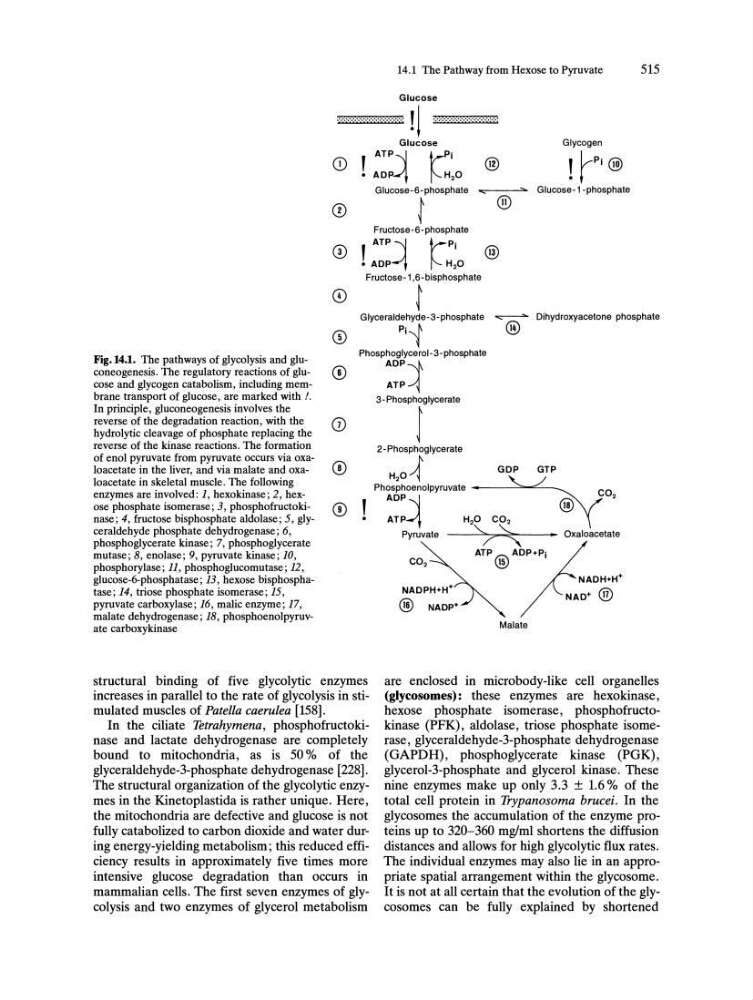
Fig.14.1. The pathways of glycolysis and gluconeogenesis. The regulatory reactions of glucose and glycogen catabolism, including membrane transport of glucose, are marked with f.
In principle, gluconeogenesis involves the
reverse of the degradation reaction, with the
hydrolytic cleavage of phosphate replacing the
reverse of the kinase reactions. The formation
of enol pyruvate from pyruvate occurs via oxaloacetate in the liver, and via malate and oxaloacetate in skeletal muscle. The following
enzymes are involved: 1, hexokinase; 2, hexose phosphate isomerase; 3, phosphofructokinase; 4, fructose bisphosphate aldolase; 5, glyceraldehyde phosphate dehydrogenase; 6,
phosphoglycerate kinase; 7, phosphoglycerate
mutase; 8, enolase; 9, pyruvate kinase; 10,
phosphorylase; 11, phosphoglucomutase; 12,
glucose-6-phosphatase; 13, hexose bisphosphatase; 14, triose phosphate isomerase; 15,
pyruvate carboxylase; 16, malic enzyme; 17,
malate dehydrogenase; 18, phosphoenolpyruvate carboxykinase
Phosphoglycerol- 3 - phosphate
ADP"i
®
structural binding of five glycolytic enzymes
increases in parallel to the rate of glycolysis in stimulated muscles of Patella caerulea [158].
In the ciliate Tetrahymena, phosphofructokinase and lactate dehydrogenase are completely
bound to mitochondria, as is 50 % of the
glyceraldehyde-3-phosphate dehydrogenase [228].
The structural organization of the glycolytic enzymes in the Kinetoplastida is rather unique. Here,
the mitochondria are defective and glucose is not
fully catabolized to carbon dioxide and water during energy-yielding metabolism; this reduced efficiency results in approximately five times more
intensive glucose degradation than occurs in
mammalian cells. The first seven enzymes of glycolysis and two enzymes of glycerol metabolism
ATP-1
3-Ph"' T"",m"
2- Phosphoglycerate
H20~
GDP
GTP
Phosphoenolpyruvate ----....:;,...""""--_
ADP~
ATP-1
Pyruvate
NADPH+H+
® NADP+
@
H20 CO 2
~
.. Oxaloacetate
ATP ® A/6D+Pi
Malate
NADH+H+
NAD+ ®
are enclosed in microbody-like cell organelles
(glycosomes): these enzymes are hexokinase,
hexose phosphate isomerase, phosphofructokinase (PFK), aldolase, triose phosphate isomerase, glyceraldehyde-3-phosphate dehydrogenase
(GAPDH), phosphoglycerate kinase (PGK) ,
glycerol-3-phosphate and glycerol kinase. These
nine enzymes make up only 3.3 ± 1.6 % of the
total cell protein in Trypanosoma brucei. In the
glycosomes the accumulation of the enzyme proteins up to 320-360 mg/ml shortens the diffusion
distances and allows for high glycolytic flux rates.
The individual enzymes may also lie in an appropriate spatial arrangement within the glycosome.
It is not at all certain that the evolution of the glycosomes can be fully explained by shortened