

38
2 Nucleic Acids and Nuclear Proteins
have a CCAAT sequence but neither a TATA box
nor GC elements; here again, it is clear that the
ciliates stand apart from the other eukaryotes
[52]. The DNA region at which Pol II begins transcription is termed the promoter; the TATA box is
an element of the promoter. Pol II requires several transcription factors (TFII) for initiation. In
the formation of the Pol II initiation complex, the
factors TFIID and TFIIA first bind directly to the
TATA box, and then to the factors TFIIB and
TFIIE, which interact alternately with each other
and with the polymerase. For Pol III there are
the cofactors TFIIIA and TFIIIC [149, 342].
Enhanced, regulated gene expression is achieved
by the binding of specific regulatory proteins
(activators) to a sequence element (the enhancer)
that can stimulate the transcription of the relevant gene from a distance of several thousand base
pairs. Enhancers are also known for Pol 1transcribed, ribosomal RNA genes (see Fig. 2.15)
[313, 381]. In front of the start site of translation
at the AUG start codon there is a conserved
sequence in the mRNA that probably corresponds to a complementary sequence in the 18S
rRNA of the ribosome. In vertebrates, the consensus sequence here is GCCRCCAUG [239],
and in Drosophila one finds the significantly different sequence C/AAAAlCAUG; thus, in Drosophila A is preferred, whereas in vertebrates C is
preferred [62a]. In the 3' region, the strongly conserved consensus sequence AAUAAA is the signal for splitting the primary transcript 10-30 nt
downstream during RNA maturation, and for
attaching the poly(A) tail. Due to the immediately ensuing processes of RNA maturation in
vivo, the termination of Pol II transcription can
only be investigated in vitro using purified enzymes. Then it is seen that particular T-rich sequences act as termination signals at which the polymerase is released from the DNA. However, the
termination is apparently not very precise [227].
2.7.3 Maturation of the Primary Transcripts
(RNA Processing)
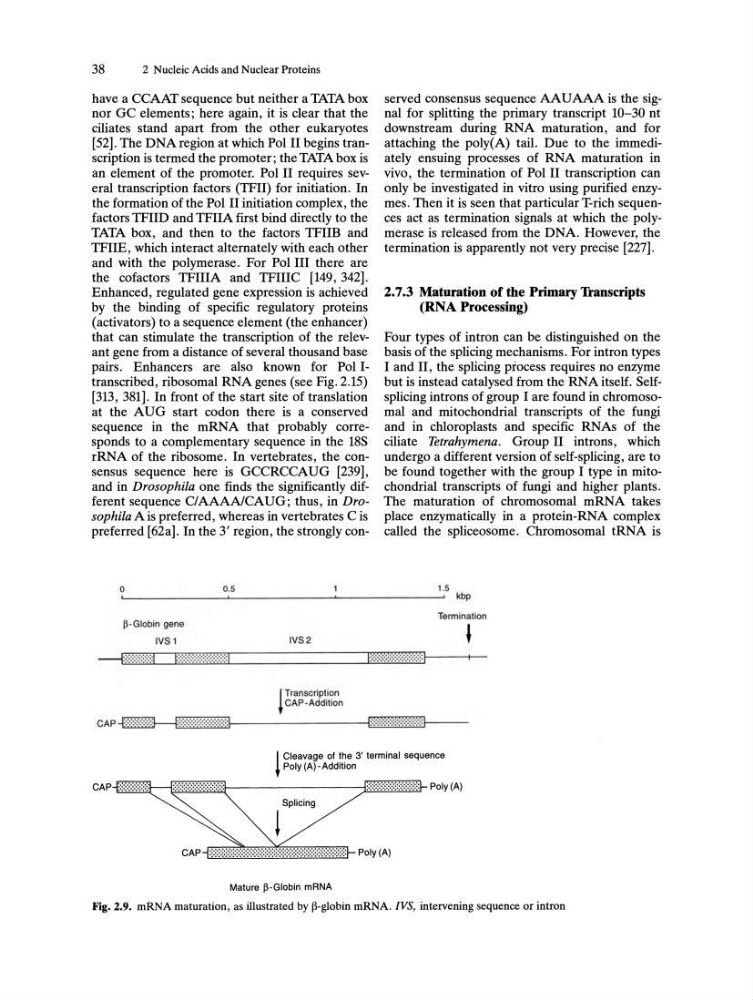
Four types of intron can be distinguished on the
basis of the splicing mechanisms. For intron types
I and II, the splicing process requires no enzyme
but is instead catalysed from the RNA itself. Selfsplicing introns of group I are found in chromosomal and mitochondrial transcripts of the fungi
and in chloroplasts and specific RNAs of the
ciliate Tetrahymena. Group II introns, which
undergo a different version of self-splicing, are to
be found together with the group I type in mitochondrial transcripts of fungi and higher plants.
The maturation of chromosomal mRNA takes
place enzymatically in a protein-RNA complex
called the spliceosome. Chromosomal tRNA is
o
0.5
1.5
~, ____________ ~ ______________ ~ ____________ ~ ' kbp
~-Globin gene
IVSl
----l:::::::::::::::::1 k::::::::::::::::::::::::::1
Termination
IVS2
rTranscription
+ CAP-Addition
CAP~Q:::::]:::::I:::::[:::::I:::::: ]::: I---------------illKTI::: ::2 :::::TI:::::: §: ::::S::::: ~ I ---I Cleavage of the 3' terminal sequence
+ Poly (A) - Addition
:::::::::::::::::::::::::::::: Poly (A)
Splicing
l
CAP ========-'-'-'-'-.:..:..1
Poly (A)
Mature ~-GlobinmRNA
Fig. 2.9. mRNA maturation, as illustrated by ~-globin mRNA. IVS, intervening sequence or intron
2 Nucleic Acids and Nuclear Proteins
have a CCAAT sequence but neither a TATA box
nor GC elements; here again, it is clear that the
ciliates stand apart from the other eukaryotes
[52]. The DNA region at which Pol II begins transcription is termed the promoter; the TATA box is
an element of the promoter. Pol II requires several transcription factors (TFII) for initiation. In
the formation of the Pol II initiation complex, the
factors TFIID and TFIIA first bind directly to the
TATA box, and then to the factors TFIIB and
TFIIE, which interact alternately with each other
and with the polymerase. For Pol III there are
the cofactors TFIIIA and TFIIIC [149, 342].
Enhanced, regulated gene expression is achieved
by the binding of specific regulatory proteins
(activators) to a sequence element (the enhancer)
that can stimulate the transcription of the relevant gene from a distance of several thousand base
pairs. Enhancers are also known for Pol 1transcribed, ribosomal RNA genes (see Fig. 2.15)
[313, 381]. In front of the start site of translation
at the AUG start codon there is a conserved
sequence in the mRNA that probably corresponds to a complementary sequence in the 18S
rRNA of the ribosome. In vertebrates, the consensus sequence here is GCCRCCAUG [239],
and in Drosophila one finds the significantly different sequence C/AAAAlCAUG; thus, in Drosophila A is preferred, whereas in vertebrates C is
preferred [62a]. In the 3' region, the strongly conserved consensus sequence AAUAAA is the signal for splitting the primary transcript 10-30 nt
downstream during RNA maturation, and for
attaching the poly(A) tail. Due to the immediately ensuing processes of RNA maturation in
vivo, the termination of Pol II transcription can
only be investigated in vitro using purified enzymes. Then it is seen that particular T-rich sequences act as termination signals at which the polymerase is released from the DNA. However, the
termination is apparently not very precise [227].
2.7.3 Maturation of the Primary Transcripts
(RNA Processing)
Four types of intron can be distinguished on the
basis of the splicing mechanisms. For intron types
I and II, the splicing process requires no enzyme
but is instead catalysed from the RNA itself. Selfsplicing introns of group I are found in chromosomal and mitochondrial transcripts of the fungi
and in chloroplasts and specific RNAs of the
ciliate Tetrahymena. Group II introns, which
undergo a different version of self-splicing, are to
be found together with the group I type in mitochondrial transcripts of fungi and higher plants.
The maturation of chromosomal mRNA takes
place enzymatically in a protein-RNA complex
called the spliceosome. Chromosomal tRNA is
o
0.5
1.5
~, ____________ ~ ______________ ~ ____________ ~ ' kbp
~-Globin gene
IVSl
----l:::::::::::::::::1 k::::::::::::::::::::::::::1
Termination
IVS2
rTranscription
+ CAP-Addition
CAP~Q:::::]:::::I:::::[:::::I:::::: ]::: I---------------illKTI::: ::2 :::::TI:::::: §: ::::S::::: ~ I ---I Cleavage of the 3' terminal sequence
+ Poly (A) - Addition
:::::::::::::::::::::::::::::: Poly (A)
Splicing
l
CAP ========-'-'-'-'-.:..:..1
Poly (A)
Mature ~-GlobinmRNA
Fig. 2.9. mRNA maturation, as illustrated by ~-globin mRNA. IVS, intervening sequence or intron