

504
13 The Structure and Metabolism of Carbohydrates
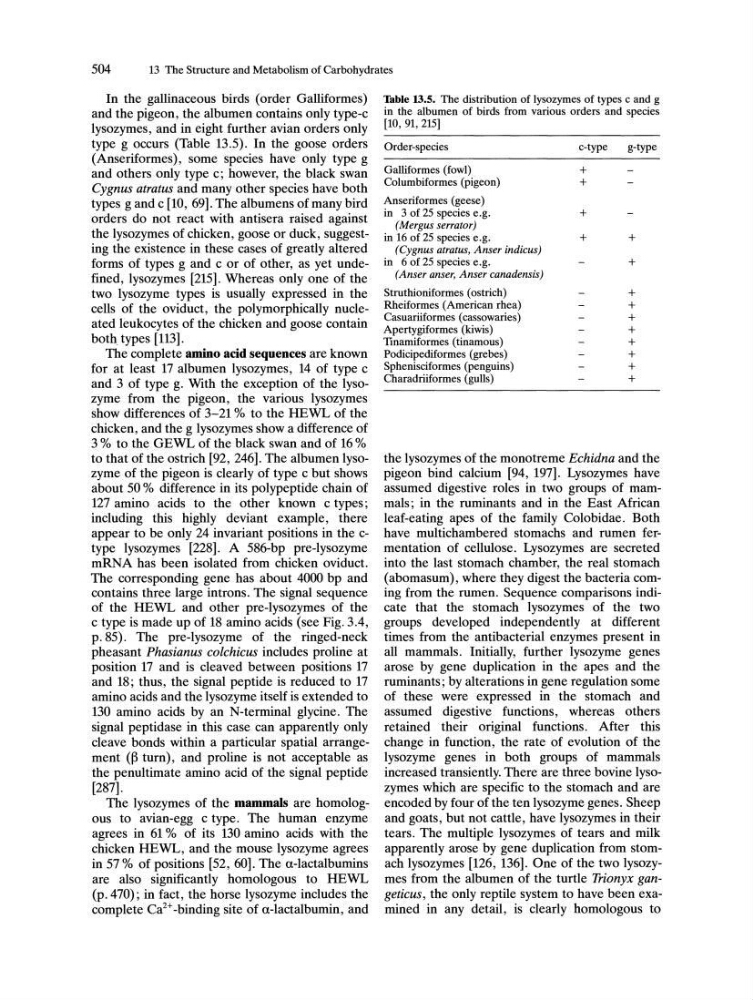
In the gallinaceous birds (order Galliformes)
and the pigeon, the albumen contains only type-c
lysozymes, and in eight further avian orders only
type g occurs (Table 13.5). In the goose orders
(Anseriformes), some species have only type g
and others only type c; however, the black swan
Cygnus atratus and many other species have both
types g and c [10,69]. The albumens of many bird
orders do not react with antisera raised against
the lysozymes of chicken, goose or duck, suggesting the existence in these cases of greatly altered
forms of types g and c or of other, as yet undefined, lysozymes [215]. Whereas only one of the
two lysozyme types is usually expressed in the
cells of the oviduct, the polymorphically nucleated leukocytes of the chicken and goose contain
both types [113].
The complete amino acid sequences are known
for at least 17 albumen lysozymes, 14 of type c
and 3 of type g. With the exception of the lysozyme from the pigeon, the various lysozymes
show differences of 3-21 % to the HEWL of the
chicken, and the g lysozymes show a difference of
3 % to the GEWL of the black swan and of 16 %
to that of the ostrich [92, 246]. The albumen lysozyme of the pigeon is clearly of type c but shows
about 50 % difference in its polypeptide chain of
127 amino acids to the other known c types;
including this highly deviant example, there
appear to be only 24 invariant positions in the ctype lysozymes [228]. A 586-bp pre-lysozyme
mRNA has been isolated from chicken oviduct.
The corresponding gene has about 4000 bp and
contains three large introns. The signal sequence
of the HEWL and other pre-Iysozymes of the
c type is made up of 18 amino acids (see Fig. 3.4,
p.85). The pre-lysozyme of the ringed-neck
pheasant Phasianus colchicus includes proline at
position 17 and is cleaved between positions 17
and 18; thus, the signal peptide is reduced to 17
amino acids and the lysozyme itself is extended to
130 amino acids by an N-terminal glycine. The
signal peptidase in this case can apparently only
cleave bonds within a particular spatial arrangement (B turn), and proline is not acceptable as
the penultimate amino acid of the signal peptide
[287].
The lysozymes of the mammals are homologous to avian-egg c type. The human enzyme
agrees in 61 % of its 130 amino acids with the
chicken HEWL, and the mouse lysozyme agrees
in 57 % of positions [52, 60]. The a-Iactalbumins
are also significantly homologous to HEWL
(p. 470); in fact, the horse lysozyme includes the
complete Ca 2 + -binding site of a-lactalbumin, and
Table 13.5. The distribution of lysozymes of types c and g
in the albumen of birds from various orders and species
[10, 91, 215]
Order-species
c-type
g-type
Galliformes (fowl)
+
Columbiformes (pigeon)
+
Anseriformes (geese)
in 3 of 25 species e.g.
+
(Mergus serrator)
in 16 of 25 species e.g.
+
+
(Cygnus atratus, Anser indicus)
in 6 of 25 species e.g.
+
(Anser anser, Anser canadensis)
Struthioniformes (ostrich)
+
Rheiformes (American rhea)
+
Casuariiformes (cassowaries)
+
Apertygiformes (kiwis)
+
TInamiformes (tinamous)
+
Podicipediformes (grebes)
+
Sphenisciformes (penguins)
+
Charadriiformes (gulls)
+
the lysozymes of the monotreme Echidna and the
pigeon bind calcium [94, 197]. Lysozymes have
assumed digestive roles in two groups of mammals; in the ruminants and in the East African
leaf-eating apes of the family Colobidae. Both
have multichambered stomachs and rumen fermentation of cellulose. Lysozymes are secreted
into the last stomach chamber, the real stomach
(abomasum), where they digest the bacteria coming from the rumen. Sequence comparisons indicate that the stomach lysozymes of the two
groups developed independently at different
times from the antibacterial enzymes present in
all mammals. Initially, further lysozyme genes
arose by gene duplication in the apes and the
ruminants; by alterations in gene regulation some
of these were expressed in the stomach and
assumed digestive functions, whereas others
retained their original functions. After this
change in function, the rate of evolution of the
lysozyme genes in both groups of mammals
increased transiently. There are three bovine lysozymes which are specific to the stomach and are
encoded by four of the ten lysozyme genes. Sheep
and goats, but not cattle, have lysozymes in their
tears. The multiple lysozymes of tears and milk
apparently arose by gene duplication from stomach lysozymes [126, 136]. One of the two lysozymes from the albumen of the turtle Trionyx gangeticus, the only reptile system to have been examined in any detail, is clearly homologous to