

494
13 The Structure and Metabolism of Carbohydrates
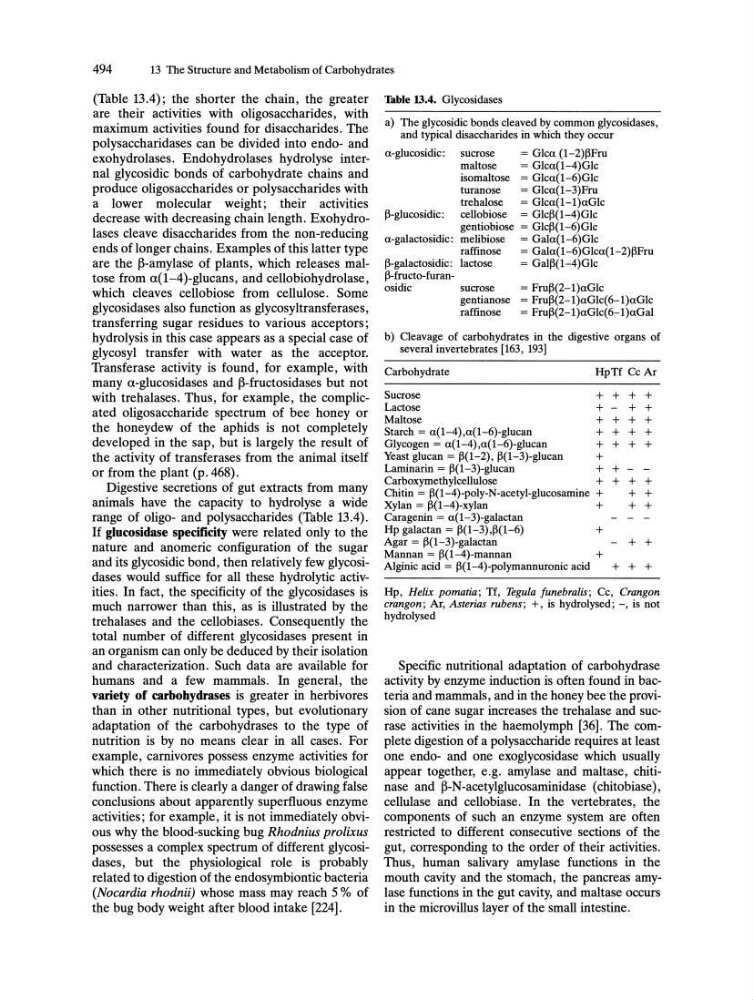
(Table 13.4); the shorter the chain, the greater
are their activities with oligosaccharides, with
maximum activities found for disaccharides. The
polysaccharidases can be divided into endo- and
exohydrolases. Endohydrolases hydrolyse internal glycosidic bonds of carbohydrate chains and
produce oligosaccharides or polysaccharides with
a lower molecular weight; their activities
decrease with decreasing chain length. Exohydrolases cleave disaccharides from the non-reducing
ends of longer chains. Examples of this latter type
are the B-amylase of plants, which releases maltose from a(1-4)-glucans, and cellobiohydrolase,
which cleaves cellobiose from cellulose. Some
glycosidases also function as glycosyltransferases,
transferring sugar residues to various acceptors;
hydrolysis in this case appears as a special case of
glycosyl transfer with water as the acceptor.
Transferase activity is found, for example, with
many a-glucosidases and B-fructosidases but not
with trehalases. Thus, for example, the complicated oligosaccharide spectrum of bee honey or
the honeydew of the aphids is not completely
developed in the sap, but is largely the result of
the activity of transferases from the animal itself
or from the plant (p. 468).
Digestive secretions of gut extracts from many
animals have the capacity to hydrolyse a wide
range of oligo- and polysaccharides (Table 13.4).
If glucosidase specificity were related only to the
nature and anomeric configuration of the sugar
and its glycosidic bond, then relatively few glycosidases would suffice for all these hydrolytic activities. In fact, the specificity of the glycosidases is
much narrower than this, as is illustrated by the
trehalases and the cellobiases. Consequently the
total number of different glycosidases present in
an organism can only be deduced by their isolation
and characterization. Such data are available for
humans and a few mammals. In general, the
variety of carbobydrases is greater in herbivores
than in other nutritional types, but evolutionary
adaptation of the carbohydrases to the type of
nutrition is by no means clear in all cases. For
example, carnivores possess enzyme activities for
which there is no immediately obvious biological
function. There is clearly a danger of drawing false
conclusions about apparently superfluous enzyme
activities; for example, it is not immediately obvious why the blood-sucking bug Rhodnius prolixus
possesses a complex spectrum of different glycosidases, but the physiological role is probably
related to digestion of the endosymbiontic bacteria
(Nocardia rhodnii) whose mass may reach 5 % of
the bug body weight after blood intake [224].
Table 13.4. Glycosidases
a) The glycosidic bonds cleaved by common glycosidases,
and typical disaccharides in which they occur
a-glucosidic: sucrose
= Glea (1-2)~Fru
maltose
= Glea(1-4)Gle
isomaltose = Glea(1-6)Gle
turanose
= Glea(1-3)Fru
trehalose
= Glea(l-l)aGle
~-glucosidic:
cellobiose = Gle~(1-4)Gle
gentiobiose = Gle~(1-6)Gle
a-galactosidic: melibiose = Gala(1-6)Gle
raffinose
= Gala(1-6)Glea(1-2)~Fru
~-galactosidic: lactose
= Gal~( 1-4 )Gle
~-fructo-furanosidic
sucrose
= Fru~(2-1 )aGle
gentianose = Fru~(2-1)aGlc(6-1)aGle
raffinose
= Fru~(2-1 )aGle( 6-1 )aGal
b) Cleavage of carbohydrates in the digestive organs of
several invertebrates [163, 193]
Carbohydrate
HpTf Cc Ar
Sucrose
+ + + +
Lactose
+ - + +
Maltose
+ + + +
Starch = a(1-4),a(1-6)-glucan
+ + + +
Glycogen = a(1-4),a(1-6)-glucan
+ + + +
Yeast glucan = ~(1-2), ~(1-3)-glucan
+
Laminarin = ~(1-3)-glucan
+ +
Carboxymethyleellulose
+ + + +
Chitin = ~(1-4)-poly-N-acetyl-glucosamine +
+ +
Xylan = ~(1-4)-xylan
+
+ +
Caragenin = a(1-3)-galactan
Hp galactan = ~(1-3),~(1-6)
+
Agar = ~(1-3)-galactan
- + +
Mannan = ~(1-4)-mannan
+
Alginic acid = ~(1-4)-polymannuronic acid
+ + +
Hp, Helix pomatia; Tf, Tegula funebralis; Cc, Crangon
crangon; Ar, Asterias rubens; +, is hydrolysed; -, is not
hydrolysed
Specific nutritional adaptation of carbohydrase
activity by enzyme induction is often found in bacteria and mammals, and in the honey bee the provision of cane sugar increases the trehalase and sucrase activities in the haemolymph [36]. The complete digestion of a polysaccharide requires at least
one endo- and one exoglycosidase which usually
appear together, e.g. amylase and maltase, chitinase and B-N -acetylglucosaminidase (chitobiase),
cellulase and cellobiase. In the vertebrates, the
components of such an enzyme system are often
restricted to different consecutive sections of the
gut, corresponding to the order of their activities.
Thus, human salivary amylase functions in the
mouth cavity and the stomach, the pancreas amylase functions in the gut cavity, and maltase occurs
in the microvillus layer of the small intestine.