

[90]. Inhibition experiments with 3-amino-l,2,4triazol indicate that the catalase of D. melanogaster is only marginally involved in ethanol metabolism but is important for the catabolism of
methanol [277].
13.3.5 Biosynthesis of Ascorbic Acid
Ascorbic acid is a substrate involved in redox
reactions such as the hydroxylation of proline in
collagen synthesis or the formation of noradrenalin from dopamine by dopamine-~-monooxygenase. It is present in plant foodstuffs but can
also be synthesized de novo in many vertebrates.
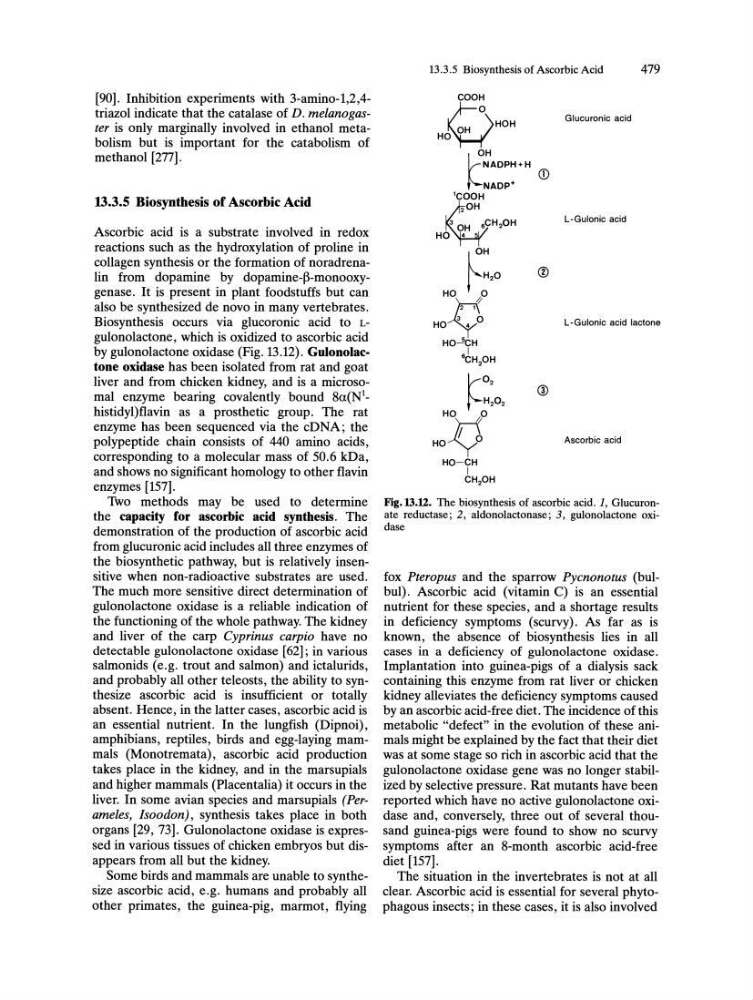
Biosynthesis occurs via glucoronic acid to Lgulonolactone, which is oxidized to ascorbic acid
by gulonolactone oxidase (Fig. 13.12). Gulonolactone oxidase has been isolated from rat and goat
liver and from chicken kidney, and is a microsomal enzyme bearing covalently bound 8a(N 1 -
histidyl)flavin as a prosthetic group. The rat
enzyme has been sequenced via the cDNA; the
polypeptide chain consists of 440 amino acids,
corresponding to a molecular mass of 50.6 kDa,
and shows no significant homology to other flavin
enzymes [157].
Two methods may be used to determine
the capacity for ascorbic acid synthesis. The
demonstration of the production of ascorbic acid
from glucuronic acid includes all three enzymes of
the biosynthetic pathway, but is relatively insensitive when non-radioactive substrates are used.
The much more sensitive direct determination of
gulonolactone oxidase is a reliable indication of
the functioning of the whole pathway. The kidney
and liver of the carp Cyprinus carpio have no
detectable gulonolactone oxidase [62]; in various
salmonids (e.g. trout and salmon) and ictalurids,
and probably all other teleosts, the ability to synthesize ascorbic acid is insufficient or totally
absent. Hence, in the latter cases, ascorbic acid is
an essential nutrient. In the lungfish (Dipnoi),
amphibians, reptiles, birds and egg-laying mammals (Monotremata), ascorbic acid production
takes place in the kidney, and in the marsupials
and higher mammals (Placentalia) it occurs in the
liver. In some avian species and marsupials (Perameles, Isoodon) , synthesis takes place in both
organs [29, 73]. Gulonolactone oxidase is expressed in various tissues of chicken embryos but disappears from all but the kidney.
Some birds and mammals are unable to synthesize ascorbic acid, e.g. humans and probably all
other primates, the guinea-pig, marmot, flying
13.3.5 Biosynthesis of Ascorbic Acid
479
Glucuronic acid
L-Gulonic acid
L-Gulonic acid lactone
Ascorbic acid
Fig.13.12. The biosynthesis of ascorbic acid. 1, Glucuronate reductase; 2, aldonolactonase; 3, gulonolactone oxidase
fox Pteropus and the sparrow Pycnonotus (bulbul). Ascorbic acid (vitamin C) is an essential
nutrient for these species, and a shortage results
in deficiency symptoms (scurvy). As far as is
known, the absence of biosynthesis lies in all
cases in a deficiency of gulonolactone oxidase.
Implantation into guinea-pigs of a dialysis sack
containing this enzyme from rat liver or chicken
kidney alleviates the deficiency symptoms caused
by an ascorbic acid-free diet. The incidence of this
metabolic "defect" in the evolution of these animals might be explained by the fact that their diet
was at some stage so rich in ascorbic acid that the
gulonolactone oxidase gene was no longer stabilized by selective pressure. Rat mutants have been
reported which have no active gulonolactone oxidase and, conversely, three out of several thousand guinea-pigs were found to show no scurvy
symptoms after an 8-month ascorbic acid-free
diet [157].
The situation in the invertebrates is not at all
clear. Ascorbic acid is essential for several phytophagous insects; in these cases, it is also involved