

450
12 Small Nitrogenous Compounds
dependent adenylate cyclases [139]. There are
only isolated results on hormone-dependent
adenylate cyclases of other invertebrate groups:
an octopamine-dependent adenylate cyclase was
found in the central nervous system of Limulus,
and serotonin-dependent enzymes have been
found in various platyhelminths. The hyperglycaemic hormone of the crustaceans also affects an
adenylate cyclase [64]. Like the adenylate cyclases of yeast and Neurospora, the enzyme of Trypanosoma is only loosely associated with the cell
membrane and requires Mn2+. However, it can
interact in vitro with G-proteins from the membrane of avian erythrocytes and it is then activated by GTP and Mg2+; activation by Ca 2 +calmodulin can also be shown in vitro. Thus, the
flagellate enzyme differs from those of the higher
vertebrates more in the type of binding to regulatory components than in catalytic properties [248].
The adenylate cyclase of the ciliate Paramecium
tetraurelia is also not regulated by one specific
hormone and is not linked to a GTP-binding protein; it therefore resembles an enzyme found in
mammalian spermatozoa [219].
Guanylate cyclases appear to be just as ubiquitous in the animal kingdom. These enzymes
resemble the adenylate cyclases in that they
require a divalent metal ion, but they differ in
that Mn 2 + can be replaced and fluoride is not stimulatory. Membrane-bound guanylate cyclases in
mammals serve as receptors for the atrial natriuretic peptide, and in sea-urchin sperm they serve
as receptors for the chemotactic peptides resact
and speract (p. 305). Mammals also possess
soluble enzymes of this type; they are heterodimers of homologous subunits of 70 and 82 kDa.
The membrane-bound guanylate cyclases from
the sperm of the sea urchin Strongylocentrotus,
on the other hand, is a single polypeptide chain of
1104 amino acids and is subdivided into an Nterminal, extracellular domain (485 amino acids),
a transmembrane segment (25 amino acids) and a
C-terminal domain (594 amino acids). The Cterminal section of 202 amino acids agrees by up
®
AMP
®
- I M P
®
• XMP
G)!
Xanthosine
G).
4
G).
.
@)
I
.
Adenosine -
noslne
@~
@.
@!
to 42 % with the soluble guanylate cyclase of
bovine lung. In contrast, the membrane-bound
enzyme from the sperm of the sea urchin Arbacia
punctulata has a C-terminal sequence which is
very different from that of the soluble mammalian enzyme [162, 247]. The concentration of
cGMP is usually 10- to 100-fold lower than that of
cAMP; however, higher cGMP concentrations,
and high activities of cGMP-dependent protein
kinases, are found in the insects. In the fat body
of the silkworm Bombyx mori, the ratio of guanylate cyclase to adenylate cyclase increases during pupation from 0.5: 1 to about 15: 1. Extremely
high cGMP concentrations of up to 50 flmol/l are
found in the spermatophores of crickets of the
genera Gryllus and Acheta, although the guanylate cyclase activity of the accessory sex glands is
not unusually high. It is remarkable that such
high cGMP values are found only in representatives of a single subfamily of the orthopterans, the
Gryllinae. The activities of adenylate cyclases in
the sperm of vertebrates and invertebrates are
more or less the same, whereas guanylate cyclase
activities may be 100- to lOOO-fold higher in many
invertebrates than in the vertebrates.
12.11.3 Catabolism of Purine Nucleotides
and Uric Acid Synthesis
The IMP produced during nitrogen metabolism in
uricotelic animals is immediately metabolized further to uric acid. This takes place in the liver and
kidneys of birds and reptiles, in the fat body of
insects, and in the hepatopancreas of the terrestrial gastropods. Uric acid is also the primary
end product of purine metabolism in all other animals, but it is often degraded further (uricolysis).
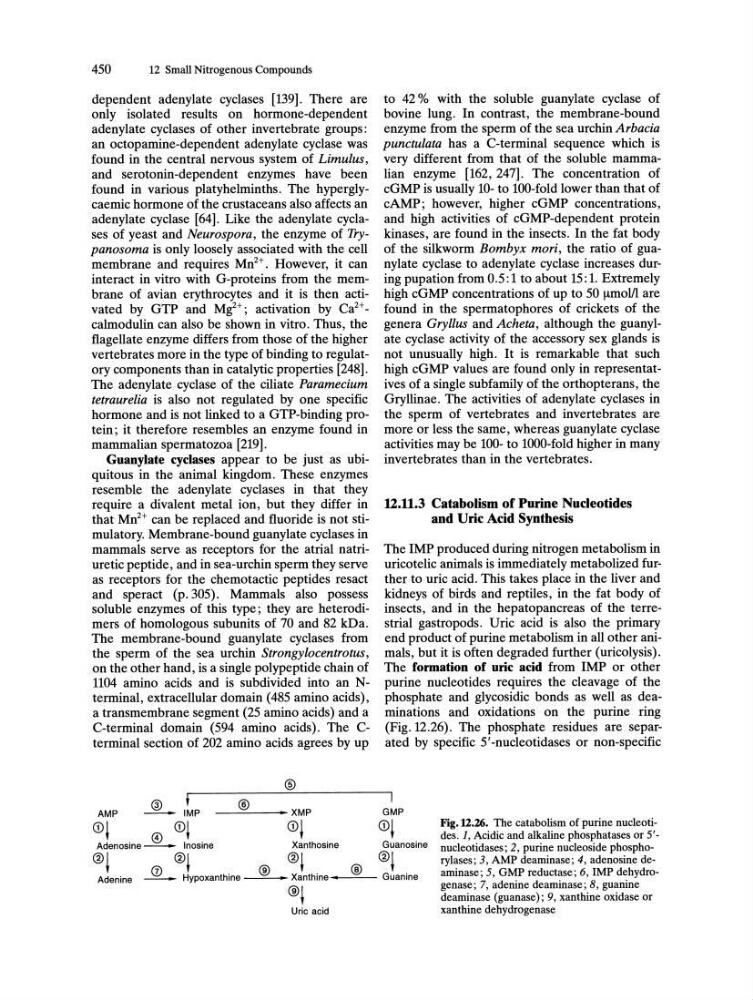
The formation of uric acid from IMP or other
purine nucleotides requires the cleavage of the
phosphate and glycosidic bonds as well as deaminations and oxidations on the purine ring
(Fig. 12.26). The phosphate residues are separated by specific 5' -nucleotidases or non-specific
GMP
G).
Guanosine
@t
®
®
• Xanthine •
(J)
h'
Adenine -
Hypoxant me --=-_----'-- Guanine
Fig.12.26. The catabolism of purine nucleotides. 1, Acidic and alkaline phosphatases or 5'nucleotidases; 2, purine nucleoside phosphorylases; 3, AMP deaminase; 4, adenosine deaminase; 5, GMP reductase; 6, IMP dehydrogenase; 7, adenine deaminase; 8, guanine
deaminase (guanase); 9, xanthine oxidase or
xanthine dehydrogenase
®.
Uric acid