

2.5.2 The Histone Genes
31
Length:
Order:
~ ~
~
~
~
Various sea urchins
Drosophila melanogaster
Salmo gairdneri
Notophthalmus viridescens
Xenopus borealis
6.3-7.2
5.0
10.2
9.0
8.5
H1-H4-H28-H3-H2A
~
~
~
~
~
H3-H4-H2A-H28-H1
~
~
~
~
~
H4-H28-H1-H2A-H3
~ ~
~
~
~
H1-H3-H28-H2A-H4
~
~
~
~ ~
H4-H2A-H28-H1-H3
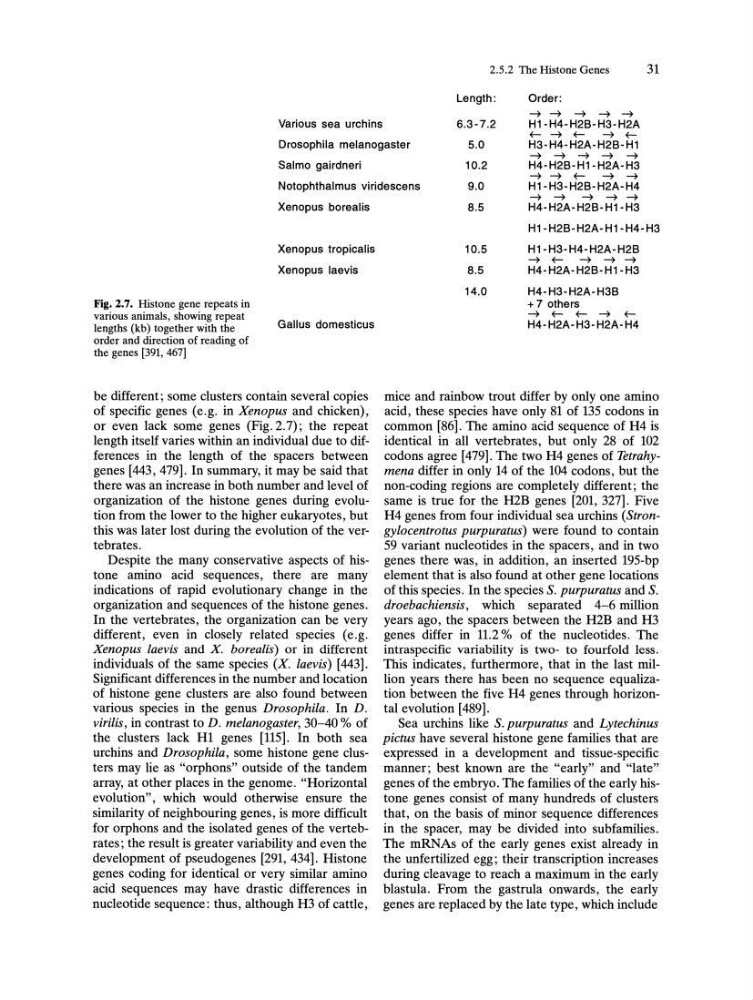
Fig. 2.7. Histone gene repeats in
various animals, showing repeat
lengths (kb) together with the
order and direction of reading of
the genes [391, 467]
Xenopus tropicalis
Xenopus laevis
Gallus domesticus
be different; some clusters contain several copies
of specific genes (e.g. in Xenopus and chicken),
or even lack some genes (Fig. 2.7); the repeat
length itself varies within an individual due to differences in the length of the spacers between
genes [443, 479]. In summary, it may be said that
there was an increase in both number and level of
organization of the histone genes during evolution from the lower to the higher eukaryotes, but
this was later lost during the evolution of the vertebrates.
Despite the many conservative aspects of histone amino acid sequences, there are many
indications of rapid evolutionary change in the
organization and sequences of the histone genes.
In the vertebrates, the organization can be very
different, even in closely related species (e.g.
Xenopus laevis and X. borealis) or in different
individuals of the same species (X. laevis) [443].
Significant differences in the number and location
of histone gene clusters are also found between
various species in the genus Drosophila. In D.
virilis, in contrast to D. melanogaster, 30-40 % of
the clusters lack HI genes [115]. In both sea
urchins and Drosophila, some histone gene clusters may lie as "orphons" outside of the tandem
array, at other places in the genome. "Horizontal
evolution", which would otherwise ensure the
similarity of neighbouring genes, is more difficult
for orphons and the isolated genes of the vertebrates; the result is greater variability and even the
development of pseudogenes [291,434]. Histone
genes coding for identical or very similar amino
acid sequences may have drastic differences in
nucleotide sequence: thus, although H3 of cattle,
H1-H28-H2A-H1-H4-H3
10.5
H1-H3-H4-H2A-H28
~
~
~
~ ~
8.5
H4-H2A-H28-H1-H3
14.0
H4-H3-H2A-H38
+ 7 others
~
~
~
~
~
H4-H2A-H3-H2A-H4
mice and rainbow trout differ by only one amino
acid, these species have only 81 of 135 codons in
common [86]. The amino acid sequence of H4 is
identical in all vertebrates, but only 28 of 102
co dons agree [479]. The two H4 genes of Tetrahymena differ in only 14 of the 104 codons, but the
non-coding regions are completely different; the
same is true for the H2B genes [201, 327]. Five
H4 genes from four individual sea urchins (Strongylocentrotus purpuratus) were found to contain
59 variant nucleotides in the spacers, and in two
genes there was, in addition, an inserted 195-bp
element that is also found at other gene locations
of this species. In the species S. purpuratus and S.
droebachiensis, which separated 4-6 million
years ago, the spacers between the H2B and H3
genes differ in 11.2 % of the nucleotides. The
intraspecific variability is two- to fourfold less.
This indicates, furthermore, that in the last million years there has been no sequence equalization between the five H4 genes through horizontal evolution [489].
Sea urchins like S. purpuratus and Lytechinus
pictus have several histone gene families that are
expressed in a development and tissue-specific
manner; best known are the "early" and "late"
genes of the embryo. The families of the early histone genes consist of many hundreds of clusters
that, on the basis of minor sequence differences
in the spacer, may be divided into subfamilies.
The mRNAs of the early genes exist already in
the unfertilized egg; their transcription increases
during cleavage to reach a maximum in the early
blastula. From the gastrula onwards, the early
genes are replaced by the late type, which include
31
Length:
Order:
~ ~
~
~
~
Various sea urchins
Drosophila melanogaster
Salmo gairdneri
Notophthalmus viridescens
Xenopus borealis
6.3-7.2
5.0
10.2
9.0
8.5
H1-H4-H28-H3-H2A
~
~
~
~
~
H3-H4-H2A-H28-H1
~
~
~
~
~
H4-H28-H1-H2A-H3
~ ~
~
~
~
H1-H3-H28-H2A-H4
~
~
~
~ ~
H4-H2A-H28-H1-H3
Fig. 2.7. Histone gene repeats in
various animals, showing repeat
lengths (kb) together with the
order and direction of reading of
the genes [391, 467]
Xenopus tropicalis
Xenopus laevis
Gallus domesticus
be different; some clusters contain several copies
of specific genes (e.g. in Xenopus and chicken),
or even lack some genes (Fig. 2.7); the repeat
length itself varies within an individual due to differences in the length of the spacers between
genes [443, 479]. In summary, it may be said that
there was an increase in both number and level of
organization of the histone genes during evolution from the lower to the higher eukaryotes, but
this was later lost during the evolution of the vertebrates.
Despite the many conservative aspects of histone amino acid sequences, there are many
indications of rapid evolutionary change in the
organization and sequences of the histone genes.
In the vertebrates, the organization can be very
different, even in closely related species (e.g.
Xenopus laevis and X. borealis) or in different
individuals of the same species (X. laevis) [443].
Significant differences in the number and location
of histone gene clusters are also found between
various species in the genus Drosophila. In D.
virilis, in contrast to D. melanogaster, 30-40 % of
the clusters lack HI genes [115]. In both sea
urchins and Drosophila, some histone gene clusters may lie as "orphons" outside of the tandem
array, at other places in the genome. "Horizontal
evolution", which would otherwise ensure the
similarity of neighbouring genes, is more difficult
for orphons and the isolated genes of the vertebrates; the result is greater variability and even the
development of pseudogenes [291,434]. Histone
genes coding for identical or very similar amino
acid sequences may have drastic differences in
nucleotide sequence: thus, although H3 of cattle,
H1-H28-H2A-H1-H4-H3
10.5
H1-H3-H4-H2A-H28
~
~
~
~ ~
8.5
H4-H2A-H28-H1-H3
14.0
H4-H3-H2A-H38
+ 7 others
~
~
~
~
~
H4-H2A-H3-H2A-H4
mice and rainbow trout differ by only one amino
acid, these species have only 81 of 135 codons in
common [86]. The amino acid sequence of H4 is
identical in all vertebrates, but only 28 of 102
co dons agree [479]. The two H4 genes of Tetrahymena differ in only 14 of the 104 codons, but the
non-coding regions are completely different; the
same is true for the H2B genes [201, 327]. Five
H4 genes from four individual sea urchins (Strongylocentrotus purpuratus) were found to contain
59 variant nucleotides in the spacers, and in two
genes there was, in addition, an inserted 195-bp
element that is also found at other gene locations
of this species. In the species S. purpuratus and S.
droebachiensis, which separated 4-6 million
years ago, the spacers between the H2B and H3
genes differ in 11.2 % of the nucleotides. The
intraspecific variability is two- to fourfold less.
This indicates, furthermore, that in the last million years there has been no sequence equalization between the five H4 genes through horizontal evolution [489].
Sea urchins like S. purpuratus and Lytechinus
pictus have several histone gene families that are
expressed in a development and tissue-specific
manner; best known are the "early" and "late"
genes of the embryo. The families of the early histone genes consist of many hundreds of clusters
that, on the basis of minor sequence differences
in the spacer, may be divided into subfamilies.
The mRNAs of the early genes exist already in
the unfertilized egg; their transcription increases
during cleavage to reach a maximum in the early
blastula. From the gastrula onwards, the early
genes are replaced by the late type, which include