

precursor of sclerotizing substances. This switch
in tyrosine metabolism is controlled by the hormone ecdysone. The peptide hormone bursicon is
also involved in the triggering of the sclerotization process in the adult animal [128].
12.6.1 ScIerotizing Substances
The sclerotization of the cuticula after each moult
requires large reserves of aromatic amino acids in
the larva. There are, however, limits to the solubility of these amino acids, and thus phenylalanine and tyrosine are converted to more soluble
compounds for storage in the haemolymph or in
the tissues. At the same time, they are protected
from attack by oxidases and other enzymes, and
cause less disturbance to osmoregulation and the
transport of amino acids through the plasma
membrane. The Lepidoptera and the Mediterranean fruit fly Ceratitis capitata produce tyrosineO-~-glucoside which is tenfold more soluble in
water than the free amino acid. Most Drosophila
species store tyrosine-O-phosphate but D. busckii
accumulates tyrosine-~-glucoside [128, 192].
The aromatic amino acids can also be stored in
the form of dipeptides or polypeptides. In the larvae of the blowfly Sarcophage bullata, 70-90 %
of the non-protein-bound tyrosine is in the form
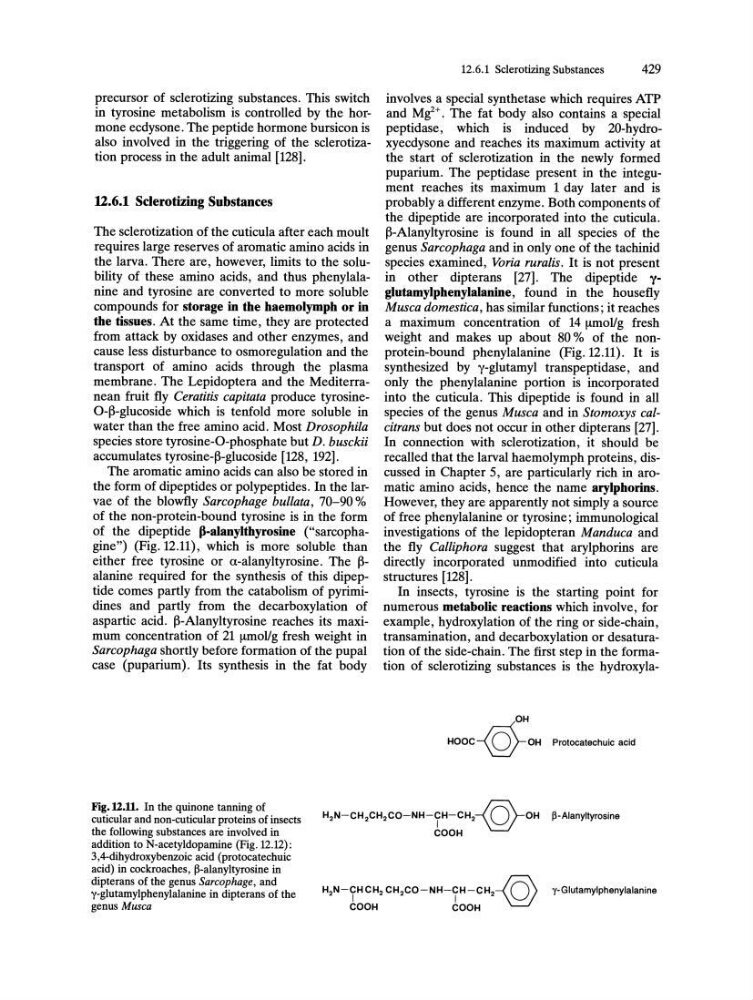
of the dipeptide ~-a1anylthyrosine ("sarcophagine") (Fig. 12.11), which is more soluble than
either free tyrosine or a-alanyltyrosine. The ~alanine required for the synthesis of this dipeptide comes partly from the catabolism of pyrimidines and partly from the decarboxylation of
aspartic acid. ~-Alanyltyrosine reaches its maximum concentration of 21 f,lmol/g fresh weight in
Sarcophaga shortly before formation of the pupal
case (puparium). Its synthesis in the fat body
12.6.1 Sc1erotizing Substances
429
involves a special synthetase which requires ATP
and Mg2+. The fat body also contains a special
peptidase, which is induced by 20-hydroxyecdysone and reaches its maximum activity at
the start of sclerotization in the newly formed
puparium. The peptidase present in the integument reaches its maximum 1 day later and is
probably a different enzyme. Both components of
the dipeptide are incorporated into the cuticula.
~-Alanyltyrosine is found in all species of the
genus Sarcophaga and in only one of the tachinid
species examined, Voria ruralis. It is not present
in other dipterans [27]. The dipeptide yglutamylphenylalanine, found in the housefly
Musca domestica, has similar functions; it reaches
a maximum concentration of 14 f,lmol/g fresh
weight and makes up about 80 % of the nonprotein-bound phenylalanine (Fig. 12.11). It is
synthesized by y-glutamyl transpeptidase, and
only the phenylalanine portion is incorporated
into the cuticula. This dipeptide is found in all
species of the genus Musca and in Stomoxys calcitrans but does not occur in other dipterans [27].
In connection with sclerotization, it should be
recalled that the larval haemolymph proteins, discussed in Chapter 5, are particularly rich in aromatic amino acids, hence the name arylphorins.
However, they are apparently not simply a source
of free phenylalanine or tyrosine; immunological
investigations of the lepidopteran Manduca and
the fly Calliphora suggest that arylphorins are
directly incorporated unmodified into cuticula
structures [128].
In insects, tyrosine is the starting point for
numerous metabolic reactions which involve, for
example, hydroxylation of the ring or side-chain,
transamination, and decarboxylation or desaturation of the side-chain. The first step in the formation of sclerotizing substances is the hydroxylaOH
HOOC~OH Protocatechuic acid
Fig.12.n. In the quinone tanning of
cuticular and non-cuticular proteins of insects
the following substances are involved in
addition to N-acetyldopamine (Fig. 12.12):
3,4-dihydroxybenzoic acid (protocatechuic
acid) in cockroaches, ~-alanyltyrosine in
dipterans of the genus Sarcophage, and
y-glutamylphenylalanine in dipterans of the
genus Musca
H2N-CH2CH2CO-NH-yH-CH2-@-OH ~-Alanyltyrosine
COOH
in tyrosine metabolism is controlled by the hormone ecdysone. The peptide hormone bursicon is
also involved in the triggering of the sclerotization process in the adult animal [128].
12.6.1 ScIerotizing Substances
The sclerotization of the cuticula after each moult
requires large reserves of aromatic amino acids in
the larva. There are, however, limits to the solubility of these amino acids, and thus phenylalanine and tyrosine are converted to more soluble
compounds for storage in the haemolymph or in
the tissues. At the same time, they are protected
from attack by oxidases and other enzymes, and
cause less disturbance to osmoregulation and the
transport of amino acids through the plasma
membrane. The Lepidoptera and the Mediterranean fruit fly Ceratitis capitata produce tyrosineO-~-glucoside which is tenfold more soluble in
water than the free amino acid. Most Drosophila
species store tyrosine-O-phosphate but D. busckii
accumulates tyrosine-~-glucoside [128, 192].
The aromatic amino acids can also be stored in
the form of dipeptides or polypeptides. In the larvae of the blowfly Sarcophage bullata, 70-90 %
of the non-protein-bound tyrosine is in the form
of the dipeptide ~-a1anylthyrosine ("sarcophagine") (Fig. 12.11), which is more soluble than
either free tyrosine or a-alanyltyrosine. The ~alanine required for the synthesis of this dipeptide comes partly from the catabolism of pyrimidines and partly from the decarboxylation of
aspartic acid. ~-Alanyltyrosine reaches its maximum concentration of 21 f,lmol/g fresh weight in
Sarcophaga shortly before formation of the pupal
case (puparium). Its synthesis in the fat body
12.6.1 Sc1erotizing Substances
429
involves a special synthetase which requires ATP
and Mg2+. The fat body also contains a special
peptidase, which is induced by 20-hydroxyecdysone and reaches its maximum activity at
the start of sclerotization in the newly formed
puparium. The peptidase present in the integument reaches its maximum 1 day later and is
probably a different enzyme. Both components of
the dipeptide are incorporated into the cuticula.
~-Alanyltyrosine is found in all species of the
genus Sarcophaga and in only one of the tachinid
species examined, Voria ruralis. It is not present
in other dipterans [27]. The dipeptide yglutamylphenylalanine, found in the housefly
Musca domestica, has similar functions; it reaches
a maximum concentration of 14 f,lmol/g fresh
weight and makes up about 80 % of the nonprotein-bound phenylalanine (Fig. 12.11). It is
synthesized by y-glutamyl transpeptidase, and
only the phenylalanine portion is incorporated
into the cuticula. This dipeptide is found in all
species of the genus Musca and in Stomoxys calcitrans but does not occur in other dipterans [27].
In connection with sclerotization, it should be
recalled that the larval haemolymph proteins, discussed in Chapter 5, are particularly rich in aromatic amino acids, hence the name arylphorins.
However, they are apparently not simply a source
of free phenylalanine or tyrosine; immunological
investigations of the lepidopteran Manduca and
the fly Calliphora suggest that arylphorins are
directly incorporated unmodified into cuticula
structures [128].
In insects, tyrosine is the starting point for
numerous metabolic reactions which involve, for
example, hydroxylation of the ring or side-chain,
transamination, and decarboxylation or desaturation of the side-chain. The first step in the formation of sclerotizing substances is the hydroxylaOH
HOOC~OH Protocatechuic acid
Fig.12.n. In the quinone tanning of
cuticular and non-cuticular proteins of insects
the following substances are involved in
addition to N-acetyldopamine (Fig. 12.12):
3,4-dihydroxybenzoic acid (protocatechuic
acid) in cockroaches, ~-alanyltyrosine in
dipterans of the genus Sarcophage, and
y-glutamylphenylalanine in dipterans of the
genus Musca
H2N-CH2CH2CO-NH-yH-CH2-@-OH ~-Alanyltyrosine
COOH