

Tryptamine
S-Hydroxytryptophan
S-Hydroxytryptamine
(Serotonin)
S-Hydroxyindole acetic acid
Indoleacetic acid
t
Indolepyruvic acid
Indolelactic acid
/
Tryptophan
N-Formylkynurenine
Kynurenine
3-Hydroxykynurenine
3-Hydroxyanthranilic acid
3-carboxymuconic acid
semialdehyde
2-Aminomuconic acid
semialdehyde
t
2-Aminomuconic acid
~
Glutaryl-CoA
l
12.5.4 Tryptophan
425
H"
/COOH
C-CH=CH-C=C
~
cP
I
"NH
COOH
2
COOH
HOOC-CH=CH-CH=C/
\NH2
~
VN.JCOOH
Kynurenic acid
~COOH
~NH2
Anthranilic acid
~
YN~COOH
OH
Xanthurenic acid
Ommochrome
~COOH
(.~ "N COOH
Quinolinic acid
ribosyl-Sphosphate
Acetoacetyl-CoA
CH 3-CO-CH 2 -CO- Co A
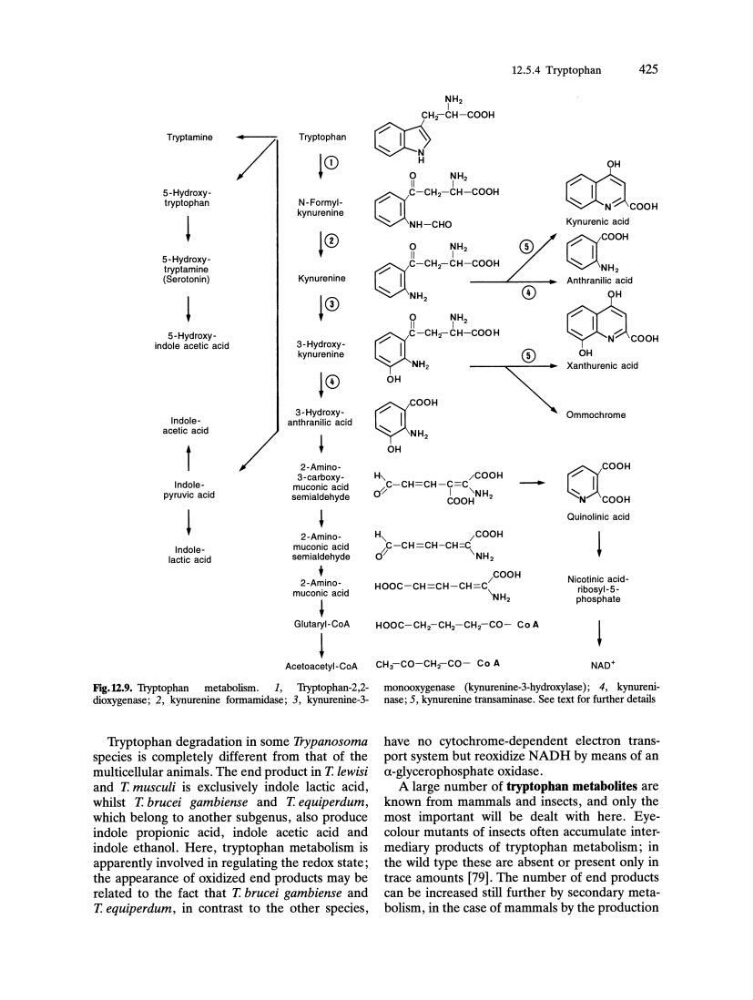
Fig.12.9. Tryptophan metabolism. 1, Tryptophan-2,2dioxygenase; 2, kynurenine fonnamidase; 3, kynurenine-3Tryptophan degradation in some Trypanosoma
species is completely different from that of the
multicellular animals. The end product in T. lewisi
and T. musculi is exclusively indole lactic acid,
whilst T. brucei gambiense and T. equiperdum,
which belong to another subgenus, also produce
indole propionic acid, indole acetic acid and
indole ethanol. Here, tryptophan metabolism is
apparently involved in regulating the redox state;
the appearance of oxidized end products may be
related to the fact that T. brucei gambiense and
T. equiperdum, in contrast to the other species,
monooxygenase (kynurenine-3-hydroxylase); 4, kynureninase; 5, kynurenine transaminase. See text for further details
have no cytochrome-dependent electron transport system but reoxidize NADH by means of an
a-glycerophosphate oxidase.
A large number of tryptophan metabolites are
known from mammals and insects, and only the
most important will be dealt with here. Eyecolour mutants of insects often accumulate intermediary products of tryptophan metabolism; in
the wild type these are absent or present only in
trace amounts [79]. The number of end products
can be increased still further by secondary metabolism, in the case of mammals by the production
S-Hydroxytryptophan
S-Hydroxytryptamine
(Serotonin)
S-Hydroxyindole acetic acid
Indoleacetic acid
t
Indolepyruvic acid
Indolelactic acid
/
Tryptophan
N-Formylkynurenine
Kynurenine
3-Hydroxykynurenine
3-Hydroxyanthranilic acid
3-carboxymuconic acid
semialdehyde
2-Aminomuconic acid
semialdehyde
t
2-Aminomuconic acid
~
Glutaryl-CoA
l
12.5.4 Tryptophan
425
H"
/COOH
C-CH=CH-C=C
~
cP
I
"NH
COOH
2
COOH
HOOC-CH=CH-CH=C/
\NH2
~
VN.JCOOH
Kynurenic acid
~COOH
~NH2
Anthranilic acid
~
YN~COOH
OH
Xanthurenic acid
Ommochrome
~COOH
(.~ "N COOH
Quinolinic acid
ribosyl-Sphosphate
Acetoacetyl-CoA
CH 3-CO-CH 2 -CO- Co A
Fig.12.9. Tryptophan metabolism. 1, Tryptophan-2,2dioxygenase; 2, kynurenine fonnamidase; 3, kynurenine-3Tryptophan degradation in some Trypanosoma
species is completely different from that of the
multicellular animals. The end product in T. lewisi
and T. musculi is exclusively indole lactic acid,
whilst T. brucei gambiense and T. equiperdum,
which belong to another subgenus, also produce
indole propionic acid, indole acetic acid and
indole ethanol. Here, tryptophan metabolism is
apparently involved in regulating the redox state;
the appearance of oxidized end products may be
related to the fact that T. brucei gambiense and
T. equiperdum, in contrast to the other species,
monooxygenase (kynurenine-3-hydroxylase); 4, kynureninase; 5, kynurenine transaminase. See text for further details
have no cytochrome-dependent electron transport system but reoxidize NADH by means of an
a-glycerophosphate oxidase.
A large number of tryptophan metabolites are
known from mammals and insects, and only the
most important will be dealt with here. Eyecolour mutants of insects often accumulate intermediary products of tryptophan metabolism; in
the wild type these are absent or present only in
trace amounts [79]. The number of end products
can be increased still further by secondary metabolism, in the case of mammals by the production