

414
12 Small Nitrogenous Compounds
I Keto acids I I Amino acids I
?H2-COOH
'>-- L
HOOC-C=O
----,
AMINOTRANSFERASE
Oxalacetate
I
Aspartate
I
H.y~~ GTZ" ':;.<., •
CH 2 -COOH
I
HOOC-CH
I
I
I
I
NH
~)l..N
ADENYLOSUCCINATER I .b
SYNTHETASE
I .P
m N I
Rib.P
IMP
Adenylosuccinate
AMP
DEAMINASE
ADENYLOSUCCINATE-I
LYASE
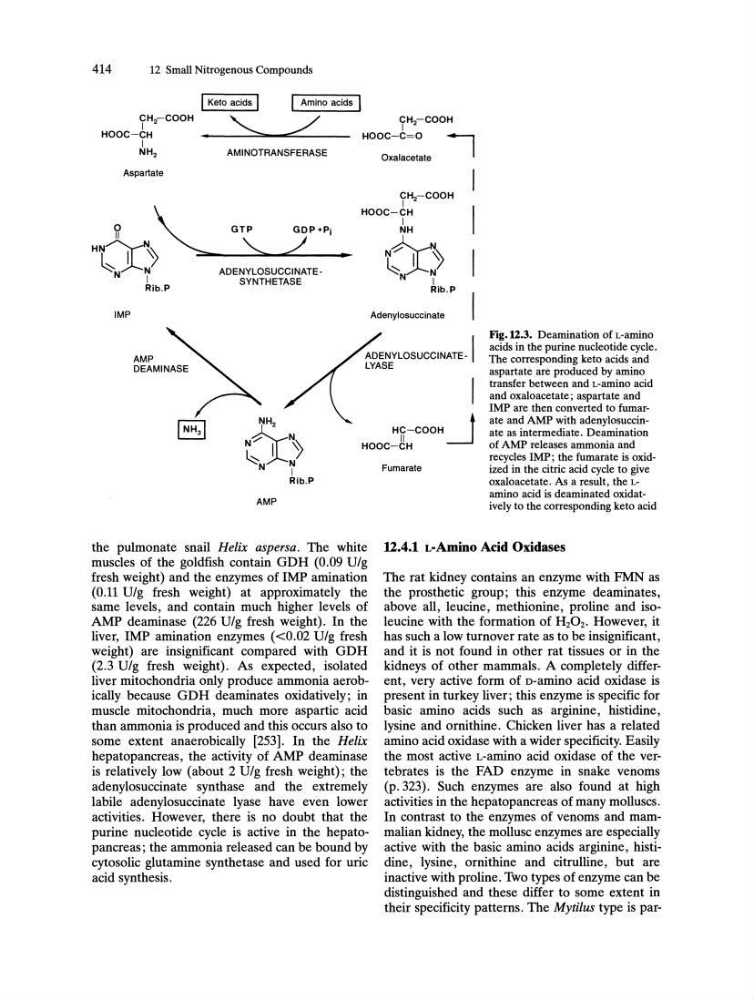
Fig.12.3. Deamination of L-amino
acids in the purine nucleotide cycle.
The corresponding keto acids and
aspartate are produced by amino
transfer between and L-amino acid
and oxaloacetate; aspartate and
IMP are then converted to fumarate and AMP with adenylosuccinate as intermediate. Deamination
of AMP releases ammonia and
recycles IMP; the fumarate is oxidized in the citric acid cycle to give
oxaloacetate. As a result, the Lamino acid is deaminated oxidatively to the corresponding keto acid
NH2
(iN~
HC-COOH
t
II
.-J
HOOC-CH
N
N
I
Rib.P
AMP
the pulmonate snail Helix aspersa. The white
muscles of the goldfish contain GDH (0.09 U/g
fresh weight) and the enzymes of IMP amination
(0.11 U/g fresh weight) at approximately the
same levels, and contain much higher levels of
AMP deaminase (226 U/g fresh weight). In the
liver, IMP amination enzymes «0.02 U/g fresh
weight) are insignificant compared with GDH
(2.3 U/g fresh weight). As expected, isolated
liver mitochondria only produce ammonia aerobically because GDH deaminates oxidatively; in
muscle mitochondria, much more aspartic acid
than ammonia is produced and this occurs also to
some extent anaerobically [253]. In the Helix
hepatopancreas, the activity of AMP deaminase
is relatively low (about 2 U/g fresh weight); the
adenylosuccinate synthase and the extremely
labile adenylosuccinate lyase have even lower
activities. However, there is no doubt that the
purine nucleotide cycle is active in the hepatopancreas; the ammonia released can be bound by
cytosolic glutamine synthetase and used for uric
acid synthesis.
Fumarate
12.4.1 L-Amino Acid Oxidases
The rat kidney contains an enzyme with FMN as
the prosthetic group; this enzyme deaminates,
above all, leucine, methionine, proline and isoleucine with the formation of H20 2 • However, it
has such a low turnover rate as to be insignificant,
and it is not found in other rat tissues or in the
kidneys of other mammals. A completely different, very active form of D-amino acid oxidase is
present in turkey liver; this enzyme is specific for
basic amino acids such as arginine, histidine,
lysine and ornithine. Chicken liver has a related
amino acid oxidase with a wider specificity. Easily
the most active L-amino acid oxidase of the vertebrates is the FAD enzyme in snake venoms
(p.323). Such enzymes are also found at high
activities in the hepatopancreas of many molluscs.
In contrast to the enzymes of venoms and mammalian kidney, the mollusc enzymes are especially
active with the basic amino acids arginine, histidine, lysine, ornithine and citrulline, but are
inactive with proline. Two types of enzyme can be
distinguished and these differ to some extent in
their specificity patterns. The Mytilus type is par-
12 Small Nitrogenous Compounds
I Keto acids I I Amino acids I
?H2-COOH
'>-- L
HOOC-C=O
----,
AMINOTRANSFERASE
Oxalacetate
I
Aspartate
I
H.y~~ GTZ" ':;.<., •
CH 2 -COOH
I
HOOC-CH
I
I
I
I
NH
~)l..N
ADENYLOSUCCINATER I .b
SYNTHETASE
I .P
m N I
Rib.P
IMP
Adenylosuccinate
AMP
DEAMINASE
ADENYLOSUCCINATE-I
LYASE
Fig.12.3. Deamination of L-amino
acids in the purine nucleotide cycle.
The corresponding keto acids and
aspartate are produced by amino
transfer between and L-amino acid
and oxaloacetate; aspartate and
IMP are then converted to fumarate and AMP with adenylosuccinate as intermediate. Deamination
of AMP releases ammonia and
recycles IMP; the fumarate is oxidized in the citric acid cycle to give
oxaloacetate. As a result, the Lamino acid is deaminated oxidatively to the corresponding keto acid
NH2
(iN~
HC-COOH
t
II
.-J
HOOC-CH
N
N
I
Rib.P
AMP
the pulmonate snail Helix aspersa. The white
muscles of the goldfish contain GDH (0.09 U/g
fresh weight) and the enzymes of IMP amination
(0.11 U/g fresh weight) at approximately the
same levels, and contain much higher levels of
AMP deaminase (226 U/g fresh weight). In the
liver, IMP amination enzymes «0.02 U/g fresh
weight) are insignificant compared with GDH
(2.3 U/g fresh weight). As expected, isolated
liver mitochondria only produce ammonia aerobically because GDH deaminates oxidatively; in
muscle mitochondria, much more aspartic acid
than ammonia is produced and this occurs also to
some extent anaerobically [253]. In the Helix
hepatopancreas, the activity of AMP deaminase
is relatively low (about 2 U/g fresh weight); the
adenylosuccinate synthase and the extremely
labile adenylosuccinate lyase have even lower
activities. However, there is no doubt that the
purine nucleotide cycle is active in the hepatopancreas; the ammonia released can be bound by
cytosolic glutamine synthetase and used for uric
acid synthesis.
Fumarate
12.4.1 L-Amino Acid Oxidases
The rat kidney contains an enzyme with FMN as
the prosthetic group; this enzyme deaminates,
above all, leucine, methionine, proline and isoleucine with the formation of H20 2 • However, it
has such a low turnover rate as to be insignificant,
and it is not found in other rat tissues or in the
kidneys of other mammals. A completely different, very active form of D-amino acid oxidase is
present in turkey liver; this enzyme is specific for
basic amino acids such as arginine, histidine,
lysine and ornithine. Chicken liver has a related
amino acid oxidase with a wider specificity. Easily
the most active L-amino acid oxidase of the vertebrates is the FAD enzyme in snake venoms
(p.323). Such enzymes are also found at high
activities in the hepatopancreas of many molluscs.
In contrast to the enzymes of venoms and mammalian kidney, the mollusc enzymes are especially
active with the basic amino acids arginine, histidine, lysine, ornithine and citrulline, but are
inactive with proline. Two types of enzyme can be
distinguished and these differ to some extent in
their specificity patterns. The Mytilus type is par-