

410
12 Small Nitrogenous Compounds
[74]. Compounds structurally related to the essential amino acids (amino acid antagonists) inhibit
metabolism of the natural forms and produce
effects very similar to those of amino acid deficiency. In many cases, they are also used for protein synthesis and dysfunctional proteins are produced. Amongst the amino acid antagonists are
natural compounds such as canavanine, produced
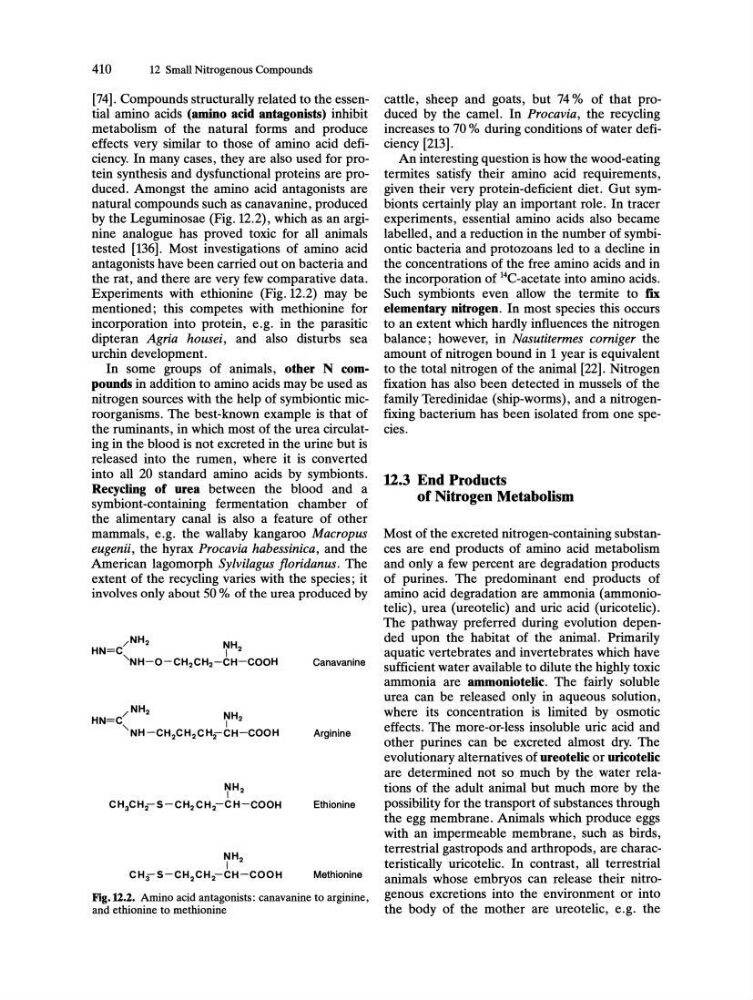
by the Leguminosae (Fig. 12.2), which as an arginine analogue has proved toxic for all animals
tested [136]. Most investigations of amino acid
antagonists have been carried out on bacteria and
the rat, and there are very few comparative data.
Experiments with ethionine (Fig. 12.2) may be
mentioned; this competes with methionine for
incorporation into protein, e.g. in the parasitic
dipteran Agria housei, and also disturbs sea
urchin development.
In some groups of animals, other N compounds in addition to amino acids may be used as
nitrogen sources with the help of symbiontic microorganisms. The best-known example is that of
the ruminants, in which most of the urea circulating in the blood is not excreted in the urine but is
released into the rumen, where it is converted
into all 20 standard amino acids by symbionts.
Recycling of urea between the blood and a
symbiont-containing fermentation chamber of
the alimentary canal is also a feature of other
mammals, e.g. the wallaby kangaroo Macropus
eugenii, the hyrax Procavia habessinica, and the
American lagomorph Sy/vilagus floridanus. The
extent of the recycling varies with the species; it
involves only about 50 % of the urea produced by
/NH2
NH
HN=C
I 2
'NH-O-CH 2 CH2 -CH-COOH
Canavanine
Arginine
Ethionine
Methionine
Fig.12.2. Amino acid antagonists: canavanine to arginine,
and ethionine to methionine
cattle, sheep and goats, but 74 % of that produced by the camel. In Procavia, the recycling
increases to 70 % during conditions of water deficiency [213].
An interesting question is how the wood-eating
termites satisfy their amino acid requirements,
given their very protein-deficient diet. Gut symbionts certainly play an important role. In tracer
experiments, essential amino acids also became
labelled, and a reduction in the number of symbiontic bacteria and protozoans led to a decline in
the concentrations of the free amino acids and in
the incorporation of 14C-acetate into amino acids.
Such symbionts even allow the termite to fix
elementary nitrogen. In most species this occurs
to an extent which hardly influences the nitrogen
balance; however, in Nasutitermes corniger the
amount of nitrogen bound in 1 year is equivalent
to the total nitrogen of the animal [22]. Nitrogen
fixation has also been detected in mussels of the
family Teredinidae (ship-worms), and a nitrogenfixing bacterium has been isolated from one species.
12.3 End Products
of Nitrogen Metabolism
Most of the excreted nitrogen-containing substances are end products of amino acid metabolism
and only a few percent are degradation products
of purines. The predominant end products of
amino acid degradation are ammonia (ammoniotelic), urea (ureotelic) and uric acid (uricotelic).
The pathway preferred during evolution depended upon the habitat of the animal. Primarily
aquatic vertebrates and invertebrates which have
sufficient water available to dilute the highly toxic
ammonia are ammoniotelic. The fairly soluble
urea can be released only in aqueous solution,
where its concentration is limited by osmotic
effects. The more-or-Iess insoluble uric acid and
other purines can be excreted almost dry. The
evolutionary alternatives of ureotelic or uricotelic
are determined not so much by the water relations of the adult animal but much more by the
possibility for the transport of substances through
the egg membrane. Animals which produce eggs
with an impermeable membrane, such as birds,
terrestrial gastropods and arthropods, are characteristically uricotelic. In contrast, all terrestrial
animals whose embryos can release their nitrogenous excretions into the environment or into
the body of the mother are ureotelic, e.g. the
12 Small Nitrogenous Compounds
[74]. Compounds structurally related to the essential amino acids (amino acid antagonists) inhibit
metabolism of the natural forms and produce
effects very similar to those of amino acid deficiency. In many cases, they are also used for protein synthesis and dysfunctional proteins are produced. Amongst the amino acid antagonists are
natural compounds such as canavanine, produced
by the Leguminosae (Fig. 12.2), which as an arginine analogue has proved toxic for all animals
tested [136]. Most investigations of amino acid
antagonists have been carried out on bacteria and
the rat, and there are very few comparative data.
Experiments with ethionine (Fig. 12.2) may be
mentioned; this competes with methionine for
incorporation into protein, e.g. in the parasitic
dipteran Agria housei, and also disturbs sea
urchin development.
In some groups of animals, other N compounds in addition to amino acids may be used as
nitrogen sources with the help of symbiontic microorganisms. The best-known example is that of
the ruminants, in which most of the urea circulating in the blood is not excreted in the urine but is
released into the rumen, where it is converted
into all 20 standard amino acids by symbionts.
Recycling of urea between the blood and a
symbiont-containing fermentation chamber of
the alimentary canal is also a feature of other
mammals, e.g. the wallaby kangaroo Macropus
eugenii, the hyrax Procavia habessinica, and the
American lagomorph Sy/vilagus floridanus. The
extent of the recycling varies with the species; it
involves only about 50 % of the urea produced by
/NH2
NH
HN=C
I 2
'NH-O-CH 2 CH2 -CH-COOH
Canavanine
Arginine
Ethionine
Methionine
Fig.12.2. Amino acid antagonists: canavanine to arginine,
and ethionine to methionine
cattle, sheep and goats, but 74 % of that produced by the camel. In Procavia, the recycling
increases to 70 % during conditions of water deficiency [213].
An interesting question is how the wood-eating
termites satisfy their amino acid requirements,
given their very protein-deficient diet. Gut symbionts certainly play an important role. In tracer
experiments, essential amino acids also became
labelled, and a reduction in the number of symbiontic bacteria and protozoans led to a decline in
the concentrations of the free amino acids and in
the incorporation of 14C-acetate into amino acids.
Such symbionts even allow the termite to fix
elementary nitrogen. In most species this occurs
to an extent which hardly influences the nitrogen
balance; however, in Nasutitermes corniger the
amount of nitrogen bound in 1 year is equivalent
to the total nitrogen of the animal [22]. Nitrogen
fixation has also been detected in mussels of the
family Teredinidae (ship-worms), and a nitrogenfixing bacterium has been isolated from one species.
12.3 End Products
of Nitrogen Metabolism
Most of the excreted nitrogen-containing substances are end products of amino acid metabolism
and only a few percent are degradation products
of purines. The predominant end products of
amino acid degradation are ammonia (ammoniotelic), urea (ureotelic) and uric acid (uricotelic).
The pathway preferred during evolution depended upon the habitat of the animal. Primarily
aquatic vertebrates and invertebrates which have
sufficient water available to dilute the highly toxic
ammonia are ammoniotelic. The fairly soluble
urea can be released only in aqueous solution,
where its concentration is limited by osmotic
effects. The more-or-Iess insoluble uric acid and
other purines can be excreted almost dry. The
evolutionary alternatives of ureotelic or uricotelic
are determined not so much by the water relations of the adult animal but much more by the
possibility for the transport of substances through
the egg membrane. Animals which produce eggs
with an impermeable membrane, such as birds,
terrestrial gastropods and arthropods, are characteristically uricotelic. In contrast, all terrestrial
animals whose embryos can release their nitrogenous excretions into the environment or into
the body of the mother are ureotelic, e.g. the