

404
12 Small Nitrogenous Compounds
rogenous substances contains "rare" amino
acids which, despite the name, in fact occur
quite often. They include protein-associated
amino acids which were chemically altered posttranslationally and released by proteolysis, in
particular methyl, hydroxyl and halogen derivatives. There are, however, rare amino acids which
are never protein bound. Some of the latter arise
during normal metabolism in animal cells and
are, therefore, more-or-Iess ubiquitous, e.g.
ornithine, which is a product of arginine cleavage by arginase, and B-amino-isobutyric acid and
B-alanine, which are degradation products of
pyrimidine bases (Fig. 12.29); other such amino
acids are formed in subsidiary pathways of metabolism. As higher plants are particularly rich in
the products of secondary metabolism, it is often
the case that unusual amino acids found in herbivores originate from nutrients. One example of
this is the first report of its kind from the animal
kingdom of S-methylcysteine in the caterpillar of
the moth Prodenia eridania. It was later found
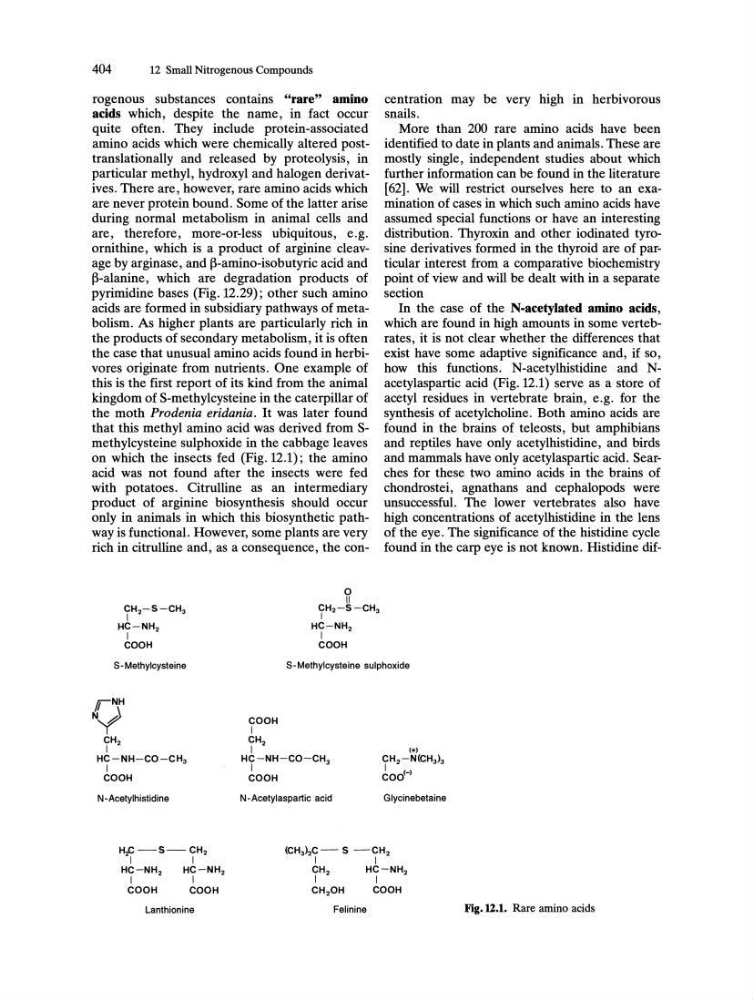
that this methyl amino acid was derived from Smethylcysteine sulphoxide in the cabbage leaves
on which the insects fed (Fig. 12.1); the amino
acid was not found after the insects were fed
with potatoes. Citrulline as an intermediary
product of arginine biosynthesis should occur
only in animals in which this biosynthetic pathway is functional. However, some plants are very
rich in citrulline and, as a consequence, the cono
II
CH2-S-CH
I
3
HC-NH2
I
COOH
centration may be very high in herbivorous
snails.
More than 200 rare amino acids have been
identified to date in plants and animals. These are
mostly single, independent studies about which
further information can be found in the literature
[62]. We will restrict ourselves here to an examination of cases in which such amino acids have
assumed special functions or have an interesting
distribution. Thyroxin and other iodinated tyrosine derivatives formed in the thyroid are of particular interest from a comparative biochemistry
point of view and will be dealt with in a separate
section
In the case of the N-acetylated amino acids,
which are found in high amounts in some vertebrates, it is not clear whether the differences that
exist have some adaptive significance and, if so,
how this functions. N-acetylhistidine and Nacetylaspartic acid (Fig. 12.1) serve as a store of
acetyl residues in vertebrate brain, e.g. for the
synthesis of acetylcholine. Both amino acids are
found in the brains of teleosts, but amphibians
and reptiles have only acetylhistidine, and birds
and mammals have only acetylaspartic acid. Searches for these two amino acids in the brains of
chondrostei, agnathans and cephalopods were
unsuccessful. The lower vertebrates also have
high concentrations of acetylhistidine in the lens
of the eye. The significance of the histidine cycle
found in the carp eye is not known. Histidine difS-Methylcysteine
S - Methylcysteine sulphoxide
pNH
N~
CH2
I
HC-NH-CO-CH3
I
COOH
N-Acetylhistidine
H 2 C-S-CH2
I
I
HC-NH 2
HC-NH2
I
I
COOH
COOH
Lanthionine
COOH
I
CH 2
I
HC-NH-CO-CH
I
3
COOH
N - Acetylaspartic acid
Glycinebetaine
(CH3>2C- S -CH 2
I
I
CH 2
HC-NH2
I
I
CH 2 0H
COOH
Felinine
Fig.12.1. Rare amino acids
12 Small Nitrogenous Compounds
rogenous substances contains "rare" amino
acids which, despite the name, in fact occur
quite often. They include protein-associated
amino acids which were chemically altered posttranslationally and released by proteolysis, in
particular methyl, hydroxyl and halogen derivatives. There are, however, rare amino acids which
are never protein bound. Some of the latter arise
during normal metabolism in animal cells and
are, therefore, more-or-Iess ubiquitous, e.g.
ornithine, which is a product of arginine cleavage by arginase, and B-amino-isobutyric acid and
B-alanine, which are degradation products of
pyrimidine bases (Fig. 12.29); other such amino
acids are formed in subsidiary pathways of metabolism. As higher plants are particularly rich in
the products of secondary metabolism, it is often
the case that unusual amino acids found in herbivores originate from nutrients. One example of
this is the first report of its kind from the animal
kingdom of S-methylcysteine in the caterpillar of
the moth Prodenia eridania. It was later found
that this methyl amino acid was derived from Smethylcysteine sulphoxide in the cabbage leaves
on which the insects fed (Fig. 12.1); the amino
acid was not found after the insects were fed
with potatoes. Citrulline as an intermediary
product of arginine biosynthesis should occur
only in animals in which this biosynthetic pathway is functional. However, some plants are very
rich in citrulline and, as a consequence, the cono
II
CH2-S-CH
I
3
HC-NH2
I
COOH
centration may be very high in herbivorous
snails.
More than 200 rare amino acids have been
identified to date in plants and animals. These are
mostly single, independent studies about which
further information can be found in the literature
[62]. We will restrict ourselves here to an examination of cases in which such amino acids have
assumed special functions or have an interesting
distribution. Thyroxin and other iodinated tyrosine derivatives formed in the thyroid are of particular interest from a comparative biochemistry
point of view and will be dealt with in a separate
section
In the case of the N-acetylated amino acids,
which are found in high amounts in some vertebrates, it is not clear whether the differences that
exist have some adaptive significance and, if so,
how this functions. N-acetylhistidine and Nacetylaspartic acid (Fig. 12.1) serve as a store of
acetyl residues in vertebrate brain, e.g. for the
synthesis of acetylcholine. Both amino acids are
found in the brains of teleosts, but amphibians
and reptiles have only acetylhistidine, and birds
and mammals have only acetylaspartic acid. Searches for these two amino acids in the brains of
chondrostei, agnathans and cephalopods were
unsuccessful. The lower vertebrates also have
high concentrations of acetylhistidine in the lens
of the eye. The significance of the histidine cycle
found in the carp eye is not known. Histidine difS-Methylcysteine
S - Methylcysteine sulphoxide
pNH
N~
CH2
I
HC-NH-CO-CH3
I
COOH
N-Acetylhistidine
H 2 C-S-CH2
I
I
HC-NH 2
HC-NH2
I
I
COOH
COOH
Lanthionine
COOH
I
CH 2
I
HC-NH-CO-CH
I
3
COOH
N - Acetylaspartic acid
Glycinebetaine
(CH3>2C- S -CH 2
I
I
CH 2
HC-NH2
I
I
CH 2 0H
COOH
Felinine
Fig.12.1. Rare amino acids