

26
2 Nucleic Acids and Nuclear Proteins
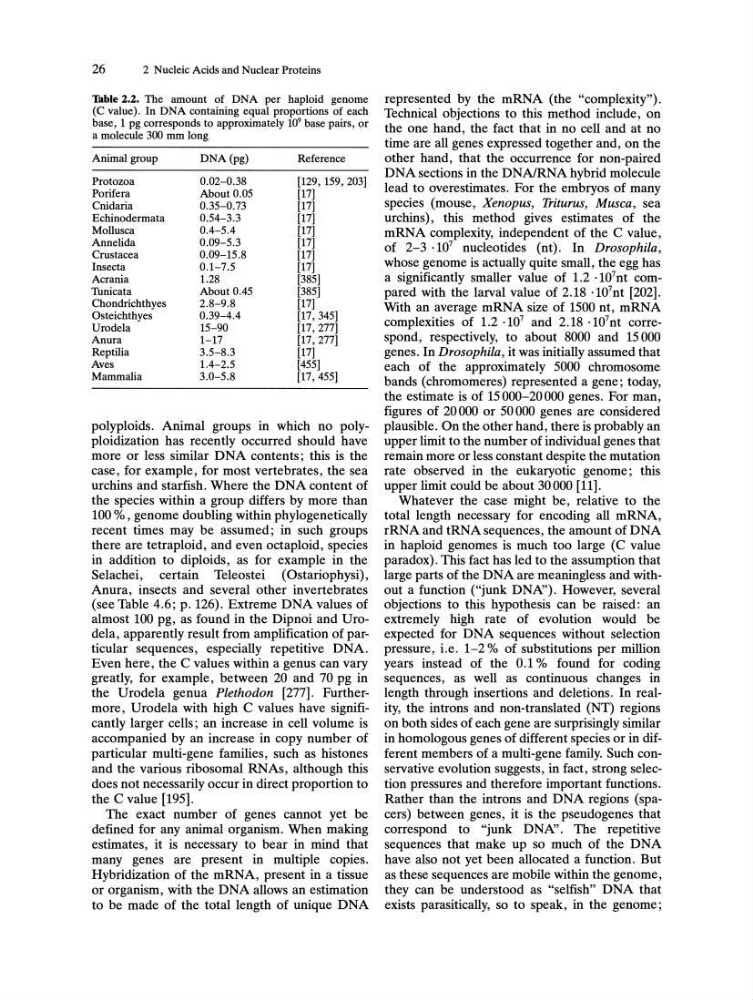
Table 2.2. The amount of DNA per haploid genome
(C value). In DNA containing equal proportions of each
base, 1 pg corresponds to approximately 10 9 base pairs, or
a molecule 300 mm long
Animal group
DNA (pg)
Reference
Protozoa
0.02-0.38
[129, 159, 203]
Porifera
About 0.05
[17]
Cnidaria
0.35-0.73
[17]
Echinodermata
0.54-3.3
[17]
Mollusca
0.4-5.4
[17]
Annelida
0.09-5.3
[17]
Crustacea
0.09-15.8
[17]
Insecta
0.1-7.5
[17]
Acrania
1.28
[385]
Thnicata
About 0.45
[385]
Chondrichthyes
2.8-9.8
[17]
Osteichthyes
0.39-4.4
[17,345]
Urodela
15-90
[17,277]
Anura
1-17
[17,277]
Reptilia
3.5-8.3
[17]
Aves
1.4-2.5
[455]
Mammalia
3.0-5.8
[17,455]
polyploids. Animal groups in which no polyploidization has recently occurred should have
more or less similar DNA contents; this is the
case, for example, for most vertebrates, the sea
urchins and starfish. Where the DNA content of
the species within a group differs by more than
100 % , genome doubling within phylogenetically
recent times may be assumed; in such groups
there are tetraploid, and even octaploid, species
in addition to diploids, as for example in the
Selachei, certain Teleostei (Ostariophysi),
Anura, insects and several other invertebrates
(see Table 4.6; p. 126). Extreme DNA values of
almost 100 pg, as found in the Dipnoi and Urodela, apparently result from amplification of particular sequences, especially repetitive DNA.
Even here, the C values within a genus can vary
greatly, for example, between 20 and 70 pg in
the Urodela genua Plethodon [277]. Furthermore, Urodela with high C values have significantly larger cells; an increase in cell volume is
accompanied by an increase in copy number of
particular multi-gene families, such as histones
and the various ribosomal RNAs, although this
does not necessarily occur in direct proportion to
the C value [195].
The exact number of genes cannot yet be
defined for any animal organism. When making
estimates, it is necessary to bear in mind that
many genes are present in multiple copies.
Hybridization of the mRNA, present in a tissue
or organism, with the DNA allows an estimation
to be made of the total length of unique DNA
represented by the mRNA (the "complexity").
Technical objections to this method include, on
the one hand, the fact that in no cell and at no
time are all genes expressed together and, on the
other hand, that the occurrence for non-paired
DNA sections in the DNA/RNA hybrid molecule
lead to overestimates. For the embryos of many
species (mouse, Xenopus, Triturus, Musca, sea
urchins), this method gives estimates of the
mRNA complexity, independent of the C value,
of 2-3 .10 7 nucleotides (nt). In Drosophila,
whose genome is actually quite small, the egg has
a significantly smaller value of 1.2 .10 7 nt compared with the larval value of 2.18 .10 7 nt [202].
With an average mRNA size of 1500 nt, mRNA
complexities of 1.2 .10 7 and 2.18 .10 7 nt correspond, respectively, to about 8000 and 15 000
genes. In Drosophila, it was initially assumed that
each of the approximately 5000 chromosome
bands (chromomeres) represented a gene; today,
the estimate is of 15000-20000 genes. For man,
figures of 20000 or 50000 genes are considered
plausible. On the other hand, there is probably an
upper limit to the number of individual genes that
remain more or less constant despite the mutation
rate observed in the eukaryotic genome; this
upper limit could be about 30000 [11].
Whatever the case might be, relative to the
total length necessary for encoding all mRNA,
rRNA and tRNA sequences, the amount of DNA
in haploid genomes is much too large (C value
paradox). This fact has led to the assumption that
large parts of the DNA are meaningless and without a function ("junk DNA"). However, several
objections to this hypothesis can be raised: an
extremely high rate of evolution would be
expected for DNA sequences without selection
pressure, i.e. 1-2 % of substitutions per million
years instead of the 0.1 % found for coding
sequences, as well as continuous changes in
length through insertions and deletions. In reality, the introns and non-translated (NT) regions
on both sides of each gene are surprisingly similar
in homologous genes of different species or in different members of a mUlti-gene family. Such conservative evolution suggests, in fact, strong selection pressures and therefore important functions.
Rather than the introns and DNA regions (spacers) between genes, it is the pseudogenes that
correspond to "junk DNA". The repetitive
sequences that make up so much of the DNA
have also not yet been allocated a function. But
as these sequences are mobile within the genome,
they can be understood as "selfish" DNA that
exists parasitically, so to speak, in the genome;
2 Nucleic Acids and Nuclear Proteins
Table 2.2. The amount of DNA per haploid genome
(C value). In DNA containing equal proportions of each
base, 1 pg corresponds to approximately 10 9 base pairs, or
a molecule 300 mm long
Animal group
DNA (pg)
Reference
Protozoa
0.02-0.38
[129, 159, 203]
Porifera
About 0.05
[17]
Cnidaria
0.35-0.73
[17]
Echinodermata
0.54-3.3
[17]
Mollusca
0.4-5.4
[17]
Annelida
0.09-5.3
[17]
Crustacea
0.09-15.8
[17]
Insecta
0.1-7.5
[17]
Acrania
1.28
[385]
Thnicata
About 0.45
[385]
Chondrichthyes
2.8-9.8
[17]
Osteichthyes
0.39-4.4
[17,345]
Urodela
15-90
[17,277]
Anura
1-17
[17,277]
Reptilia
3.5-8.3
[17]
Aves
1.4-2.5
[455]
Mammalia
3.0-5.8
[17,455]
polyploids. Animal groups in which no polyploidization has recently occurred should have
more or less similar DNA contents; this is the
case, for example, for most vertebrates, the sea
urchins and starfish. Where the DNA content of
the species within a group differs by more than
100 % , genome doubling within phylogenetically
recent times may be assumed; in such groups
there are tetraploid, and even octaploid, species
in addition to diploids, as for example in the
Selachei, certain Teleostei (Ostariophysi),
Anura, insects and several other invertebrates
(see Table 4.6; p. 126). Extreme DNA values of
almost 100 pg, as found in the Dipnoi and Urodela, apparently result from amplification of particular sequences, especially repetitive DNA.
Even here, the C values within a genus can vary
greatly, for example, between 20 and 70 pg in
the Urodela genua Plethodon [277]. Furthermore, Urodela with high C values have significantly larger cells; an increase in cell volume is
accompanied by an increase in copy number of
particular multi-gene families, such as histones
and the various ribosomal RNAs, although this
does not necessarily occur in direct proportion to
the C value [195].
The exact number of genes cannot yet be
defined for any animal organism. When making
estimates, it is necessary to bear in mind that
many genes are present in multiple copies.
Hybridization of the mRNA, present in a tissue
or organism, with the DNA allows an estimation
to be made of the total length of unique DNA
represented by the mRNA (the "complexity").
Technical objections to this method include, on
the one hand, the fact that in no cell and at no
time are all genes expressed together and, on the
other hand, that the occurrence for non-paired
DNA sections in the DNA/RNA hybrid molecule
lead to overestimates. For the embryos of many
species (mouse, Xenopus, Triturus, Musca, sea
urchins), this method gives estimates of the
mRNA complexity, independent of the C value,
of 2-3 .10 7 nucleotides (nt). In Drosophila,
whose genome is actually quite small, the egg has
a significantly smaller value of 1.2 .10 7 nt compared with the larval value of 2.18 .10 7 nt [202].
With an average mRNA size of 1500 nt, mRNA
complexities of 1.2 .10 7 and 2.18 .10 7 nt correspond, respectively, to about 8000 and 15 000
genes. In Drosophila, it was initially assumed that
each of the approximately 5000 chromosome
bands (chromomeres) represented a gene; today,
the estimate is of 15000-20000 genes. For man,
figures of 20000 or 50000 genes are considered
plausible. On the other hand, there is probably an
upper limit to the number of individual genes that
remain more or less constant despite the mutation
rate observed in the eukaryotic genome; this
upper limit could be about 30000 [11].
Whatever the case might be, relative to the
total length necessary for encoding all mRNA,
rRNA and tRNA sequences, the amount of DNA
in haploid genomes is much too large (C value
paradox). This fact has led to the assumption that
large parts of the DNA are meaningless and without a function ("junk DNA"). However, several
objections to this hypothesis can be raised: an
extremely high rate of evolution would be
expected for DNA sequences without selection
pressure, i.e. 1-2 % of substitutions per million
years instead of the 0.1 % found for coding
sequences, as well as continuous changes in
length through insertions and deletions. In reality, the introns and non-translated (NT) regions
on both sides of each gene are surprisingly similar
in homologous genes of different species or in different members of a mUlti-gene family. Such conservative evolution suggests, in fact, strong selection pressures and therefore important functions.
Rather than the introns and DNA regions (spacers) between genes, it is the pseudogenes that
correspond to "junk DNA". The repetitive
sequences that make up so much of the DNA
have also not yet been allocated a function. But
as these sequences are mobile within the genome,
they can be understood as "selfish" DNA that
exists parasitically, so to speak, in the genome;