

390
11 Extracellular Structural and Secretory Proteins
the N-terminal region [6]. All the phosphorylation sites have similar sequences, with several
serines followed by two glutamic acid residues.
Compared with the a caseins, the ~ caseins have
a lower phosphate content and are precipitated at
much higher Ca 2 + concentrations; the x caseins
are calcium insensitive. The caseins are clotted by
chymosin in young animals or by pepsin in the
adult; x casein is cleaved into an N-terminal fragment, para-x-casein, and the casein macropeptide. Many caseins are glycosylated, and x casein
is especially carbohydrate rich. The a casein of
the rat is one of the few glycoproteins to have glucose as the sugar component.
As for many other proteins, extensive sequence
comparisons amongst the caseins became possible
only with the availability of DNA sequence analysis, e.g. of the cDNAs or genes of human,
bovine, sheep and murine caseins as well as of
those of the rat, guinea-pig and rabbit [2, 12,
27,48,52, 59, 76, 143]. The milk from most ofthe
mammal species investigated contains the known
bovine casein types, although they may have
received other names before the sequence data
became available. The caseins may also show differences from the bovine spectrum. For example,
human and other primate caseins lack type as. In
the rat there is an a casein that is homologous to
bovine asl but which includes a unique insert of
60 amino acids that is composed of 10 amino acid
repeats. The rat also possesses a so-called y casein,
which apparently belongs to the a-casein group
but has only limited sequence similarity to bovine
asl [59]. Mouse milk contains no fewer than eight
different calcium-sensitive caseins, three of which
are known as a" two as~, and one each as y, () and
E; the E casein is similar to bovine asl [52, 143].
The genes of the four bovine casein types are
arranged in the genome in a 200-kb-Iong cluster
[128]. Of particular interest is the synchronous
regulation of their expression by the concerted
action of steroid and peptide hormones; this
occurs at the level of both transcription and translation. In fact, all casein genes of the rat and
bovine asl have a very similar organization in the
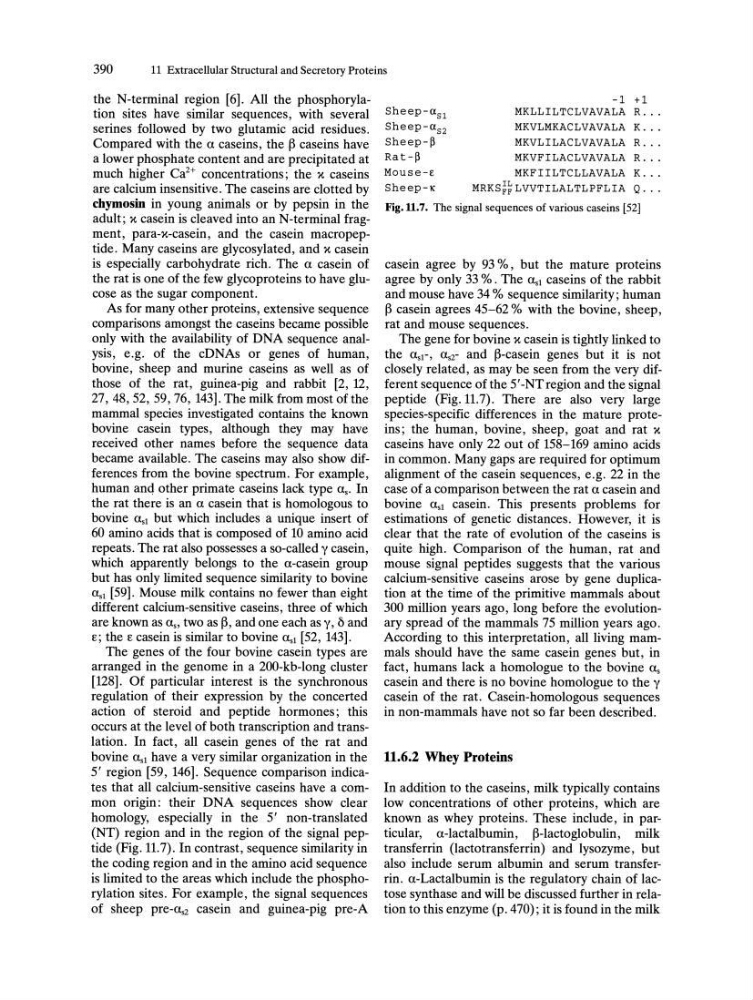
5' region [59, 146]. Sequence comparison indicates that all calcium-sensitive caseins have a common origin: their DNA sequences show clear
homology, especially in the 5' non-translated
(NT) region and in the region of the signal peptide (Fig. 11.7). In contrast, sequence similarity in
the coding region and in the amino acid sequence
is limited to the areas which include the phosphorylation sites. For example, the signal sequences
of sheep pre-as2 casein and guinea-pig pre-A
-1 +1
Sheep-a Sl
MKLLILTCLVAVALA R ...
Sheep-a S2
MKVLMKACLVAVALA K ...
Sheep-~
MKVLILACLVAVALA R ...
Rat-~
MKVFILACLVAVALA R ...
Mouse-I::
MKFIILTCLLAVALA K ...
Sheep-K
MRKS~~LVVTILALTLPFLIA Q ••.
Fig.ll.7. The signal sequences of various caseins [52]
casein agree by 93 %, but the mature proteins
agree by only 33 %. The asl caseins of the rabbit
and mouse have 34 % sequence similarity; human
~ casein agrees 45-62 % with the bovine, sheep,
rat and mouse sequences.
The gene for bovine x casein is tightly linked to
the asi-, a s2- and ~-casein genes but it is not
closely related, as may be seen from the very different sequence of the 5' -NT region and the signal
peptide (Fig. 11.7). There are also very large
species-specific differences in the mature proteins; the human, bovine, sheep, goat and rat x
caseins have only 22 out of 158-169 amino acids
in common. Many gaps are required for optimum
alignment of the casein sequences, e.g. 22 in the
case of a comparison between the rat a casein and
bovine asl casein. This presents problems for
estimations of genetic distances. However, it is
clear that the rate of evolution of the caseins is
quite high. Comparison of the human, rat and
mouse signal peptides suggests that the various
calcium-sensitive caseins arose by gene duplication at the time of the primitive mammals about
300 million years ago, long before the evolutionary spread of the mammals 75 million years ago.
According to this interpretation, all living mammals should have the same casein genes but, in
fact, humans lack a homologue to the bovine as
casein and there is no bovine homologue to the y
casein of the rat. Casein-homologous sequences
in non-mammals have not so far been described.
11.6.2 Whey Proteins
In addition to the caseins, milk typically contains
low concentrations of other proteins, which are
known as whey proteins. These include, in particular, a-lactalbumin, ~-lactoglobulin, milk
transferrin (lactotransferrin) and lysozyme, but
also include serum albumin and serum transferrin. a-Lactalbumin is the regulatory chain of lactose synthase and will be discussed further in relation to this enzyme (p. 470); it is found in the milk
11 Extracellular Structural and Secretory Proteins
the N-terminal region [6]. All the phosphorylation sites have similar sequences, with several
serines followed by two glutamic acid residues.
Compared with the a caseins, the ~ caseins have
a lower phosphate content and are precipitated at
much higher Ca 2 + concentrations; the x caseins
are calcium insensitive. The caseins are clotted by
chymosin in young animals or by pepsin in the
adult; x casein is cleaved into an N-terminal fragment, para-x-casein, and the casein macropeptide. Many caseins are glycosylated, and x casein
is especially carbohydrate rich. The a casein of
the rat is one of the few glycoproteins to have glucose as the sugar component.
As for many other proteins, extensive sequence
comparisons amongst the caseins became possible
only with the availability of DNA sequence analysis, e.g. of the cDNAs or genes of human,
bovine, sheep and murine caseins as well as of
those of the rat, guinea-pig and rabbit [2, 12,
27,48,52, 59, 76, 143]. The milk from most ofthe
mammal species investigated contains the known
bovine casein types, although they may have
received other names before the sequence data
became available. The caseins may also show differences from the bovine spectrum. For example,
human and other primate caseins lack type as. In
the rat there is an a casein that is homologous to
bovine asl but which includes a unique insert of
60 amino acids that is composed of 10 amino acid
repeats. The rat also possesses a so-called y casein,
which apparently belongs to the a-casein group
but has only limited sequence similarity to bovine
asl [59]. Mouse milk contains no fewer than eight
different calcium-sensitive caseins, three of which
are known as a" two as~, and one each as y, () and
E; the E casein is similar to bovine asl [52, 143].
The genes of the four bovine casein types are
arranged in the genome in a 200-kb-Iong cluster
[128]. Of particular interest is the synchronous
regulation of their expression by the concerted
action of steroid and peptide hormones; this
occurs at the level of both transcription and translation. In fact, all casein genes of the rat and
bovine asl have a very similar organization in the
5' region [59, 146]. Sequence comparison indicates that all calcium-sensitive caseins have a common origin: their DNA sequences show clear
homology, especially in the 5' non-translated
(NT) region and in the region of the signal peptide (Fig. 11.7). In contrast, sequence similarity in
the coding region and in the amino acid sequence
is limited to the areas which include the phosphorylation sites. For example, the signal sequences
of sheep pre-as2 casein and guinea-pig pre-A
-1 +1
Sheep-a Sl
MKLLILTCLVAVALA R ...
Sheep-a S2
MKVLMKACLVAVALA K ...
Sheep-~
MKVLILACLVAVALA R ...
Rat-~
MKVFILACLVAVALA R ...
Mouse-I::
MKFIILTCLLAVALA K ...
Sheep-K
MRKS~~LVVTILALTLPFLIA Q ••.
Fig.ll.7. The signal sequences of various caseins [52]
casein agree by 93 %, but the mature proteins
agree by only 33 %. The asl caseins of the rabbit
and mouse have 34 % sequence similarity; human
~ casein agrees 45-62 % with the bovine, sheep,
rat and mouse sequences.
The gene for bovine x casein is tightly linked to
the asi-, a s2- and ~-casein genes but it is not
closely related, as may be seen from the very different sequence of the 5' -NT region and the signal
peptide (Fig. 11.7). There are also very large
species-specific differences in the mature proteins; the human, bovine, sheep, goat and rat x
caseins have only 22 out of 158-169 amino acids
in common. Many gaps are required for optimum
alignment of the casein sequences, e.g. 22 in the
case of a comparison between the rat a casein and
bovine asl casein. This presents problems for
estimations of genetic distances. However, it is
clear that the rate of evolution of the caseins is
quite high. Comparison of the human, rat and
mouse signal peptides suggests that the various
calcium-sensitive caseins arose by gene duplication at the time of the primitive mammals about
300 million years ago, long before the evolutionary spread of the mammals 75 million years ago.
According to this interpretation, all living mammals should have the same casein genes but, in
fact, humans lack a homologue to the bovine as
casein and there is no bovine homologue to the y
casein of the rat. Casein-homologous sequences
in non-mammals have not so far been described.
11.6.2 Whey Proteins
In addition to the caseins, milk typically contains
low concentrations of other proteins, which are
known as whey proteins. These include, in particular, a-lactalbumin, ~-lactoglobulin, milk
transferrin (lactotransferrin) and lysozyme, but
also include serum albumin and serum transferrin. a-Lactalbumin is the regulatory chain of lactose synthase and will be discussed further in relation to this enzyme (p. 470); it is found in the milk