

tains collagen molecules which, like the corresponding vertebrate collagens, are linked headto-head by disulphide bridges [150].
The cuticle of the nematode Caenorhabditis
elegans is a multi-layered extracellular structure
consisting mainly of collagen. It is replaced after
each of the post-embryonal ecdyses, changing
each time in its ultrastructure and protein composition. Many collagen components of 30 to
more than 210 kDa may be extracted from the
cuticle following reduction. The pattern is specific
for each ecdysis stage and includes at least 18 different chains in the adult cuticle; all have the typical amino acid composition of collagens but varying peptic digest patterns, i.e. they are the products of different genes. In vitro translation of collagen mRNAs in fact yields more than 30 different peptides. Caenorhabditis elegans possesses at
least 50, perhaps even 150, collagen genes which
encode relatively small polypeptides of
310-460 amino acids. The nine sequenced col
genes for fibrillar collagens contain only one or
two introns, i.e. they do not fit the 54-bp hypothesis. All encode 30-kDa polypeptides with five
domains: an N-terminal non-helical domain of
about 100 amino acids; two triple-helical domains
of 30-33 and 127-132 amino acids, separated by
a non-helical spacer; and a C-terminal nonhelical domain. The longer triple-helix sequences
include one to three short interruptions. This
domain structure is somewhat similar to that of
vertebrate collagen IX [23]. The neighbouring
genes col-12 and col-13 differ in only 5 out of
951 bp and encode the same amino acid
sequence. Col-13 mRNA, however, bears a transspliced leader, and col-12 a cis-spliced leader. As
illustrated in Chapter 2, about 10 % of all Caenorhabditis elegans mRNAs are trans-spliced
[95]. In addition to the genes for fibrillar collagens, two genes (clb-l and clb-2) for basementmembrane collagens have been sequenced. As
in the mammals, the nematode basementmembrane collagen is a heterotrimer. The
encoded polypeptides have distinct sequence
similarity in the C-terminal non-helical domain to
the NCl domains of mammalian a(IV) chains,
e.g. clb-lIa2(IV) 72 % and clb-2/al(IV) 63 %.
The gene duplication al(IV)/a2(IV) thus apparently occurred early in the evolution of the Metazoa. The existence of only a single homotrimeric
basement-membrane collagen in Drosophila
stems probably from the loss of one of the two
genes [46].
11.3 Matrix Proteins of Calcifying Tissues
385
11.3 Matrix Proteins of Calcifying Tissues
The organic matrix plays an important, if not
always obvious, role in the growth of crystals in
mineralizing tissues. It is apparently organized
quite similarly in vertebrates and invertebrates,
with the main components being collagens and
specific acidic phosphoproteins and polysaccharides; phospholipids may also be involved in calcification [57]. In addition to the acidic proteins,
there may also be a network of relatively nonpolar proteins that has mainly a mechanical function. The bones of all vertebrates, from the teleosts to the mammals, have a complex spectrum of
phosphoproteins with molecular masses between
4-5 and over 100 kDa; these contain not only
phospho serine and phosphothreonine but also
glutamic and aspartic acid. The largest also contain hydroxyproline and hydroxylysine and may
therefore be associated with collagens [44]. The
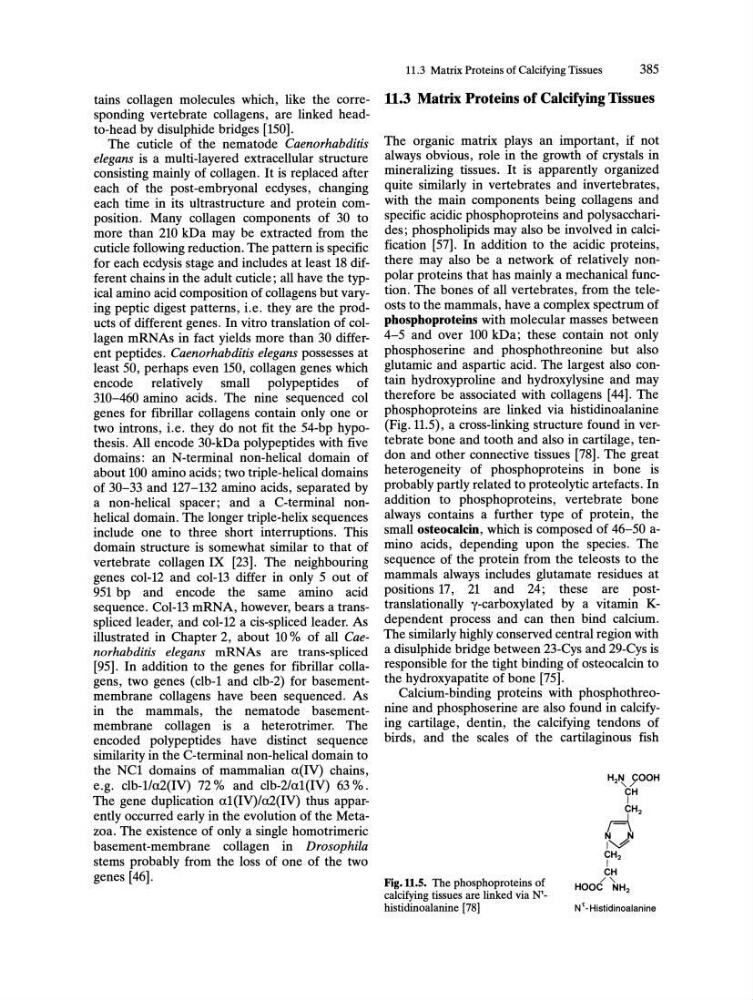
phosphoproteins are linked via histidinoalanine
(Fig. 11.5), a cross-linking structure found in vertebrate bone and tooth and also in cartilage, tendon and other connective tissues [78]. The great
heterogeneity of phosphoproteins in bone is
probably partly related to proteolytic artefacts. In
addition to phosphoproteins, vertebrate bone
always contains a further type of protein, the
small osteocalcin, which is composed of 46-50 amino acids, depending upon the species. The
sequence of the protein from the teleosts to the
mammals always includes glutamate residues at
positions 17, 21 and 24; these are posttranslationally y-carboxylated by a vitamin Kdependent process and can then bind calcium.
The similarly highly conserved central region with
a disulphide bridge between 23-Cys and 29-Cys is
responsible for the tight binding of osteocalcin to
the hydroxyapatite of bone [75].
Calcium-binding proteins with phosphothreonine and phosphoserine are also found in calcifying cartilage, dentin, the calcifying tendons of
birds, and the scales of the cartilaginous fish
Fig.ll.S. The phosphoproteins of
calcifying tissues are linked via N T _
histidinoalanine [78]
NT - Histidinoalanine
The cuticle of the nematode Caenorhabditis
elegans is a multi-layered extracellular structure
consisting mainly of collagen. It is replaced after
each of the post-embryonal ecdyses, changing
each time in its ultrastructure and protein composition. Many collagen components of 30 to
more than 210 kDa may be extracted from the
cuticle following reduction. The pattern is specific
for each ecdysis stage and includes at least 18 different chains in the adult cuticle; all have the typical amino acid composition of collagens but varying peptic digest patterns, i.e. they are the products of different genes. In vitro translation of collagen mRNAs in fact yields more than 30 different peptides. Caenorhabditis elegans possesses at
least 50, perhaps even 150, collagen genes which
encode relatively small polypeptides of
310-460 amino acids. The nine sequenced col
genes for fibrillar collagens contain only one or
two introns, i.e. they do not fit the 54-bp hypothesis. All encode 30-kDa polypeptides with five
domains: an N-terminal non-helical domain of
about 100 amino acids; two triple-helical domains
of 30-33 and 127-132 amino acids, separated by
a non-helical spacer; and a C-terminal nonhelical domain. The longer triple-helix sequences
include one to three short interruptions. This
domain structure is somewhat similar to that of
vertebrate collagen IX [23]. The neighbouring
genes col-12 and col-13 differ in only 5 out of
951 bp and encode the same amino acid
sequence. Col-13 mRNA, however, bears a transspliced leader, and col-12 a cis-spliced leader. As
illustrated in Chapter 2, about 10 % of all Caenorhabditis elegans mRNAs are trans-spliced
[95]. In addition to the genes for fibrillar collagens, two genes (clb-l and clb-2) for basementmembrane collagens have been sequenced. As
in the mammals, the nematode basementmembrane collagen is a heterotrimer. The
encoded polypeptides have distinct sequence
similarity in the C-terminal non-helical domain to
the NCl domains of mammalian a(IV) chains,
e.g. clb-lIa2(IV) 72 % and clb-2/al(IV) 63 %.
The gene duplication al(IV)/a2(IV) thus apparently occurred early in the evolution of the Metazoa. The existence of only a single homotrimeric
basement-membrane collagen in Drosophila
stems probably from the loss of one of the two
genes [46].
11.3 Matrix Proteins of Calcifying Tissues
385
11.3 Matrix Proteins of Calcifying Tissues
The organic matrix plays an important, if not
always obvious, role in the growth of crystals in
mineralizing tissues. It is apparently organized
quite similarly in vertebrates and invertebrates,
with the main components being collagens and
specific acidic phosphoproteins and polysaccharides; phospholipids may also be involved in calcification [57]. In addition to the acidic proteins,
there may also be a network of relatively nonpolar proteins that has mainly a mechanical function. The bones of all vertebrates, from the teleosts to the mammals, have a complex spectrum of
phosphoproteins with molecular masses between
4-5 and over 100 kDa; these contain not only
phospho serine and phosphothreonine but also
glutamic and aspartic acid. The largest also contain hydroxyproline and hydroxylysine and may
therefore be associated with collagens [44]. The
phosphoproteins are linked via histidinoalanine
(Fig. 11.5), a cross-linking structure found in vertebrate bone and tooth and also in cartilage, tendon and other connective tissues [78]. The great
heterogeneity of phosphoproteins in bone is
probably partly related to proteolytic artefacts. In
addition to phosphoproteins, vertebrate bone
always contains a further type of protein, the
small osteocalcin, which is composed of 46-50 amino acids, depending upon the species. The
sequence of the protein from the teleosts to the
mammals always includes glutamate residues at
positions 17, 21 and 24; these are posttranslationally y-carboxylated by a vitamin Kdependent process and can then bind calcium.
The similarly highly conserved central region with
a disulphide bridge between 23-Cys and 29-Cys is
responsible for the tight binding of osteocalcin to
the hydroxyapatite of bone [75].
Calcium-binding proteins with phosphothreonine and phosphoserine are also found in calcifying cartilage, dentin, the calcifying tendons of
birds, and the scales of the cartilaginous fish
Fig.ll.S. The phosphoproteins of
calcifying tissues are linked via N T _
histidinoalanine [78]
NT - Histidinoalanine