

any case not detectable. Based on its chemical
structure, agnathan cartilage cannot be considered a normal hyaline vertebrate cartilage, but
represents a further unique type of connective tissue [138].
11.2.2 Invertebrate Collagens
Collagens are not found in plants or protozoans
but are present in all metazoans from the Porifera
onwards. The extracellular matrix of invertebrate
animals, such as the annelids, molluscs and arthropods, also consists of collagens and anionic glycans. In addition to the interstitial collagens of
mesenchymal origin, the invertebrates also possess collagens of epithelial or partly ectodermal
origin in basement membranes, in the cuticle,
e.g. of the nematodes and annelids, and in secretions such as the byssus threads of the edible mussel Mytilus and the silks of insect larvae. Only a
few invertebrate collagens have been sequenced
so far and consequently very little can be said
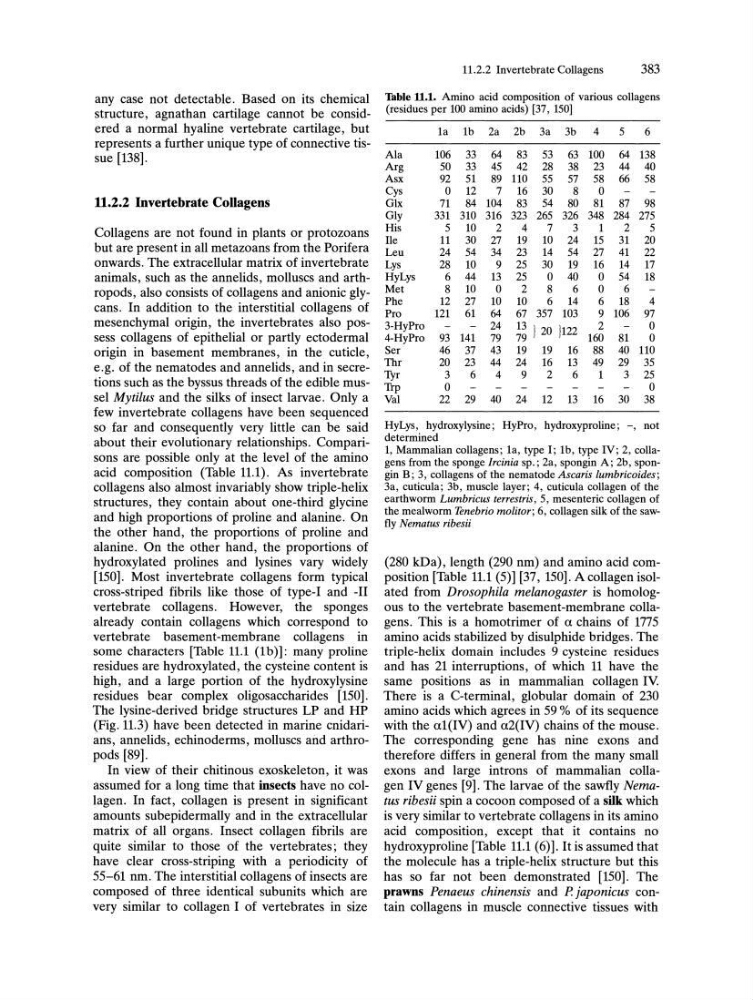
about their evolutionary relationships. Comparisons are possible only at the level of the amino
acid composition (Table 11.1). As invertebrate
collagens also almost invariably show triple-helix
structures, they contain about one-third glycine
and high proportions of proline and alanine. On
the other hand, the proportions of proline and
alanine. On the other hand, the proportions of
hydroxylated pro lines and lysines vary widely
[150]. Most invertebrate collagens form typical
cross-striped fibrils like those of type-I and -II
vertebrate collagens. However, the sponges
already contain collagens which correspond to
vertebrate basement-membrane collagens in
some characters [Table 11.1 (1 b)]: many proline
residues are hydroxylated, the cysteine content is
high, and a large portion of the hydroxylysine
residues bear complex oligosaccharides [150].
The lysine-derived bridge structures LP and HP
(Fig. 11.3) have been detected in marine cnidarians, annelids, echinoderms, molluscs and arthropods [89].
In view of their chitinous exoskeleton, it was
assumed for a long time that insects have no collagen. In fact, collagen is present in significant
amounts subepidermally and in the extracellular
matrix of all organs. Insect collagen fibrils are
quite similar to those of the vertebrates; they
have clear cross-striping with a periodicity of
55-61 nm. The interstitial collagens of insects are
composed of three identical subunits which are
very similar to collagen I of vertebrates in size
11.2.2 Invertebrate Collagens
383
Table 11.1. Amino acid composition of various collagens
(residues per 100 amino acids) [37, 150]
1a 1b 2a 2b 3a 3b
4
5
6
Ala
106 33 64 83 53 63 100 64 138
Arg
50 33 45 42 28 38 23 44 40
Asx
92 51 89 110 55 57 58 66 58
Cys
0 12
7 16 30
8
0
Glx
71 84 104 83 54 80 81 87 98
Gly
331 310 316 323 265 326 348 284 275
His
5 10
2
4
7
3
1
2
5
lIe
11 30 27 19 10 24 15 31 20
Leu
24 54 34 23 14 54 27 41 22
Lys
28 10
9 25 30 19 16 14 17
HyLys
6 44 13 25
0 40
0 54 18
Met
8 10
0
2
8
6
0
6
Phe
12 27 10 10
6 14
6 18
4
Pro
121 61 64 67 357 103
9 106 97
3-HyPro
24 13 ) 20 )122
2
0
4-HyPro 93 141 79 79
160 81
0
Ser
46 37 43 19 19 16 88 40 110
Thr
20 23 44 24 16 13 49 29 35
Tyr
3
6
4
9
2
6
1
3 25
Trp
0
0
Val
22 29 40 24 12 13 16 30 38
HyLys, hydroxylysine; HyPro, hydroxyproline; -, not
determined
1, Mammalian collagens; la, type I; Ib, type IV; 2, collagens from the sponge Ircinia sp.; 2a, spongin A; 2b, spongin B; 3, collagens of the nematode Ascaris lumbricoides;
3a, cuticula; 3b, muscle layer; 4, cuticula collagen of the
earthworm Lumbricus terrestris, 5, mesenteric collagen of
the mealworm Tenebrio molitor; 6, collagen silk of the sawfly Nematus ribesii
(280 kDa), length (290 nm) and amino acid composition [Table 11.1 (5)] [37, 150]. A collagen isolated from Drosophila melanogaster is homologous to the vertebrate basement-membrane collagens. This is a homotrimer of a chains of 1775
amino acids stabilized by disulphide bridges. The
triple-helix domain includes 9 cysteine residues
and has 21 interruptions, of which 11 have the
same positions as in mammalian collagen IV.
There is a C-terminal, globular domain of 230
amino acids which agrees in 59 % of its sequence
with the al(IV) and a2(IV) chains of the mouse.
The corresponding gene has nine exons and
therefore differs in general from the many small
exons and large introns of mammalian collagen IV genes [9]. The larvae of the sawfly Nematus ribesii spin a cocoon composed of a silk which
is very similar to vertebrate collagens in its amino
acid composition, except that it contains no
hydroxyproline [Table 11.1 (6)]. It is assumed that
the molecule has a triple-helix structure but this
has so far not been demonstrated [150]. The
prawns Penaeus chinensis and P. japonicus contain collagens in muscle connective tissues with
structure, agnathan cartilage cannot be considered a normal hyaline vertebrate cartilage, but
represents a further unique type of connective tissue [138].
11.2.2 Invertebrate Collagens
Collagens are not found in plants or protozoans
but are present in all metazoans from the Porifera
onwards. The extracellular matrix of invertebrate
animals, such as the annelids, molluscs and arthropods, also consists of collagens and anionic glycans. In addition to the interstitial collagens of
mesenchymal origin, the invertebrates also possess collagens of epithelial or partly ectodermal
origin in basement membranes, in the cuticle,
e.g. of the nematodes and annelids, and in secretions such as the byssus threads of the edible mussel Mytilus and the silks of insect larvae. Only a
few invertebrate collagens have been sequenced
so far and consequently very little can be said
about their evolutionary relationships. Comparisons are possible only at the level of the amino
acid composition (Table 11.1). As invertebrate
collagens also almost invariably show triple-helix
structures, they contain about one-third glycine
and high proportions of proline and alanine. On
the other hand, the proportions of proline and
alanine. On the other hand, the proportions of
hydroxylated pro lines and lysines vary widely
[150]. Most invertebrate collagens form typical
cross-striped fibrils like those of type-I and -II
vertebrate collagens. However, the sponges
already contain collagens which correspond to
vertebrate basement-membrane collagens in
some characters [Table 11.1 (1 b)]: many proline
residues are hydroxylated, the cysteine content is
high, and a large portion of the hydroxylysine
residues bear complex oligosaccharides [150].
The lysine-derived bridge structures LP and HP
(Fig. 11.3) have been detected in marine cnidarians, annelids, echinoderms, molluscs and arthropods [89].
In view of their chitinous exoskeleton, it was
assumed for a long time that insects have no collagen. In fact, collagen is present in significant
amounts subepidermally and in the extracellular
matrix of all organs. Insect collagen fibrils are
quite similar to those of the vertebrates; they
have clear cross-striping with a periodicity of
55-61 nm. The interstitial collagens of insects are
composed of three identical subunits which are
very similar to collagen I of vertebrates in size
11.2.2 Invertebrate Collagens
383
Table 11.1. Amino acid composition of various collagens
(residues per 100 amino acids) [37, 150]
1a 1b 2a 2b 3a 3b
4
5
6
Ala
106 33 64 83 53 63 100 64 138
Arg
50 33 45 42 28 38 23 44 40
Asx
92 51 89 110 55 57 58 66 58
Cys
0 12
7 16 30
8
0
Glx
71 84 104 83 54 80 81 87 98
Gly
331 310 316 323 265 326 348 284 275
His
5 10
2
4
7
3
1
2
5
lIe
11 30 27 19 10 24 15 31 20
Leu
24 54 34 23 14 54 27 41 22
Lys
28 10
9 25 30 19 16 14 17
HyLys
6 44 13 25
0 40
0 54 18
Met
8 10
0
2
8
6
0
6
Phe
12 27 10 10
6 14
6 18
4
Pro
121 61 64 67 357 103
9 106 97
3-HyPro
24 13 ) 20 )122
2
0
4-HyPro 93 141 79 79
160 81
0
Ser
46 37 43 19 19 16 88 40 110
Thr
20 23 44 24 16 13 49 29 35
Tyr
3
6
4
9
2
6
1
3 25
Trp
0
0
Val
22 29 40 24 12 13 16 30 38
HyLys, hydroxylysine; HyPro, hydroxyproline; -, not
determined
1, Mammalian collagens; la, type I; Ib, type IV; 2, collagens from the sponge Ircinia sp.; 2a, spongin A; 2b, spongin B; 3, collagens of the nematode Ascaris lumbricoides;
3a, cuticula; 3b, muscle layer; 4, cuticula collagen of the
earthworm Lumbricus terrestris, 5, mesenteric collagen of
the mealworm Tenebrio molitor; 6, collagen silk of the sawfly Nematus ribesii
(280 kDa), length (290 nm) and amino acid composition [Table 11.1 (5)] [37, 150]. A collagen isolated from Drosophila melanogaster is homologous to the vertebrate basement-membrane collagens. This is a homotrimer of a chains of 1775
amino acids stabilized by disulphide bridges. The
triple-helix domain includes 9 cysteine residues
and has 21 interruptions, of which 11 have the
same positions as in mammalian collagen IV.
There is a C-terminal, globular domain of 230
amino acids which agrees in 59 % of its sequence
with the al(IV) and a2(IV) chains of the mouse.
The corresponding gene has nine exons and
therefore differs in general from the many small
exons and large introns of mammalian collagen IV genes [9]. The larvae of the sawfly Nematus ribesii spin a cocoon composed of a silk which
is very similar to vertebrate collagens in its amino
acid composition, except that it contains no
hydroxyproline [Table 11.1 (6)]. It is assumed that
the molecule has a triple-helix structure but this
has so far not been demonstrated [150]. The
prawns Penaeus chinensis and P. japonicus contain collagens in muscle connective tissues with