

24
2 Nucleic Acids and Nuclear Proteins
Human : 7SL-RNA
Human : Alu - DNA
I
..... _
I
.........,
Mouse: Alu- DNA
phila melanogaster; therefore, Alu could quite
easily be older than the mammals [445].
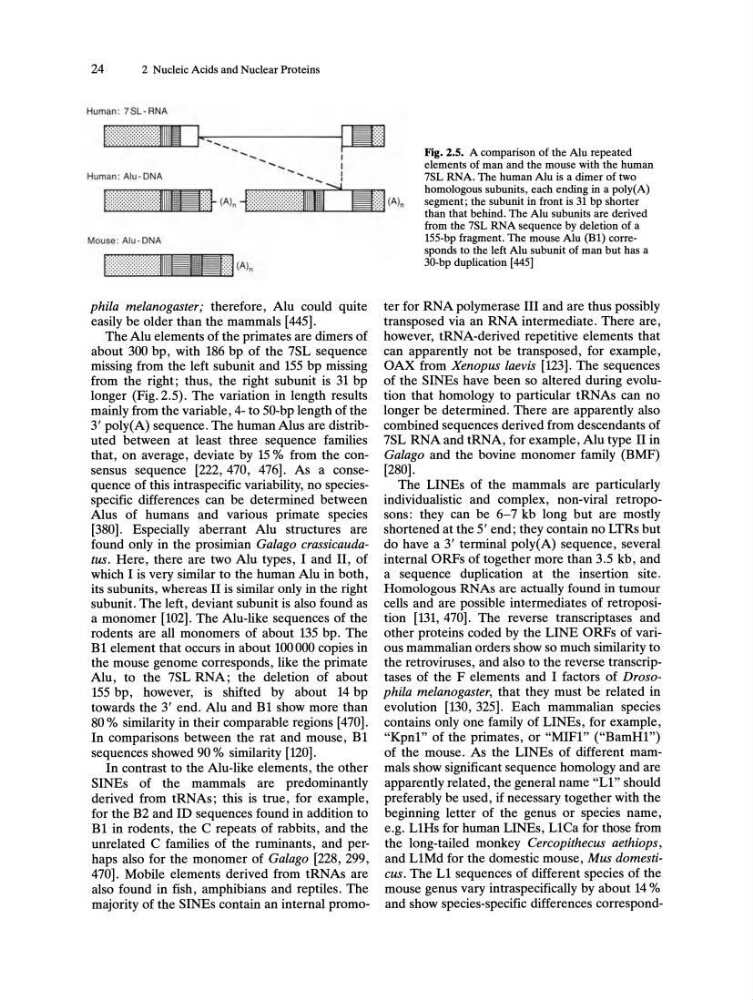
The Alu elements of the primates are dimers of
about 300 bp, with 186 bp of the 7SL sequence
missing from the left subunit and 155 bp missing
from the right; thus, the right subunit is 31 bp
longer (Fig. 2.5). The variation in length results
mainly from the variable , 4- to 50-bp length of the
3' poly(A) sequence. The human Alus are distributed between at least three sequence families
that, on average, deviate by 15 % from the consensus sequence [222,470, 476]. As a consequence of this intraspecific variability, no speciesspecific differences can be determined between
Alus of humans and various primate species
[380]. Especially aberrant Alu structures are
found only in the prosimian Galago crassicaudatus. Here, there are two Alu types, I and II, of
which I is very similar to the human Alu in both,
its subunits, whereas II is similar only in the right
subunit. The left, deviant subunit is also found as
a monomer [102]. The Alu-like sequences of the
rodents are all monomers of about 135 bp. The
B 1 element that occurs in about 100 000 copies in
the mouse genome corresponds, like the primate
Alu, to the 7SL RNA; the deletion of about
155 bp, however, is shifted by about 14 bp
towards the 3' end. Alu and Bl show more than
80 % similarity in their comparable regions [470].
In comparisons between the rat and mouse, Bl
sequences showed 90 % similarity [120].
In contrast to the Alu-like elements, the other
SINEs of the mammals are predominantly
derived from tRNAs; this is true, for example,
for the B2 and ID sequences found in addition to
Bl in rodents, the C repeats of rabbits, and the
unrelated C families of the ruminants, and perhaps also for the monomer of Galago [228, 299,
470]. Mobile elements derived from tRNAs are
also found in fish, amphibians and reptiles. The
majority of the SINEs contain an internal promoFig. 2.5. A comparison of the AIu repeated
elements of man and the mouse with the human
7SL RNA. The human Alu is a dimer of two
homologous subunits, each ending in a poly(A)
segment; the subunit in front is 31 bp shorter
than that behind. The Alu subunits are derived
from the 7SL RNA sequence by deletion of a
155-bp fragment. The mouse Alu (Bl) corresponds to the left Alu subunit of man but has a
30-bp duplication [445]
ter for RNA polymerase III and are thus possibly
transposed via an RNA intermediate. There are,
however, tRNA-derived repetitive elements that
can apparently not be transposed, for example,
OAX from Xenopus laevis [123]. The sequences
of the SINEs have been so altered during evolution that homology to particular tRNAs can no
longer be determined. There are apparently also
combined sequences derived from descendants of
7SL RNA and tRNA, for example, Alu type II in
Galago and the bovine monomer family (BMF)
[280].
The LINEs of the mammals are particularly
individualistic and complex, non-viral retroposons: they can be 6-7 kb long but are mostly
shortened at the 5' end; they contain no LTRs but
do have a 3' terminal poly(A) sequence, several
internal ORFs of together more than 3.5 kb, and
a sequence duplication at the insertion site.
Homologous RNAs are actually found in tumour
cells and are possible intermediates of retroposition [131, 470]. The reverse transcriptases and
other proteins coded by the LINE ORFs of various mammalian orders show so much similarity to
the retroviruses, and also to the reverse transcriptases of the F elements and I factors of Drosophila melanogaster, that they must be related in
evolution [130, 325]. Each mammalian species
contains only one family of LINEs, for example,
"Kpnl" of the primates, or "MIFl" ("BamHl")
of the mouse. As the LINEs of different mammals show significant sequence homology and are
apparently related, the general name "Ll" should
preferably be used, if necessary together with the
beginning letter of the genus or species name,
e.g. LIHs for human LINEs, LICa for those from
the long-tailed monkey Cercopithecus aethiops,
and LIMd for the domestic mouse, Mus domesticus. The Ll sequences of different species of the
mouse genus vary intraspecifically by about 14 %
and show species-specific differences correspond-
2 Nucleic Acids and Nuclear Proteins
Human : 7SL-RNA
Human : Alu - DNA
I
..... _
I
.........,
Mouse: Alu- DNA
phila melanogaster; therefore, Alu could quite
easily be older than the mammals [445].
The Alu elements of the primates are dimers of
about 300 bp, with 186 bp of the 7SL sequence
missing from the left subunit and 155 bp missing
from the right; thus, the right subunit is 31 bp
longer (Fig. 2.5). The variation in length results
mainly from the variable , 4- to 50-bp length of the
3' poly(A) sequence. The human Alus are distributed between at least three sequence families
that, on average, deviate by 15 % from the consensus sequence [222,470, 476]. As a consequence of this intraspecific variability, no speciesspecific differences can be determined between
Alus of humans and various primate species
[380]. Especially aberrant Alu structures are
found only in the prosimian Galago crassicaudatus. Here, there are two Alu types, I and II, of
which I is very similar to the human Alu in both,
its subunits, whereas II is similar only in the right
subunit. The left, deviant subunit is also found as
a monomer [102]. The Alu-like sequences of the
rodents are all monomers of about 135 bp. The
B 1 element that occurs in about 100 000 copies in
the mouse genome corresponds, like the primate
Alu, to the 7SL RNA; the deletion of about
155 bp, however, is shifted by about 14 bp
towards the 3' end. Alu and Bl show more than
80 % similarity in their comparable regions [470].
In comparisons between the rat and mouse, Bl
sequences showed 90 % similarity [120].
In contrast to the Alu-like elements, the other
SINEs of the mammals are predominantly
derived from tRNAs; this is true, for example,
for the B2 and ID sequences found in addition to
Bl in rodents, the C repeats of rabbits, and the
unrelated C families of the ruminants, and perhaps also for the monomer of Galago [228, 299,
470]. Mobile elements derived from tRNAs are
also found in fish, amphibians and reptiles. The
majority of the SINEs contain an internal promoFig. 2.5. A comparison of the AIu repeated
elements of man and the mouse with the human
7SL RNA. The human Alu is a dimer of two
homologous subunits, each ending in a poly(A)
segment; the subunit in front is 31 bp shorter
than that behind. The Alu subunits are derived
from the 7SL RNA sequence by deletion of a
155-bp fragment. The mouse Alu (Bl) corresponds to the left Alu subunit of man but has a
30-bp duplication [445]
ter for RNA polymerase III and are thus possibly
transposed via an RNA intermediate. There are,
however, tRNA-derived repetitive elements that
can apparently not be transposed, for example,
OAX from Xenopus laevis [123]. The sequences
of the SINEs have been so altered during evolution that homology to particular tRNAs can no
longer be determined. There are apparently also
combined sequences derived from descendants of
7SL RNA and tRNA, for example, Alu type II in
Galago and the bovine monomer family (BMF)
[280].
The LINEs of the mammals are particularly
individualistic and complex, non-viral retroposons: they can be 6-7 kb long but are mostly
shortened at the 5' end; they contain no LTRs but
do have a 3' terminal poly(A) sequence, several
internal ORFs of together more than 3.5 kb, and
a sequence duplication at the insertion site.
Homologous RNAs are actually found in tumour
cells and are possible intermediates of retroposition [131, 470]. The reverse transcriptases and
other proteins coded by the LINE ORFs of various mammalian orders show so much similarity to
the retroviruses, and also to the reverse transcriptases of the F elements and I factors of Drosophila melanogaster, that they must be related in
evolution [130, 325]. Each mammalian species
contains only one family of LINEs, for example,
"Kpnl" of the primates, or "MIFl" ("BamHl")
of the mouse. As the LINEs of different mammals show significant sequence homology and are
apparently related, the general name "Ll" should
preferably be used, if necessary together with the
beginning letter of the genus or species name,
e.g. LIHs for human LINEs, LICa for those from
the long-tailed monkey Cercopithecus aethiops,
and LIMd for the domestic mouse, Mus domesticus. The Ll sequences of different species of the
mouse genus vary intraspecifically by about 14 %
and show species-specific differences correspond-