

356
10 Proteins of Muscle and the Cytoskeleton
N-terminal domains I.
Central domains - - _ , I C-terminal domains
I IA
IB
2A
2B
:
I
LI
L12 L2
I
L-n
n.Jl
1--iJ=======:jlHJ=====:j1
I
I
r-r----i Type I
Acidic keratins
f------v...
~
~
I
I
I
I
I
~ Type II
Neutral/basic
~
N VI HII
keratins
IH2 V2 C
I
I
d Type III Vimentin, Desmin, b
N HI:
G F A P : H2
I
I
r-r----i
Neurofilaments
~
~
~
I
I
I
I
d
Lamins
t==:::J
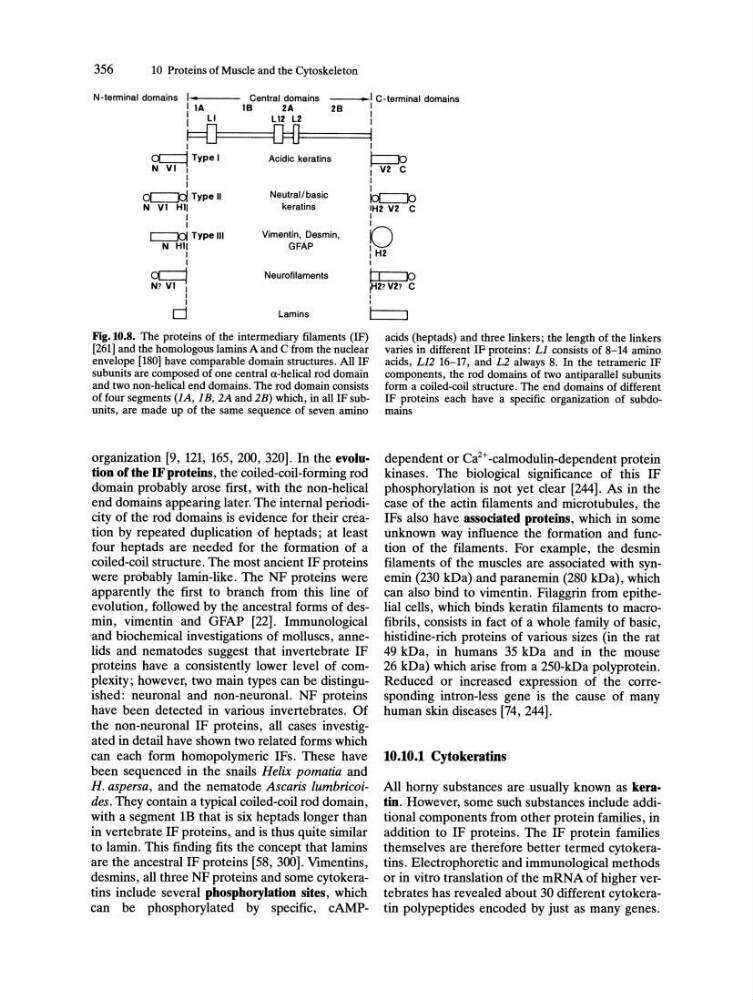
Fig.tO.S. The proteins of the intermediary filaments (IF)
[261] and the homologous lamins A and C from the nuclear
envelope [180] have comparable domain structures. All IF
subunits are composed of one central a-helical rod domain
and two non-helical end domains. The rod domain consists
of four segments (lA, 1B, 2A and 2B) which, in all IF subunits, are made up of the same sequence of seven amino
organization [9, 121, 165, 200, 320]. In the evolution of the IF proteins, the coiled-coil-forming rod
domain probably arose first, with the non-helical
end domains appearing later. The internal periodicity of the rod domains is evidence for their creation by repeated duplication of heptads; at least
four heptads are needed for the formation of a
coiled-coil structure. The most ancient IF proteins
were probably lamin-like. The NF proteins were
apparently the first to branch from this line of
evolution, followed by the ancestral forms of desmin, vimentin and GFAP [22]. Immunological
and biochemical investigations of molluscs, annelids and nematodes suggest that invertebrate IF
proteins have a consistently lower level of complexity; however, two main types can be distinguished: neuronal and non-neuronal. NF proteins
have been detected in various invertebrates. Of
the non-neuronal IF proteins, all cases investigated in detail have shown two related forms which
can each form homopolymeric IFs. These have
been sequenced in the snails Helix pomatia and
H. aspersa, and the nematode Ascaris lumbricoides. They contain a typical coiled-coil rod domain,
with a segment 1B that is six heptads longer than
in vertebrate IF proteins, and is thus quite similar
to lamin. This finding fits the concept that lamins
are the ancestral IF proteins [58, 300]. Vimentins,
desmins, all three NF proteins and some cytokeratins include several phosphorylation sites, which
can be phosphorylated by specific, cAMPacids (heptads) and three linkers; the length of the linkers
varies in different IF proteins: L1 consists of 8-14 amino
acids, L12 16-17, and L2 always 8. In the tetrameric IF
components, the rod domains of two antiparallel subunits
form a coiled-coil structure. The end domains of different
IF proteins each have a specific organization of subdomains
dependent or Ca 2 + -calmodulin-dependent protein
kinases. The biological significance of this IF
phosphorylation is not yet clear [244]. As in the
case of the actin filaments and microtubules, the
IFs also have associated proteins, which in some
unknown way influence the formation and function of the filaments. For example, the desmin
filaments of the muscles are associated with synemin (230 kDa) and paranemin (280 kDa), which
can also bind to vimentin. Filaggrin from epithelial cells, which binds keratin filaments to macrofibrils, consists in fact of a whole family of basic,
histidine-rich proteins of various sizes (in the rat
49 kDa, in humans 35 kDa and in the mouse
26 kDa) which arise from a 250-kDa polyprotein.
Reduced or increased expression of the corresponding intron-Iess gene is the cause of many
human skin diseases [74, 244].
10.10.1 Cytokeratins
All horny substances are usually known as keratin. However, some such substances include additional components from other protein families, in
addition to IF proteins. The IF protein families
themselves are therefore better termed cytokeratins. Electrophoretic and immunological methods
or in vitro translation of the mRNA of higher vertebrates has revealed about 30 different cytokeratin polypeptides encoded by just as many genes.
10 Proteins of Muscle and the Cytoskeleton
N-terminal domains I.
Central domains - - _ , I C-terminal domains
I IA
IB
2A
2B
:
I
LI
L12 L2
I
L-n
n.Jl
1--iJ=======:jlHJ=====:j1
I
I
r-r----i Type I
Acidic keratins
f------v...
~
~
I
I
I
I
I
~ Type II
Neutral/basic
~
N VI HII
keratins
IH2 V2 C
I
I
d Type III Vimentin, Desmin, b
N HI:
G F A P : H2
I
I
r-r----i
Neurofilaments
~
~
~
I
I
I
I
d
Lamins
t==:::J
Fig.tO.S. The proteins of the intermediary filaments (IF)
[261] and the homologous lamins A and C from the nuclear
envelope [180] have comparable domain structures. All IF
subunits are composed of one central a-helical rod domain
and two non-helical end domains. The rod domain consists
of four segments (lA, 1B, 2A and 2B) which, in all IF subunits, are made up of the same sequence of seven amino
organization [9, 121, 165, 200, 320]. In the evolution of the IF proteins, the coiled-coil-forming rod
domain probably arose first, with the non-helical
end domains appearing later. The internal periodicity of the rod domains is evidence for their creation by repeated duplication of heptads; at least
four heptads are needed for the formation of a
coiled-coil structure. The most ancient IF proteins
were probably lamin-like. The NF proteins were
apparently the first to branch from this line of
evolution, followed by the ancestral forms of desmin, vimentin and GFAP [22]. Immunological
and biochemical investigations of molluscs, annelids and nematodes suggest that invertebrate IF
proteins have a consistently lower level of complexity; however, two main types can be distinguished: neuronal and non-neuronal. NF proteins
have been detected in various invertebrates. Of
the non-neuronal IF proteins, all cases investigated in detail have shown two related forms which
can each form homopolymeric IFs. These have
been sequenced in the snails Helix pomatia and
H. aspersa, and the nematode Ascaris lumbricoides. They contain a typical coiled-coil rod domain,
with a segment 1B that is six heptads longer than
in vertebrate IF proteins, and is thus quite similar
to lamin. This finding fits the concept that lamins
are the ancestral IF proteins [58, 300]. Vimentins,
desmins, all three NF proteins and some cytokeratins include several phosphorylation sites, which
can be phosphorylated by specific, cAMPacids (heptads) and three linkers; the length of the linkers
varies in different IF proteins: L1 consists of 8-14 amino
acids, L12 16-17, and L2 always 8. In the tetrameric IF
components, the rod domains of two antiparallel subunits
form a coiled-coil structure. The end domains of different
IF proteins each have a specific organization of subdomains
dependent or Ca 2 + -calmodulin-dependent protein
kinases. The biological significance of this IF
phosphorylation is not yet clear [244]. As in the
case of the actin filaments and microtubules, the
IFs also have associated proteins, which in some
unknown way influence the formation and function of the filaments. For example, the desmin
filaments of the muscles are associated with synemin (230 kDa) and paranemin (280 kDa), which
can also bind to vimentin. Filaggrin from epithelial cells, which binds keratin filaments to macrofibrils, consists in fact of a whole family of basic,
histidine-rich proteins of various sizes (in the rat
49 kDa, in humans 35 kDa and in the mouse
26 kDa) which arise from a 250-kDa polyprotein.
Reduced or increased expression of the corresponding intron-Iess gene is the cause of many
human skin diseases [74, 244].
10.10.1 Cytokeratins
All horny substances are usually known as keratin. However, some such substances include additional components from other protein families, in
addition to IF proteins. The IF protein families
themselves are therefore better termed cytokeratins. Electrophoretic and immunological methods
or in vitro translation of the mRNA of higher vertebrates has revealed about 30 different cytokeratin polypeptides encoded by just as many genes.