

352
10 Proteins of Muscle and the Cytoskeleton
10.9 Microtubule Proteins
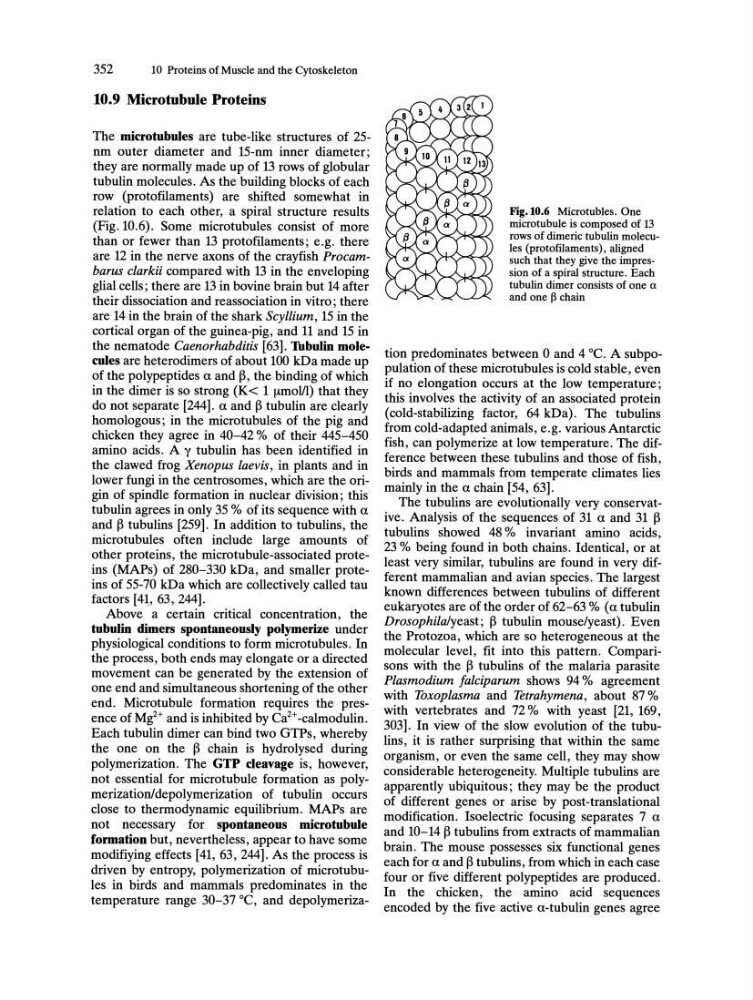
The microtubules are tube-like structures of 25nm outer diameter and 15-nm inner diameter;
they are normally made up of 13 rows of globular
tubulin molecules. As the building blocks of each
row (proto filaments ) are shifted somewhat in
relation to each other, a spiral structure results
(Fig. 10.6). Some microtubules consist of more
than or fewer than 13 protofilaments; e.g. there
are 12 in the nerve axons of the crayfish Procambarus clarkii compared with 13 in the enveloping
glial cells; there are 13 in bovine brain but 14 after
their dissociation and reassociation in vitro; there
are 14 in the brain of the shark Scyllium, 15 in the
cortical organ of the guinea-pig, and 11 and 15 in
the nematode Caenorhabditis [63]. Tubulin molecules are heterodimers of about 100 kDa made up
of the polypeptides a and B, the binding of which
in the dimer is so strong (K < 1 IlmoVl) that they
do not separate [244]. a and B tubulin are clearly
homologous; in the microtubules of the pig and
chicken they agree in 40-42 % of their 445-450
amino acids. A y tubulin has been identified in
the clawed frog Xenopus laevis, in plants and in
lower fungi in the centrosomes, which are the origin of spindle formation in nuclear division;. this
tubulin agrees in only 35 % of its sequence w1th a
and B tubulins [259]. In addition to tubulins, the
microtubules often include large amounts of
other proteins, the microtubule-associated proteins (MAPs) of 280-330 kDa, and smaller proteins of 55-70 kDa which are collectively called tau
factors [41, 63, 244].
.
Above a certain critical concentratIOn, the
tubulin dimers spontaneously polymerize under
physiological conditions to form microtubules. In
the process, both ends may elongate or a directed
movement can be generated by the extension of
one end and simultaneous shortening of the other
end. Microtubule formation requires the presence of Mg2+ and is inhibited by Ca 2 + -calmodulin.
Each tubulin dimer can bind two GTPs, whereby
the one on the B chain is hydrolysed during
polymerization. The GTP cleavage ~s, however,
not essential for microtubule formatIOn as polymerizationldepolymerization of tubulin occurs
close to thermodynamic eqUilibrium. MAPs are
not necessary for spontaneous microtubule
formation but, nevertheless, appear to have so~e
modifiying effects [41, 63, 244]. As the process 1S
driven by entropy, polymerization of microtubules in birds and mammals predominates in the
temperature range 30-37°C, and depolymerizaFig.l0.6 Microtubles. One
microtubule is composed of 13
rows of dimeric tubulin molecules (protofilaments), aligned
such that they give the impression of a spiral structure. Each
tubulin dimer consists of one a
and one ~ chain
tion predominates between 0 and 4°C. A subpopulation of these microtubules is cold stable, even
if no elongation occurs at the low temperature;
this involves the activity of an associated protein
(cold-stabilizing factor, 64 kDa) .. The tubuli~s
from cold-adapted animals, e.g. vanous Antarct1c
fish, can polymerize at low temperature. The difference between these tubulins and those of fish,
birds and mammals from temperate climates lies
mainly in the a chain [54, 63].
The tubulins are evolutionally very conservative. Analysis of the sequences of 31 a and 31 B
tubulins showed 48 % invariant amino acids,
23 % being found in both chains. Identical, or at
least very similar, tubulins are found in very different mammalian and avian species. The largest
known differences between tubulins of different
eukaryotes are of the order of 62-63 % (a tubulin
Drosophila/yeast; B tubulin mouse/yeast). Even
the Protozoa, which are so heterogeneous at th~
molecular level, fit into this pattern. Compansons with the B tubulins of the malaria parasite
Plasmodium Jalciparum shows 94 % agreement
with Toxoplasma and Tetrahymena, about 87 %
with vertebrates and 72 % with yeast [21, 169,
303]. In view of the slow evolution of the tubulins, it is rather surprising that within the same
organism, or even the s~me cell,. they ma~ show
considerable heterogene1ty. Multiple tubuhns are
apparently ubiquitous; they may be the product
of different genes or arise by post-translational
modification. Isoelectric focusing separates 7 a
and 10-14 B tubulins from extracts of mammalian
brain. The mouse possesses six functional genes
each for a and B tubulins, from which in each case
four or five different polypeptides are produced.
In the chicken, the amino acid sequences
encoded by the five active a-tubulin genes agree
10 Proteins of Muscle and the Cytoskeleton
10.9 Microtubule Proteins
The microtubules are tube-like structures of 25nm outer diameter and 15-nm inner diameter;
they are normally made up of 13 rows of globular
tubulin molecules. As the building blocks of each
row (proto filaments ) are shifted somewhat in
relation to each other, a spiral structure results
(Fig. 10.6). Some microtubules consist of more
than or fewer than 13 protofilaments; e.g. there
are 12 in the nerve axons of the crayfish Procambarus clarkii compared with 13 in the enveloping
glial cells; there are 13 in bovine brain but 14 after
their dissociation and reassociation in vitro; there
are 14 in the brain of the shark Scyllium, 15 in the
cortical organ of the guinea-pig, and 11 and 15 in
the nematode Caenorhabditis [63]. Tubulin molecules are heterodimers of about 100 kDa made up
of the polypeptides a and B, the binding of which
in the dimer is so strong (K < 1 IlmoVl) that they
do not separate [244]. a and B tubulin are clearly
homologous; in the microtubules of the pig and
chicken they agree in 40-42 % of their 445-450
amino acids. A y tubulin has been identified in
the clawed frog Xenopus laevis, in plants and in
lower fungi in the centrosomes, which are the origin of spindle formation in nuclear division;. this
tubulin agrees in only 35 % of its sequence w1th a
and B tubulins [259]. In addition to tubulins, the
microtubules often include large amounts of
other proteins, the microtubule-associated proteins (MAPs) of 280-330 kDa, and smaller proteins of 55-70 kDa which are collectively called tau
factors [41, 63, 244].
.
Above a certain critical concentratIOn, the
tubulin dimers spontaneously polymerize under
physiological conditions to form microtubules. In
the process, both ends may elongate or a directed
movement can be generated by the extension of
one end and simultaneous shortening of the other
end. Microtubule formation requires the presence of Mg2+ and is inhibited by Ca 2 + -calmodulin.
Each tubulin dimer can bind two GTPs, whereby
the one on the B chain is hydrolysed during
polymerization. The GTP cleavage ~s, however,
not essential for microtubule formatIOn as polymerizationldepolymerization of tubulin occurs
close to thermodynamic eqUilibrium. MAPs are
not necessary for spontaneous microtubule
formation but, nevertheless, appear to have so~e
modifiying effects [41, 63, 244]. As the process 1S
driven by entropy, polymerization of microtubules in birds and mammals predominates in the
temperature range 30-37°C, and depolymerizaFig.l0.6 Microtubles. One
microtubule is composed of 13
rows of dimeric tubulin molecules (protofilaments), aligned
such that they give the impression of a spiral structure. Each
tubulin dimer consists of one a
and one ~ chain
tion predominates between 0 and 4°C. A subpopulation of these microtubules is cold stable, even
if no elongation occurs at the low temperature;
this involves the activity of an associated protein
(cold-stabilizing factor, 64 kDa) .. The tubuli~s
from cold-adapted animals, e.g. vanous Antarct1c
fish, can polymerize at low temperature. The difference between these tubulins and those of fish,
birds and mammals from temperate climates lies
mainly in the a chain [54, 63].
The tubulins are evolutionally very conservative. Analysis of the sequences of 31 a and 31 B
tubulins showed 48 % invariant amino acids,
23 % being found in both chains. Identical, or at
least very similar, tubulins are found in very different mammalian and avian species. The largest
known differences between tubulins of different
eukaryotes are of the order of 62-63 % (a tubulin
Drosophila/yeast; B tubulin mouse/yeast). Even
the Protozoa, which are so heterogeneous at th~
molecular level, fit into this pattern. Compansons with the B tubulins of the malaria parasite
Plasmodium Jalciparum shows 94 % agreement
with Toxoplasma and Tetrahymena, about 87 %
with vertebrates and 72 % with yeast [21, 169,
303]. In view of the slow evolution of the tubulins, it is rather surprising that within the same
organism, or even the s~me cell,. they ma~ show
considerable heterogene1ty. Multiple tubuhns are
apparently ubiquitous; they may be the product
of different genes or arise by post-translational
modification. Isoelectric focusing separates 7 a
and 10-14 B tubulins from extracts of mammalian
brain. The mouse possesses six functional genes
each for a and B tubulins, from which in each case
four or five different polypeptides are produced.
In the chicken, the amino acid sequences
encoded by the five active a-tubulin genes agree