

348
10 Proteins of Muscle and the Cytoskeleton
a)
b)
Ac-ADGLTEEGIAEFKEAFSLFDKDGNGTITTKELGTVMRSL
LGGNPTEAELGDMINEVDADGNGTIDFPEFLTMMARK
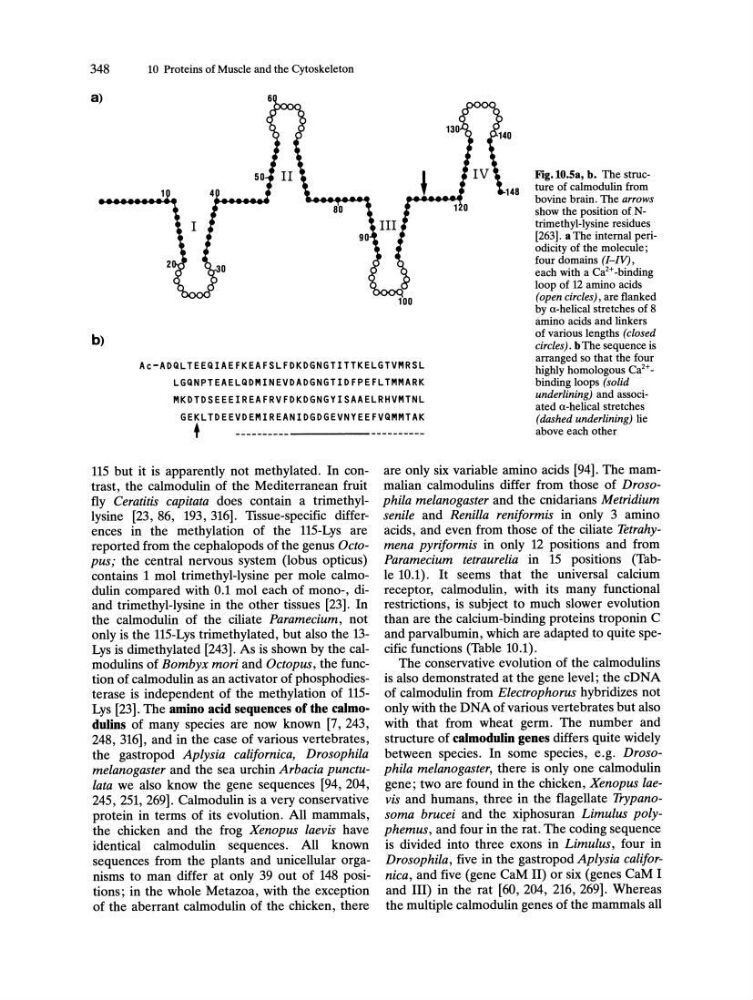
Fig.tO.5a, b. The structure of calmodulin from
bovine brain. The arrows
show the position of Ntrimethyl-Iysine residues
[263]. a The internal periodicity of the molecule;
four domains (I-IV),
each with a Ca2+ -binding
loop of 12 amino acids
(open circles), are flanked
by a-helical stretches of 8
amino acids and linkers
of various lengths (closed
circles). bThe sequence is
arranged so that the four
highly homologous Ca z +binding loops (solid
underlining) and associated a-helical stretches
(dashed underlining) lie
above each other
MKDTDSEEEIREAFRVFDKDGNGYISAAELRHVMTNL
GEKLTDEEVDEMIREANIDGDGEVNYEEFVGMMTAK
+ -------------------------115 but it is apparently not methylated. In contrast, the calmodulin of the Mediterranean fruit
fly Ceratitis capitata does contain a trimethyllysine [23, 86, 193, 316]. Tissue-specific differences in the methylation of the 115-Lys are
reported from the cephalopods of the genus Octopus; the central nervous system (lobus opticus)
contains 1 mol trimethyl-Iysine per mole calmodulin compared with 0.1 mol each of mono-, diand trimethyl-Iysine in the other tissues [23]. In
the calmodulin of the ciliate Paramecium, not
only is the 115-Lys trimethylated, but also the 13Lys is dimethylated [243]. As is shown by the calmodulins of Bombyx mori and Octopus, the function of calmodulin as an activator of phosphodiesterase is independent of the methylation of 115Lys [23]. The amino acid sequences of the calmodulins of many species are now known [7, 243,
248, 316], and in the case of various vertebrates,
the gastropod Aplysia californica, Drosophila
melanogaster and the sea urchin Arbacia punctulata we also know the gene sequences [94, 204,
245,251,269]. Calmodulin is a very conservative
protein in terms of its evolution. All mammals,
the chicken and the frog Xenopus laevis have
identical calmodulin sequences. All known
sequences from the plants and unicellular organisms to man differ at only 39 out of 148 positions; in the whole Metazoa, with the exception
of the aberrant calmodulin of the chicken, there
are only six variable amino acids [94]. The mammalian calmodulins differ from those of Drosophila melanogaster and the cnidarians Metridium
senile and Renilla reniformis in only 3 amino
acids, and even from those of the ciliate Tetrahymena pyriformis in only 12 positions and from
Paramecium tetraurelia in 15 positions (Table 10.1). It seems that the universal calcium
receptor, calmodulin, with its many functional
restrictions, is subject to much slower evolution
than are the calcium-binding proteins troponin C
and parvalbumin, which are adapted to quite specific functions (Table 10.1).
The conservative evolution of the calmodulins
is also demonstrated at the gene level; the cDNA
of calmodulin from Electrophorus hybridizes not
only with the DNA of various vertebrates but also
with that from wheat germ. The number and
structure of calmodulin genes differs quite widely
between species. In some species, e.g. Drosophila melanogaster, there is only one calmodulin
gene; two are found in the chicken, Xenopus laevis and humans, three in the flagellate Trypanosoma brucei and the xiphosuran Limulus polyphemus, and four in the rat. The coding sequence
is divided into three exons in Limulus, four in
Drosophila, five in the gastropod Aplysia californica, and five (gene CaM II) or six (genes CaM I
and III) in the rat [60, 204, 216, 269]. Whereas
the multiple calmodulin genes of the mammals all
10 Proteins of Muscle and the Cytoskeleton
a)
b)
Ac-ADGLTEEGIAEFKEAFSLFDKDGNGTITTKELGTVMRSL
LGGNPTEAELGDMINEVDADGNGTIDFPEFLTMMARK
Fig.tO.5a, b. The structure of calmodulin from
bovine brain. The arrows
show the position of Ntrimethyl-Iysine residues
[263]. a The internal periodicity of the molecule;
four domains (I-IV),
each with a Ca2+ -binding
loop of 12 amino acids
(open circles), are flanked
by a-helical stretches of 8
amino acids and linkers
of various lengths (closed
circles). bThe sequence is
arranged so that the four
highly homologous Ca z +binding loops (solid
underlining) and associated a-helical stretches
(dashed underlining) lie
above each other
MKDTDSEEEIREAFRVFDKDGNGYISAAELRHVMTNL
GEKLTDEEVDEMIREANIDGDGEVNYEEFVGMMTAK
+ -------------------------115 but it is apparently not methylated. In contrast, the calmodulin of the Mediterranean fruit
fly Ceratitis capitata does contain a trimethyllysine [23, 86, 193, 316]. Tissue-specific differences in the methylation of the 115-Lys are
reported from the cephalopods of the genus Octopus; the central nervous system (lobus opticus)
contains 1 mol trimethyl-Iysine per mole calmodulin compared with 0.1 mol each of mono-, diand trimethyl-Iysine in the other tissues [23]. In
the calmodulin of the ciliate Paramecium, not
only is the 115-Lys trimethylated, but also the 13Lys is dimethylated [243]. As is shown by the calmodulins of Bombyx mori and Octopus, the function of calmodulin as an activator of phosphodiesterase is independent of the methylation of 115Lys [23]. The amino acid sequences of the calmodulins of many species are now known [7, 243,
248, 316], and in the case of various vertebrates,
the gastropod Aplysia californica, Drosophila
melanogaster and the sea urchin Arbacia punctulata we also know the gene sequences [94, 204,
245,251,269]. Calmodulin is a very conservative
protein in terms of its evolution. All mammals,
the chicken and the frog Xenopus laevis have
identical calmodulin sequences. All known
sequences from the plants and unicellular organisms to man differ at only 39 out of 148 positions; in the whole Metazoa, with the exception
of the aberrant calmodulin of the chicken, there
are only six variable amino acids [94]. The mammalian calmodulins differ from those of Drosophila melanogaster and the cnidarians Metridium
senile and Renilla reniformis in only 3 amino
acids, and even from those of the ciliate Tetrahymena pyriformis in only 12 positions and from
Paramecium tetraurelia in 15 positions (Table 10.1). It seems that the universal calcium
receptor, calmodulin, with its many functional
restrictions, is subject to much slower evolution
than are the calcium-binding proteins troponin C
and parvalbumin, which are adapted to quite specific functions (Table 10.1).
The conservative evolution of the calmodulins
is also demonstrated at the gene level; the cDNA
of calmodulin from Electrophorus hybridizes not
only with the DNA of various vertebrates but also
with that from wheat germ. The number and
structure of calmodulin genes differs quite widely
between species. In some species, e.g. Drosophila melanogaster, there is only one calmodulin
gene; two are found in the chicken, Xenopus laevis and humans, three in the flagellate Trypanosoma brucei and the xiphosuran Limulus polyphemus, and four in the rat. The coding sequence
is divided into three exons in Limulus, four in
Drosophila, five in the gastropod Aplysia californica, and five (gene CaM II) or six (genes CaM I
and III) in the rat [60, 204, 216, 269]. Whereas
the multiple calmodulin genes of the mammals all