

340
10 Proteins of Muscle and the Cytoskeleton
As is seen from the sequence of appearance of
the different mRNAs, individual actin genes are
activated in a stage- and tissue-specific manner.
In Xenopus, y actin is expressed from the beginning of development, whereas a skeletal muscle
and a heart appear only at gastrulation, and only
in mesodermal cells which later give rise to muscles. Embryonal muscles express a third a-actin
gene [188]. Each amphibian species has its own
set of up to eight tissue-specific, non-muscle
actins [50]. Chicken myoblasts synthesize only B
and y during the division phase, with a appearing
at the beginning of fusion. No B- or y-actin
mRNAis present in the complete myotubule. The
heart type predominates initially in skeletal
muscle, e.g. there is 80 % in the chicken leg
muscle at the 11th day of development and still
several percent in the adult animal. Conversely,
human, bovine and porcine heart ventricles contain up to 20 % skeletal-muscle actin [290]. The
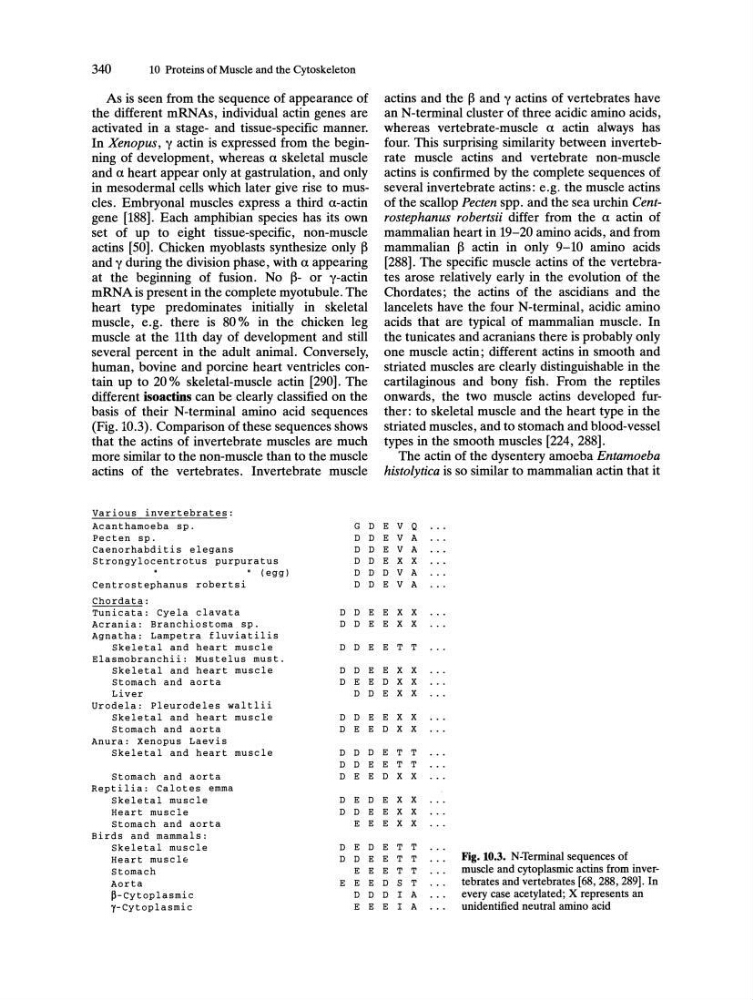
different isoactins can be clearly classified on the
basis of their N-terminal amino acid sequences
(Fig. 10.3). Comparison ofthese sequences shows
that the actins of invertebrate muscles are much
more similar to the non-muscle than to the muscle
actins of the vertebrates. Invertebrate muscle
Various invertebrates:
Acanthamoeba sp.
Pecten sp.
Caenorhabditis elegans
Strongylocentrotus purpuratus
, (egg)
Centrostephanus robertsi
Chordata:
Tunicata: Cyela clavata
Acrania: Branchiostoma sp.
Agnatha: Lampetra fluviatilis
Skeletal and heart muscle
Elasmobranchii: Mustelus must.
Skeletal and heart muscle
Stomach and aorta
Liver
G D
D D
D D
D D
D D
D D
D D E
D D E
D D E
D D E
D E E
D D
actins and the Band y actins of vertebrates have
an N-terminal cluster of three acidic amino acids,
whereas vertebrate-muscle a actin always has
four. This surprising similarity between invertebrate muscle actins and vertebrate non-muscle
actins is confirmed by the complete sequences of
several invertebrate actins: e.g. the muscle actins
of the scallop Pecten spp. and the sea urchin Centrostephanus robertsii differ from the a actin of
mammalian heart in 19-20 amino acids, and from
mammalian B actin in only 9-10 amino acids
[288]. The specific muscle actins of the vertebrates arose relatively early in the evolution of the
Chordates; the actins of the ascidians and the
lancelets have the four N-terminal, acidic amino
acids that are typical of mammalian muscle. In
the tunicates and acranians there is probably only
one muscle actin; different actins in smooth and
striated muscles are clearly distinguishable in the
cartilaginous and bony fish. From the reptiles
onwards, the two muscle actins developed further: to skeletal muscle and the heart type in the
striated muscles, and to stomach and blood-vessel
types in the smooth muscles [224, 288].
The actin of the dysentery amoeba Entamoeba
histolytica is so similar to mammalian actin that it
E V Q
E V A
E V A
E X X
D V A
E V A
E X X
E X X
E T T
E X X
D X X
E X X
Urodela: Pleurodeles waltlii
Skeletal and heart muscle
Stomach and aorta
D DEE X X
DEE D X X
Anura: Xenopus Laevis
Skeletal and heart muscle
Stomach and aorta
Reptilia: Calotes emma
Skeletal muscle
Heart muscle
Stomach and aorta
Birds and mammals:
Skeletal muscle
Heart muscle
Stomach
Aorta
~-Cytoplasmic
y-Cytoplasmic
D D D E T T
D DEE T T
DEE D X X
D E D E X X
D DEE X X
E E E X X
D E D E T T
D D E E T T
E E E T T
E E E D S T
D D D I A
E E E I A
Fig. 10.3. N-Terminal sequences of
muscle and cytoplasmic actins from invertebrates and vertebrates [68, 288, 289]. In
every case acetylated; X represents an
unidentified neutral amino acid
10 Proteins of Muscle and the Cytoskeleton
As is seen from the sequence of appearance of
the different mRNAs, individual actin genes are
activated in a stage- and tissue-specific manner.
In Xenopus, y actin is expressed from the beginning of development, whereas a skeletal muscle
and a heart appear only at gastrulation, and only
in mesodermal cells which later give rise to muscles. Embryonal muscles express a third a-actin
gene [188]. Each amphibian species has its own
set of up to eight tissue-specific, non-muscle
actins [50]. Chicken myoblasts synthesize only B
and y during the division phase, with a appearing
at the beginning of fusion. No B- or y-actin
mRNAis present in the complete myotubule. The
heart type predominates initially in skeletal
muscle, e.g. there is 80 % in the chicken leg
muscle at the 11th day of development and still
several percent in the adult animal. Conversely,
human, bovine and porcine heart ventricles contain up to 20 % skeletal-muscle actin [290]. The
different isoactins can be clearly classified on the
basis of their N-terminal amino acid sequences
(Fig. 10.3). Comparison ofthese sequences shows
that the actins of invertebrate muscles are much
more similar to the non-muscle than to the muscle
actins of the vertebrates. Invertebrate muscle
Various invertebrates:
Acanthamoeba sp.
Pecten sp.
Caenorhabditis elegans
Strongylocentrotus purpuratus
, (egg)
Centrostephanus robertsi
Chordata:
Tunicata: Cyela clavata
Acrania: Branchiostoma sp.
Agnatha: Lampetra fluviatilis
Skeletal and heart muscle
Elasmobranchii: Mustelus must.
Skeletal and heart muscle
Stomach and aorta
Liver
G D
D D
D D
D D
D D
D D
D D E
D D E
D D E
D D E
D E E
D D
actins and the Band y actins of vertebrates have
an N-terminal cluster of three acidic amino acids,
whereas vertebrate-muscle a actin always has
four. This surprising similarity between invertebrate muscle actins and vertebrate non-muscle
actins is confirmed by the complete sequences of
several invertebrate actins: e.g. the muscle actins
of the scallop Pecten spp. and the sea urchin Centrostephanus robertsii differ from the a actin of
mammalian heart in 19-20 amino acids, and from
mammalian B actin in only 9-10 amino acids
[288]. The specific muscle actins of the vertebrates arose relatively early in the evolution of the
Chordates; the actins of the ascidians and the
lancelets have the four N-terminal, acidic amino
acids that are typical of mammalian muscle. In
the tunicates and acranians there is probably only
one muscle actin; different actins in smooth and
striated muscles are clearly distinguishable in the
cartilaginous and bony fish. From the reptiles
onwards, the two muscle actins developed further: to skeletal muscle and the heart type in the
striated muscles, and to stomach and blood-vessel
types in the smooth muscles [224, 288].
The actin of the dysentery amoeba Entamoeba
histolytica is so similar to mammalian actin that it
E V Q
E V A
E V A
E X X
D V A
E V A
E X X
E X X
E T T
E X X
D X X
E X X
Urodela: Pleurodeles waltlii
Skeletal and heart muscle
Stomach and aorta
D DEE X X
DEE D X X
Anura: Xenopus Laevis
Skeletal and heart muscle
Stomach and aorta
Reptilia: Calotes emma
Skeletal muscle
Heart muscle
Stomach and aorta
Birds and mammals:
Skeletal muscle
Heart muscle
Stomach
Aorta
~-Cytoplasmic
y-Cytoplasmic
D D D E T T
D DEE T T
DEE D X X
D E D E X X
D DEE X X
E E E X X
D E D E T T
D D E E T T
E E E T T
E E E D S T
D D D I A
E E E I A
Fig. 10.3. N-Terminal sequences of
muscle and cytoplasmic actins from invertebrates and vertebrates [68, 288, 289]. In
every case acetylated; X represents an
unidentified neutral amino acid