

310
8 Peptide Hormones
a
extracellular
b
intra-disc
cytoplasmic
linked a chain interacts with the effector. Autocatalytic activity of the a chain then hydrolyses the
GTP, allowing restoration of the inactive
a-j>-y-GDP complex. The specificity of the Gprotein classes (Gs, Gi, Go, Gt = transducin) is
determined mainly by the a chains, which have a
size of 39-54 kDa, bear the GTP-binding site and
have intrinsic GTPase activity. Pertussis toxin
uncouples binding of the a chains of many Gproteins to the receptor, thus preventing signal
transduction. Cholera toxin inhibits the GTPase
activity and thereby amplifies hormone activity.
At least 16 different a chains have been described
so far, and these can be ordered into four classes
according to various structural and functional
characters. They agree amongst each other in
35-94 % of their amino acids and exhibit 82 invariant residues. A particular G-protein can bind
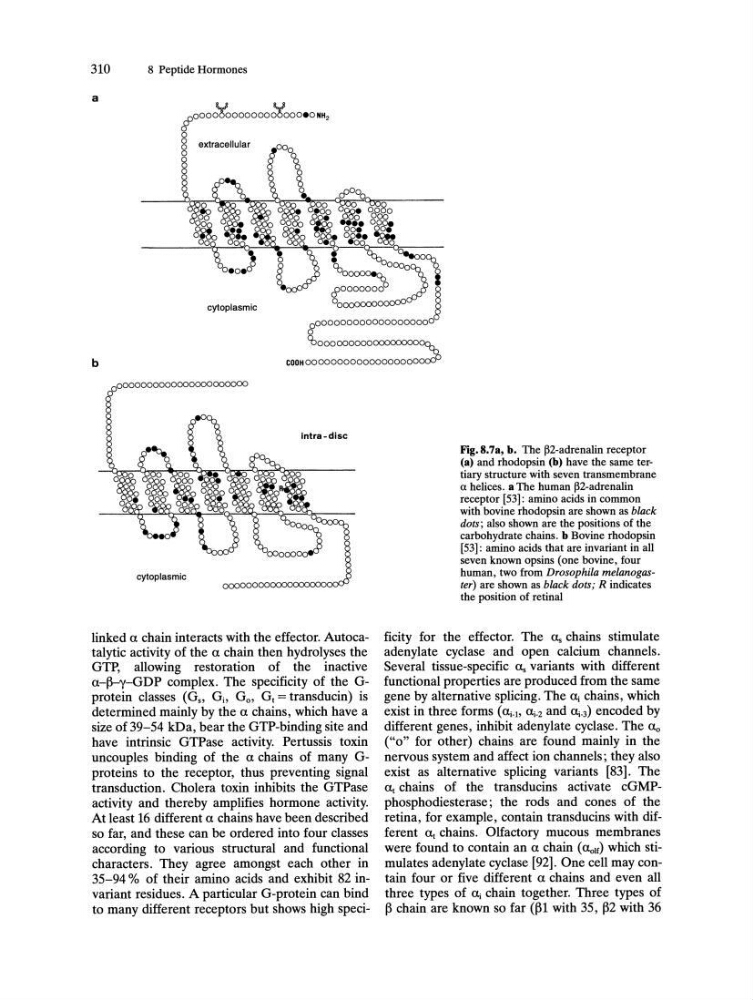
to many different receptors but shows high speciFig.8.7a, b. The ~2-adrenalin receptor
(a) and rhodopsin (b) have the same tertiary structure with seven transmembrane
a helices. a The human ~2-adrenalin
receptor [53]: amino acids in common
with bovine rhodopsin are shown as black
dots; also shown are the positions of the
carbohydrate chains. b Bovine rhodopsin
[53]: amino acids that are invariant in all
seven known opsins (one bovine, four
human, two from Drosophila melanogaster) are shown as black dots; R indicates
the position of retinal
ficity for the effector. The as chains stimulate
adenylate cyclase and open calcium channels.
Several tissue-specific as variants with different
functional properties are produced from the same
gene by alternative splicing. The
("0" for other) chains are found mainly in the
nervous system and affect ion channels; they also
exist as alternative splicing variants [83]. The
three types of
8 Peptide Hormones
a
extracellular
b
intra-disc
cytoplasmic
linked a chain interacts with the effector. Autocatalytic activity of the a chain then hydrolyses the
GTP, allowing restoration of the inactive
a-j>-y-GDP complex. The specificity of the Gprotein classes (Gs, Gi, Go, Gt = transducin) is
determined mainly by the a chains, which have a
size of 39-54 kDa, bear the GTP-binding site and
have intrinsic GTPase activity. Pertussis toxin
uncouples binding of the a chains of many Gproteins to the receptor, thus preventing signal
transduction. Cholera toxin inhibits the GTPase
activity and thereby amplifies hormone activity.
At least 16 different a chains have been described
so far, and these can be ordered into four classes
according to various structural and functional
characters. They agree amongst each other in
35-94 % of their amino acids and exhibit 82 invariant residues. A particular G-protein can bind
to many different receptors but shows high speciFig.8.7a, b. The ~2-adrenalin receptor
(a) and rhodopsin (b) have the same tertiary structure with seven transmembrane
a helices. a The human ~2-adrenalin
receptor [53]: amino acids in common
with bovine rhodopsin are shown as black
dots; also shown are the positions of the
carbohydrate chains. b Bovine rhodopsin
[53]: amino acids that are invariant in all
seven known opsins (one bovine, four
human, two from Drosophila melanogaster) are shown as black dots; R indicates
the position of retinal
ficity for the effector. The as chains stimulate
adenylate cyclase and open calcium channels.
Several tissue-specific as variants with different
functional properties are produced from the same
gene by alternative splicing. The
("0" for other) chains are found mainly in the
nervous system and affect ion channels; they also
exist as alternative splicing variants [83]. The
three types of