

302
8 Peptide Hormones
with unequal lengths. These arise by posttranslational proteolysis from a prepro-renin of
about 50 kDa. The corresponding genes of man,
the mouse and rat show several special features:
the mouse alone possesses two prepro-renin
genes, and the human gene contains an additional, tenth exon that encodes for a 3-amino-acid
insert [29]. The physiological substrates of the
renins are the angiotensinogens, which are multiple glycoproteins of about 450 amino acids produced by the liver cells [65, 141]. Renin cleaves a
decapeptide from angiotensinogen, angiotensinI, which is further processed to the biologically
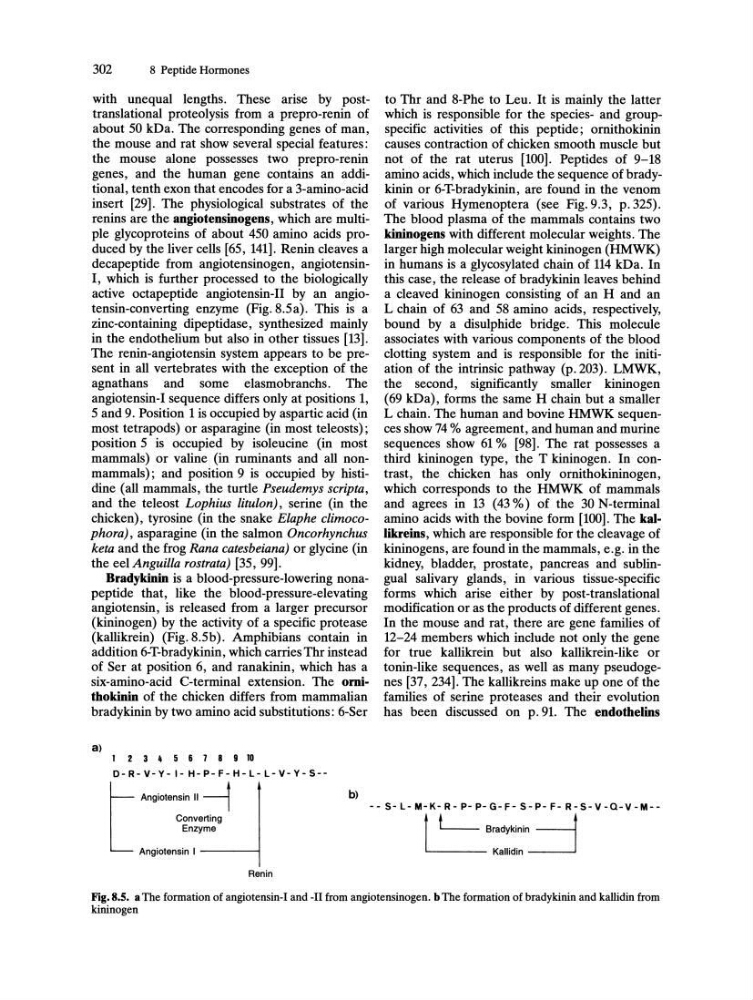
active octapeptide angiotensin-II by an angiotensin-converting enzyme (Fig.8.5a). This is a
zinc-containing dipeptidase, synthesized mainly
in the endothelium but also in other tissues [13].
The renin-angiotensin system appears to be present in all vertebrates with the exception of the
agnathans and some elasmobranchs. The
angiotensin-I sequence differs only at positions 1,
5 and 9. Position 1 is occupied by aspartic acid (in
most tetrapods) or asparagine (in most teleosts);
position 5 is occupied by isoleucine (in most
mammals) or valine (in ruminants and all nonmammals); and position 9 is occupied by histidine (all mammals, the turtle Pseudemys scripta,
and the teleost Lophius litulon), serine (in the
chicken), tyrosine (in the snake Elaphe climocophora), asparagine (in the salmon Oncorhynchus
keta and the frog Rana catesbeiana) or glycine (in
the eel Anguilla rostrata) [35, 99].
Bradykinin is a blood-pressure-Iowering nonapeptide that, like the blood-pressure-elevating
angiotensin, is released from a larger precursor
(kininogen) by the activity of a specific protease
(kallikrein) (Fig.8.5b). Amphibians contain in
addition 6-T-bradykinin, which carries Thr instead
of Ser at position 6, and ranakinin, which has a
six-amino-acid C-terminal extension. The ornithokinin of the chicken differs from mammalian
bradykinin by two amino acid substitutions: 6-Ser
a)
1 2 3 4 5 6 7 8 9 1 0
O-R-V-Y-I- H-P-F-H-L- L-V-Y-S-t
Angiotensin II ---1
Converting
Enzyme
Angiotensin I - - - - - - I
b)
Renin
to Thr and 8-Phe to Leu. It is mainly the latter
which is responsible for the species- and groupspecific activities of this peptide; omithokinin
causes contraction of chicken smooth muscle but
not of the rat uterus [100]. Peptides of 9-18
amino acids, which include the sequence of bradykinin or 6-T-bradykinin, are found in the venom
of various Hymenoptera (see Fig. 9.3, p.325).
The blood plasma of the mammals contains two
kininogens with different molecular weights. The
larger high molecular weight kininogen (HMWK)
in humans is a glycosylated chain of 114 kDa. In
this case, the release of bradykinin leaves behind
a cleaved kininogen consisting of an H and an
L chain of 63 and 58 amino acids, respectively,
bound by a disulphide bridge. This molecule
associates with various components of the blood
clotting system and is responsible for the initiation of the intrinsic pathway (p.203). LMWK,
the second, significantly smaller kininogen
(69 kDa), forms the same H chain but a smaller
L chain. The human and bovine HMWK sequences show 74 % agreement, and human and murine
sequences show 61 % [98]. The rat possesses a
third kininogen type, the T kininogen. In contrast, the chicken has only omithokininogen,
which corresponds to the HMWK of mammals
and agrees in 13 (43 %) of the 30 N-terminal
amino acids with the bovine form [100]. The kallikreins, which are responsible for the cleavage of
kininogens, are found in the mammals, e.g. in the
kidney, bladder, prostate, pancreas and sublingual salivary glands, in various tissue-specific
forms which arise either by post-translational
modification or as the products of different genes.
In the mouse and rat, there are gene families of
12-24 members which include not only the gene
for true kallikrein but also kallikrein-like or
tonin-like sequences, as well as many pseudogenes [37, 234]. The kallikreins make up one of the
families of serine proteases and their evolution
has been discussed on p.91. The endothelins
- - 5- L - M- K- R - P- P- G- F - 5 - P- F - R - 5 - V - Q- V - M -t ~ Bradykinin --J
~Kallidin~
Fig.8.S. a The formation of angiotensin-I and -II from angiotensinogen. b The formation of bradykinin and kallidin from
kininogen
8 Peptide Hormones
with unequal lengths. These arise by posttranslational proteolysis from a prepro-renin of
about 50 kDa. The corresponding genes of man,
the mouse and rat show several special features:
the mouse alone possesses two prepro-renin
genes, and the human gene contains an additional, tenth exon that encodes for a 3-amino-acid
insert [29]. The physiological substrates of the
renins are the angiotensinogens, which are multiple glycoproteins of about 450 amino acids produced by the liver cells [65, 141]. Renin cleaves a
decapeptide from angiotensinogen, angiotensinI, which is further processed to the biologically
active octapeptide angiotensin-II by an angiotensin-converting enzyme (Fig.8.5a). This is a
zinc-containing dipeptidase, synthesized mainly
in the endothelium but also in other tissues [13].
The renin-angiotensin system appears to be present in all vertebrates with the exception of the
agnathans and some elasmobranchs. The
angiotensin-I sequence differs only at positions 1,
5 and 9. Position 1 is occupied by aspartic acid (in
most tetrapods) or asparagine (in most teleosts);
position 5 is occupied by isoleucine (in most
mammals) or valine (in ruminants and all nonmammals); and position 9 is occupied by histidine (all mammals, the turtle Pseudemys scripta,
and the teleost Lophius litulon), serine (in the
chicken), tyrosine (in the snake Elaphe climocophora), asparagine (in the salmon Oncorhynchus
keta and the frog Rana catesbeiana) or glycine (in
the eel Anguilla rostrata) [35, 99].
Bradykinin is a blood-pressure-Iowering nonapeptide that, like the blood-pressure-elevating
angiotensin, is released from a larger precursor
(kininogen) by the activity of a specific protease
(kallikrein) (Fig.8.5b). Amphibians contain in
addition 6-T-bradykinin, which carries Thr instead
of Ser at position 6, and ranakinin, which has a
six-amino-acid C-terminal extension. The ornithokinin of the chicken differs from mammalian
bradykinin by two amino acid substitutions: 6-Ser
a)
1 2 3 4 5 6 7 8 9 1 0
O-R-V-Y-I- H-P-F-H-L- L-V-Y-S-t
Angiotensin II ---1
Converting
Enzyme
Angiotensin I - - - - - - I
b)
Renin
to Thr and 8-Phe to Leu. It is mainly the latter
which is responsible for the species- and groupspecific activities of this peptide; omithokinin
causes contraction of chicken smooth muscle but
not of the rat uterus [100]. Peptides of 9-18
amino acids, which include the sequence of bradykinin or 6-T-bradykinin, are found in the venom
of various Hymenoptera (see Fig. 9.3, p.325).
The blood plasma of the mammals contains two
kininogens with different molecular weights. The
larger high molecular weight kininogen (HMWK)
in humans is a glycosylated chain of 114 kDa. In
this case, the release of bradykinin leaves behind
a cleaved kininogen consisting of an H and an
L chain of 63 and 58 amino acids, respectively,
bound by a disulphide bridge. This molecule
associates with various components of the blood
clotting system and is responsible for the initiation of the intrinsic pathway (p.203). LMWK,
the second, significantly smaller kininogen
(69 kDa), forms the same H chain but a smaller
L chain. The human and bovine HMWK sequences show 74 % agreement, and human and murine
sequences show 61 % [98]. The rat possesses a
third kininogen type, the T kininogen. In contrast, the chicken has only omithokininogen,
which corresponds to the HMWK of mammals
and agrees in 13 (43 %) of the 30 N-terminal
amino acids with the bovine form [100]. The kallikreins, which are responsible for the cleavage of
kininogens, are found in the mammals, e.g. in the
kidney, bladder, prostate, pancreas and sublingual salivary glands, in various tissue-specific
forms which arise either by post-translational
modification or as the products of different genes.
In the mouse and rat, there are gene families of
12-24 members which include not only the gene
for true kallikrein but also kallikrein-like or
tonin-like sequences, as well as many pseudogenes [37, 234]. The kallikreins make up one of the
families of serine proteases and their evolution
has been discussed on p.91. The endothelins
- - 5- L - M- K- R - P- P- G- F - 5 - P- F - R - 5 - V - Q- V - M -t ~ Bradykinin --J
~Kallidin~
Fig.8.S. a The formation of angiotensin-I and -II from angiotensinogen. b The formation of bradykinin and kallidin from
kininogen