

298
8 Peptide Hormones
homologous sequence - YGWMDF-amide [167].
The tyrosine residue of CKK is always sulphated,
but in gastrin it is sulphated only in certain vertebrates. The CKK receptor in mammalian pancreas is highly specific for the sulphated CKK,
whereas the receptors in the stomach and brain
bind both sulphated and non-sulphated gastrins
just as well as CKK [249]. The chicken also contains the specific pancreas receptors and the nonspecific brain receptors; whereas in fish, amphibians and reptiles all the receptors are non-specific
[224]. CKK is apparently phylogenetically older
than gastrin; fish and amphibians already possess
CKK but not· gastrin. CKK is already found in
both the gut and brain of the agnathans, and also
in the skin of amphibians [35]. A peptide of 36
amino acids, isolated from the stomach wall of
the chicken, has the C-terminal sequence -
WMDF - but otherwise has no similarity to mammalian gastrin or to CKK. It stimulates secretion
in the stomach but not in the pancreas; this may,
in fact, be an avian gastrin. CKK has also been
detected immunologically in both the gut and
brain of birds [51].
The prepro-gastrin of mammals consists of
101 amino acids; the CKK precursor has a length
of 114 amino acids as the result of an insertion.
Otherwise, the cDNA sequences of the two precursors are very similar; 63 % of bases in codon
positions 1 and 2 are identical [48]. Internal
homologies indicate a gene duplication during
their evolution [18]. Human gastrin-34 corresponds to positions 59-92 of the precursor; the
immediate flanking sequence - Gly-Arg-Arg -
provides both the cleavage site and the glycine for
amidation of the terminal - COOH. Cleavage of
the precursor at position 75/76 gives gastrin-17.
The human and porcine precursors differ at
29 positions, of which only 4 lie within the
gastrin-34 region [18]. Gastrin- or CKK-like peptides have been detected immunologically in cnidarians, annelids, insects, crustaceans, xiphosurans, gastropods, bryozoans and tunicates
[61, 71, 154]. A sulphated, gastrin-like peptide
has even been sequenced from the cockroach
A-chain
r-s-s----,
r--G I V E Q C C T SIC SLY Q LEN yeN
I
•
I · • •
I
I
S
8
I
I
I
Leucophaea maderae (see Fig.8.6k) [148]. Cionin (NYYGWMDF-amide) from the ascidian
Ciona intestinalis is identical at the C-terminus
with gastrin, but is sulphated on both tyrosine
residues [91]. The decapeptide caerulein, found
in the skin and gut wall of amphibians (Fig. 8.2i),
and described with other frog-skin peptides on
p. 294, differs in only one position of the active
peptide from the CKK sequence and has
CKK activity [167].
8.4.2 The Insulin Family
From the point of view of comparative biochemistry, the insulins are by far the bestinvestigated peptide hormones. In mammals,
insulin is produced in the B cells of the pancreas
islets tissue; here one also finds the glucagonproducing A cells and other endocrine cell types.
In many teleosts, the endocrine pancreas tissue is
a separate organ, the so-called Brockman'sche
body, and this has facilitated isolation of the hormone mRNA, e.g. from the angler fish Lophius
americanus. In the elasmobranchs, as in the tetrapods, the islets tissue is integrated in the pancreas
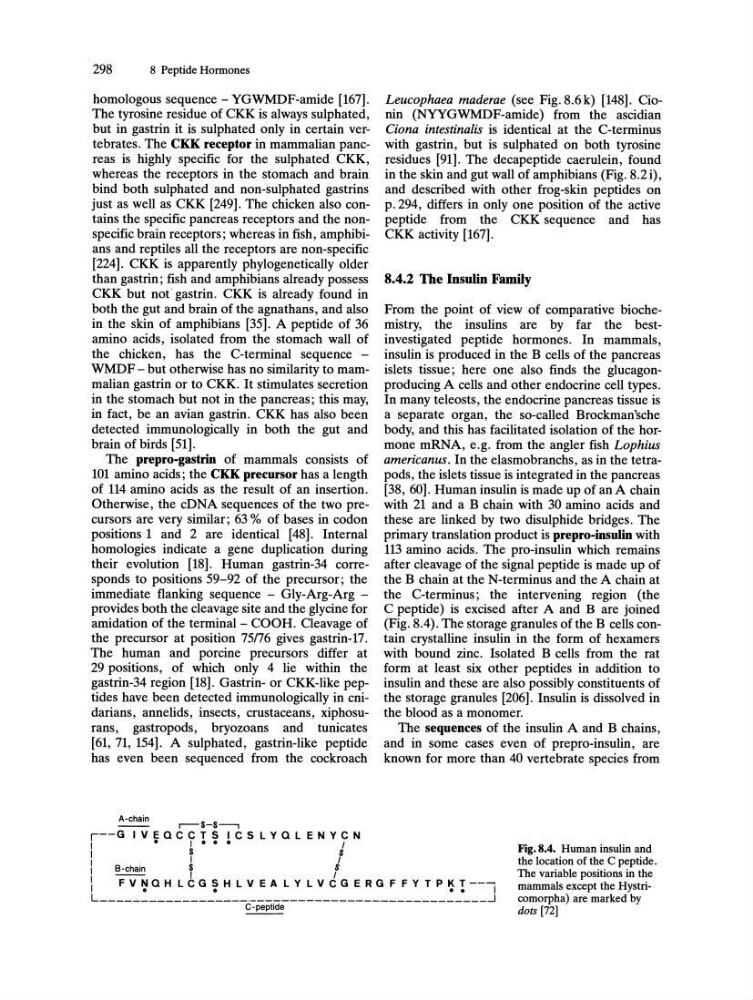
[38, 60]. Human insulin is made up of an A chain
with 21 and a B chain with 30 amino acids and
these are linked by two disulphide bridges. The
primary translation product is prepro-insulin with
113 amino acids. The pro-insulin which remains
after cleavage of the signal peptide is made up of
the B chain at the N-terminus and the A chain at
the C-terminus; the intervening region (the
C peptide) is excised after A and B are joined
(Fig. 8.4). The storage granules of the B cells contain crystalline insulin in the form of hexamers
with bound zinc. Isolated B cells from the rat
form at least six other peptides in addition to
insulin and these are also possibly constituents of
the storage granules [206]. Insulin is dissolved in
the blood as a monomer.
The sequences of the insulin A and B chains,
and in some cases even of prepro-insulin, are
known for more than 40 vertebrate species from
I
B-chain
S
8
I I
F V N Q H L b G S H L V E A L Y L V d G ERG F F Y T P K T --~I
• •
••
Fig.8.4. Human insulin and
the location of the C peptide.
The variable positions in the
mammals except the Hystricomorpha) are marked by
dots [72]
L _______________________________________________ ~
C-peptide
8 Peptide Hormones
homologous sequence - YGWMDF-amide [167].
The tyrosine residue of CKK is always sulphated,
but in gastrin it is sulphated only in certain vertebrates. The CKK receptor in mammalian pancreas is highly specific for the sulphated CKK,
whereas the receptors in the stomach and brain
bind both sulphated and non-sulphated gastrins
just as well as CKK [249]. The chicken also contains the specific pancreas receptors and the nonspecific brain receptors; whereas in fish, amphibians and reptiles all the receptors are non-specific
[224]. CKK is apparently phylogenetically older
than gastrin; fish and amphibians already possess
CKK but not· gastrin. CKK is already found in
both the gut and brain of the agnathans, and also
in the skin of amphibians [35]. A peptide of 36
amino acids, isolated from the stomach wall of
the chicken, has the C-terminal sequence -
WMDF - but otherwise has no similarity to mammalian gastrin or to CKK. It stimulates secretion
in the stomach but not in the pancreas; this may,
in fact, be an avian gastrin. CKK has also been
detected immunologically in both the gut and
brain of birds [51].
The prepro-gastrin of mammals consists of
101 amino acids; the CKK precursor has a length
of 114 amino acids as the result of an insertion.
Otherwise, the cDNA sequences of the two precursors are very similar; 63 % of bases in codon
positions 1 and 2 are identical [48]. Internal
homologies indicate a gene duplication during
their evolution [18]. Human gastrin-34 corresponds to positions 59-92 of the precursor; the
immediate flanking sequence - Gly-Arg-Arg -
provides both the cleavage site and the glycine for
amidation of the terminal - COOH. Cleavage of
the precursor at position 75/76 gives gastrin-17.
The human and porcine precursors differ at
29 positions, of which only 4 lie within the
gastrin-34 region [18]. Gastrin- or CKK-like peptides have been detected immunologically in cnidarians, annelids, insects, crustaceans, xiphosurans, gastropods, bryozoans and tunicates
[61, 71, 154]. A sulphated, gastrin-like peptide
has even been sequenced from the cockroach
A-chain
r-s-s----,
r--G I V E Q C C T SIC SLY Q LEN yeN
I
•
I · • •
I
I
S
8
I
I
I
Leucophaea maderae (see Fig.8.6k) [148]. Cionin (NYYGWMDF-amide) from the ascidian
Ciona intestinalis is identical at the C-terminus
with gastrin, but is sulphated on both tyrosine
residues [91]. The decapeptide caerulein, found
in the skin and gut wall of amphibians (Fig. 8.2i),
and described with other frog-skin peptides on
p. 294, differs in only one position of the active
peptide from the CKK sequence and has
CKK activity [167].
8.4.2 The Insulin Family
From the point of view of comparative biochemistry, the insulins are by far the bestinvestigated peptide hormones. In mammals,
insulin is produced in the B cells of the pancreas
islets tissue; here one also finds the glucagonproducing A cells and other endocrine cell types.
In many teleosts, the endocrine pancreas tissue is
a separate organ, the so-called Brockman'sche
body, and this has facilitated isolation of the hormone mRNA, e.g. from the angler fish Lophius
americanus. In the elasmobranchs, as in the tetrapods, the islets tissue is integrated in the pancreas
[38, 60]. Human insulin is made up of an A chain
with 21 and a B chain with 30 amino acids and
these are linked by two disulphide bridges. The
primary translation product is prepro-insulin with
113 amino acids. The pro-insulin which remains
after cleavage of the signal peptide is made up of
the B chain at the N-terminus and the A chain at
the C-terminus; the intervening region (the
C peptide) is excised after A and B are joined
(Fig. 8.4). The storage granules of the B cells contain crystalline insulin in the form of hexamers
with bound zinc. Isolated B cells from the rat
form at least six other peptides in addition to
insulin and these are also possibly constituents of
the storage granules [206]. Insulin is dissolved in
the blood as a monomer.
The sequences of the insulin A and B chains,
and in some cases even of prepro-insulin, are
known for more than 40 vertebrate species from
I
B-chain
S
8
I I
F V N Q H L b G S H L V E A L Y L V d G ERG F F Y T P K T --~I
• •
••
Fig.8.4. Human insulin and
the location of the C peptide.
The variable positions in the
mammals except the Hystricomorpha) are marked by
dots [72]
L _______________________________________________ ~
C-peptide