

296
8 Peptide Hormones
PRO-OPIOMELANOCORTIN (31 kDa)
~1~ ____ (_16_k_D_a_) ____ ~11 A~1H 11~ _____ ~~9~~ar~H ____ ~
~-MSH I I I I a-END
L!!!!..1 ~
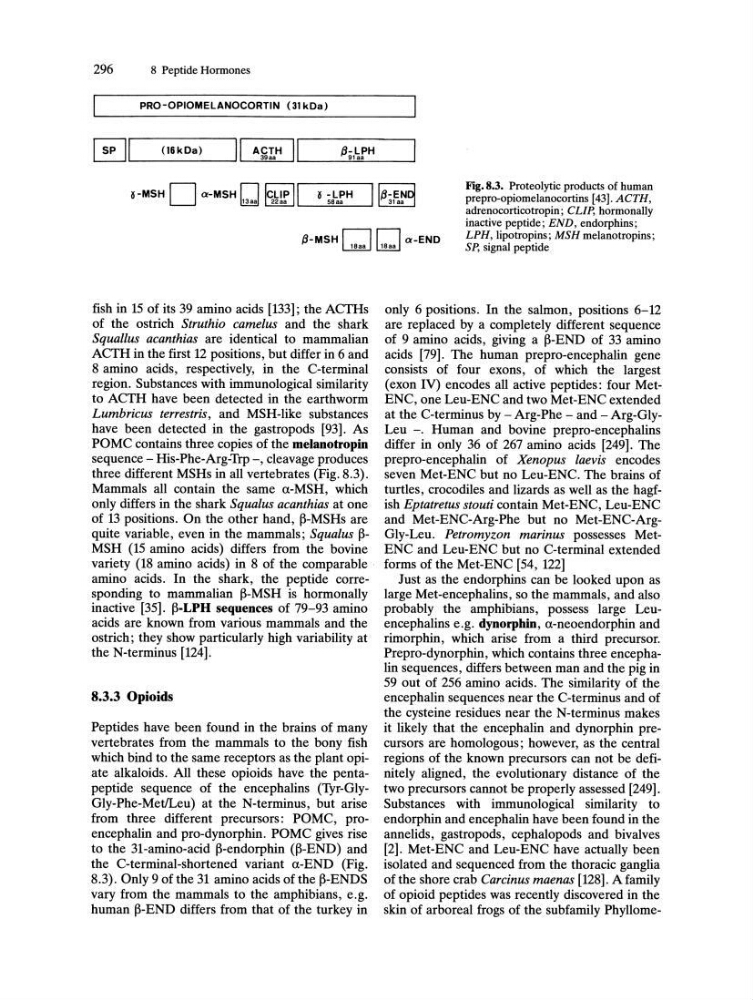
Fig.8.3. Proteolytic products of human
prepro-opiomelanocortins [43]. ACTH,
adrenocorticotropin; CLIp, hormonally
inactive peptide; END, endorphins;
LPH, lipotropins; MSH melanotropins;
SP, signal peptide
fish in 15 of its 39 amino acids [133]; the ACTHs
of the ostrich Struthio camelus and the shark
Squallus acanthias are identical to mammalian
ACTH in the first 12 positions, but differ in 6 and
8 amino acids, respectively, in the C-terminal
region. Substances with immunological similarity
to ACTH have been detected in the earthworm
Lumbricus terrestris, and MSH-like substances
have been detected in the gastropods [93]. As
POMC contains three copies of the melanotropin
sequence - His-Phe-Arg-Trp -, cleavage produces
three different MSHs in all vertebrates (Fig. 8.3).
Mammals all contain the same a-MSH, which
only differs in the shark Squalus acanthias at one
of 13 positions. On the other hand, ~-MSHs are
quite variable, even in the mammals; Squalus ~MSH (15 amino acids) differs from the bovine
variety (18 amino acids) in 8 of the comparable·
amino acids. In the shark, the peptide corresponding to mammalian ~-MSH is hormonally
inactive [35]. ~·LPH sequences of 79-93 amino
acids are known from various mammals and the
ostrich; they show particularly high variability at
the N-terminus [124].
8.3.3 Opioids
Peptides have been found in the brains of many
vertebrates from the mammals to the bony fish
which bind to the same receptors as the plant opiate alkaloids. All these opioids have the pentapeptide sequence of the encephalins (Tyr-GlyGly-Phe-MetlLeu) at the N-terminus, but arise
from three different precursors: POMC, proencephalin and pro-dynorphin. POMC gives rise
to the 31-amino-acid ~-endorphin (~-END) and
the C-terminal-shortened variant a-END (Fig.
8.3). Only 9 of the 31 amino acids of the ~-ENDS
vary from the mammals to the amphibians, e.g.
human ~-END differs from that of the turkey in
only 6 positions. In the salmon, positions 6-12
are replaced by a completely different sequence
of 9 amino acids, giving a ~-END of 33 amino
acids [79]. The human prepro-encephalin gene
consists of four exons, of which the largest
(exon IV) encodes all active peptides: four MetENC, one Leu-ENC and two Met-ENC extended
at the C-terminus by - Arg-Phe - and - Arg-GlyLeu -. Human and bovine prepro-encephalins
differ in only 36 of 267 amino acids [249]. The
prepro-encephalin of Xenopus laevis encodes
seven Met-ENC but no Leu-ENC. The brains of
turtles, crocodiles and lizards as well as the hagfish Eptatretus stouti contain Met-ENC, Leu-ENC
and Met-ENC-Arg-Phe but no Met-ENC-ArgGly-Leu. Petromyzon marinus possesses MetENC and Leu-ENC but no C-terminal extended
forms of the Met-ENC [54, 122]
Just as the endorphins can be looked upon as
large Met-encephalins, so the mammals, and also
probably the amphibians, possess large Leuencephalins e.g. dynorphin, a-neoendorphin and
rimorphin, which arise from a third precursor.
Prepro-dynorphin, which contains three encephalin sequences, differs between man and the pig in
59 out of 256 amino acids. The similarity of the
encephalin sequences near the C-terminus and of
the cysteine residues near the N-terminus makes
it likely that the encephalin and dynorphin precursors are homologous; however, as the central
regions of the known precursors can not be definitely aligned, the evolutionary distance of the
two precursors cannot be properly assessed [249].
Substances with immunological similarity to
endorphin and encephalin have been found in the
annelids, gastropods, cephalopods and bivalves
[2]. Met-ENC and Leu-ENC have actually been
isolated and sequenced from the thoracic ganglia
of the shore crab Carcinus maenas [128]. A family
of opioid pep tides was recently discovered in the
skin of arboreal frogs of the subfamily Phyllome-
8 Peptide Hormones
PRO-OPIOMELANOCORTIN (31 kDa)
~1~ ____ (_16_k_D_a_) ____ ~11 A~1H 11~ _____ ~~9~~ar~H ____ ~
~-MSH I I I I a-END
L!!!!..1 ~
Fig.8.3. Proteolytic products of human
prepro-opiomelanocortins [43]. ACTH,
adrenocorticotropin; CLIp, hormonally
inactive peptide; END, endorphins;
LPH, lipotropins; MSH melanotropins;
SP, signal peptide
fish in 15 of its 39 amino acids [133]; the ACTHs
of the ostrich Struthio camelus and the shark
Squallus acanthias are identical to mammalian
ACTH in the first 12 positions, but differ in 6 and
8 amino acids, respectively, in the C-terminal
region. Substances with immunological similarity
to ACTH have been detected in the earthworm
Lumbricus terrestris, and MSH-like substances
have been detected in the gastropods [93]. As
POMC contains three copies of the melanotropin
sequence - His-Phe-Arg-Trp -, cleavage produces
three different MSHs in all vertebrates (Fig. 8.3).
Mammals all contain the same a-MSH, which
only differs in the shark Squalus acanthias at one
of 13 positions. On the other hand, ~-MSHs are
quite variable, even in the mammals; Squalus ~MSH (15 amino acids) differs from the bovine
variety (18 amino acids) in 8 of the comparable·
amino acids. In the shark, the peptide corresponding to mammalian ~-MSH is hormonally
inactive [35]. ~·LPH sequences of 79-93 amino
acids are known from various mammals and the
ostrich; they show particularly high variability at
the N-terminus [124].
8.3.3 Opioids
Peptides have been found in the brains of many
vertebrates from the mammals to the bony fish
which bind to the same receptors as the plant opiate alkaloids. All these opioids have the pentapeptide sequence of the encephalins (Tyr-GlyGly-Phe-MetlLeu) at the N-terminus, but arise
from three different precursors: POMC, proencephalin and pro-dynorphin. POMC gives rise
to the 31-amino-acid ~-endorphin (~-END) and
the C-terminal-shortened variant a-END (Fig.
8.3). Only 9 of the 31 amino acids of the ~-ENDS
vary from the mammals to the amphibians, e.g.
human ~-END differs from that of the turkey in
only 6 positions. In the salmon, positions 6-12
are replaced by a completely different sequence
of 9 amino acids, giving a ~-END of 33 amino
acids [79]. The human prepro-encephalin gene
consists of four exons, of which the largest
(exon IV) encodes all active peptides: four MetENC, one Leu-ENC and two Met-ENC extended
at the C-terminus by - Arg-Phe - and - Arg-GlyLeu -. Human and bovine prepro-encephalins
differ in only 36 of 267 amino acids [249]. The
prepro-encephalin of Xenopus laevis encodes
seven Met-ENC but no Leu-ENC. The brains of
turtles, crocodiles and lizards as well as the hagfish Eptatretus stouti contain Met-ENC, Leu-ENC
and Met-ENC-Arg-Phe but no Met-ENC-ArgGly-Leu. Petromyzon marinus possesses MetENC and Leu-ENC but no C-terminal extended
forms of the Met-ENC [54, 122]
Just as the endorphins can be looked upon as
large Met-encephalins, so the mammals, and also
probably the amphibians, possess large Leuencephalins e.g. dynorphin, a-neoendorphin and
rimorphin, which arise from a third precursor.
Prepro-dynorphin, which contains three encephalin sequences, differs between man and the pig in
59 out of 256 amino acids. The similarity of the
encephalin sequences near the C-terminus and of
the cysteine residues near the N-terminus makes
it likely that the encephalin and dynorphin precursors are homologous; however, as the central
regions of the known precursors can not be definitely aligned, the evolutionary distance of the
two precursors cannot be properly assessed [249].
Substances with immunological similarity to
endorphin and encephalin have been found in the
annelids, gastropods, cephalopods and bivalves
[2]. Met-ENC and Leu-ENC have actually been
isolated and sequenced from the thoracic ganglia
of the shore crab Carcinus maenas [128]. A family
of opioid pep tides was recently discovered in the
skin of arboreal frogs of the subfamily Phyllome-