

292
8 Peptide Hormones
8.2 Hormones of the Hypothalamus
and Urophysis
8.2.1 Release and Release-Inhibiting Factors
Hormone release from the adenophysis is regulated by peptide factors from the hypothalamus:
thyrotropin-releasing factor (TRF) , gonadotropin- or lutropin-releasing factor (GnRF or LHRF), growth-hormone-release-inhibiting factor
(GH-RIF) or somatostatin (SST), corticotropinreleasing factor (CRF) and growth-hormonereleasing factor (GRF). These are also sometimes
referred to as releasing hormones (RH) or release-inhibiting hormones (RIH) [123]. The
thyrotropin-releasing factor stimulates the release of thyrotropin and prolactin in mammals. It
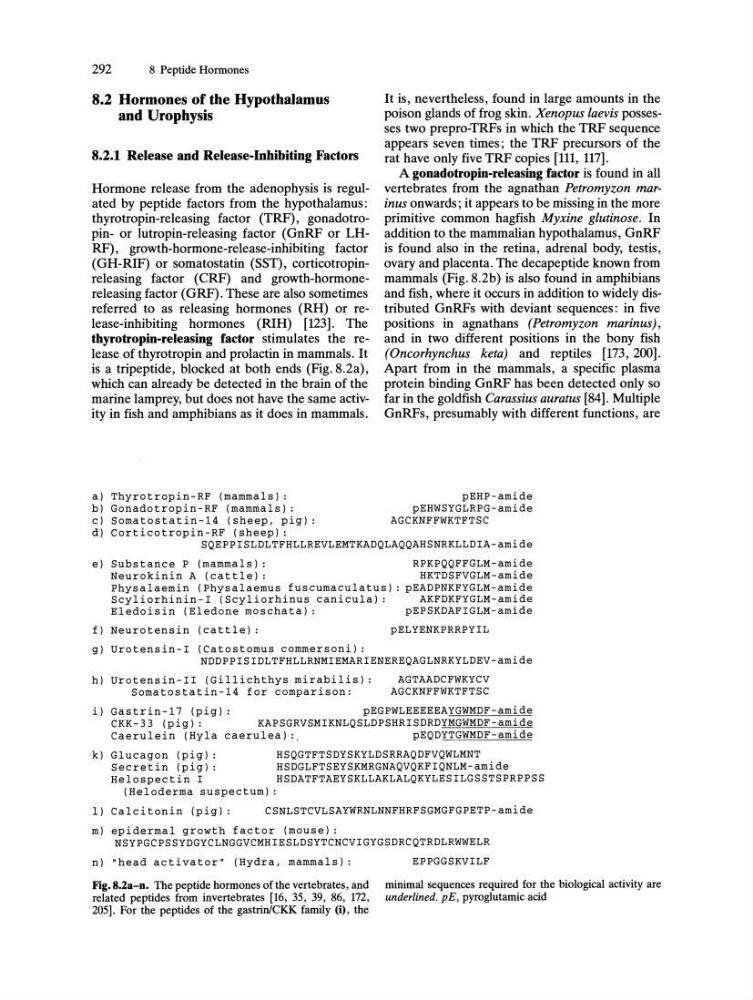
is a tripeptide, blocked at both ends (Fig.8.2a),
which can already be detected in the brain of the
marine lamprey, but does not have the same activity in fish and amphibians as it does in mammals.
a) Thyrotropin-RF (mammals):
b) Gonadotropin-RF (mammals):
c) Somatostatin-14 (sheep, pig):
d) Corticotropin-RF (sheep):
It is, nevertheless, found in large amounts in the
poison glands of frog skin. Xenopus laevis possesses two prepro-TRFs in which the TRF sequence
appears seven times; the TRF precursors of the
rat have only five TRF copies [111, 117].
A gonadotropin-releasing factor is found in all
vertebrates from the agnathan Petromyzon marinus onwards; it appears to be missing in the more
primitive common hagfish Myxine glutinose. In
addition to the mammalian hypothalamus, GnRF
is found also in the retina, adrenal body, testis,
ovary and placenta. The decapeptide known from
mammals (Fig. 8.2b) is also found in amphibians
and fish, where it occurs in addition to widely distributed GnRFs with deviant sequences: in five
positions in agnathans (Petromyzon marinus) ,
and in two different positions in the bony fish
(Oncorhynchus keta) and reptiles [173,200].
Apart from in the mammals, a specific plasma
protein binding GnRF has been detected only so
far in the goldfish Carassius auratus [84]. Multiple
GnRFs, presumably with different functions, are
pEHP-amide
pEHWSYGLRPG-amide
AGCKNFFWKTFTSC
SQEPPISLDLTFHLLREVLEMTKADQLAQQAHSNRKLLDIA-amide
e) Substance P (mammals):
RPKPQQFFGLM-amide
Neurokinin A (cattle):
HKTDSFVGLM-amide
Physalaemin (Physalaemus fuscumaculatus) : pEADPNKFYGLM-amide
Scyliorhinin-I (Scyliorhinus canicula) :
AKFDKFYGLM-amide
Eledoisin (Eledone moschata) :
pEPSKDAFIGLM-amide
f) Neurotensin (cattle):
pELYENKPRRPYIL
g) Urotensin-I (Catostomus commersoni) :
NDDPPISIDLTFHLLRNMIEMARIENEREQAGLNRKYLDEV-amide
h) Urotensin-II (Gillichthys mirabilis) :
AGTAADCFWKYCV
Somatostatin-14 for comparison:
AGCKNFFWKTFTSC
i) Gastrin-17 (pig):
pEGPWLEEEEEAYGWMDF-amide
CKK-33 (pig):
KAPSGRVSMIKNLQSLDPSHRISDRDYMGWMDF-amide
Caerulein (Hyla caerulea) :.
pEQDYTGWMDF-amide
k) Glucagon (pig):
HSQGTFTSDYSKYLDSRRAQDFVQWLMNT
Secretin (pig):
HSDGLFTSEYSKMRGNAQVQKFIQNLM-amide
Helospectin I
HSDATFTAEYSKLLAKLALQKYLESILGSSTSPRPPSS
(Heloderma suspectum) :
1) Calcitonin (pig):
CSNLSTCVLSAYWRNLNNFHRFSGMGFGPETP-amide
m) epidermal growth factor (mouse):
NSYPGCPSSYDGYCLNGGVCMHIESLDSYTCNCVIGYGSDRCQTRDLRWWELR
n) 'head activator' (Hydra, mammals):
Fig. 8.2a-n. The peptide hormones of the vertebrates, and
related peptides from invertebrates [16, 35, 39, 86, 172,
205]. For the peptides of the gastrinlCKK family (i), the
EPPGGSKVILF
minimal sequences required for the biological activity are
underlined. pE, pyroglutamic acid
8 Peptide Hormones
8.2 Hormones of the Hypothalamus
and Urophysis
8.2.1 Release and Release-Inhibiting Factors
Hormone release from the adenophysis is regulated by peptide factors from the hypothalamus:
thyrotropin-releasing factor (TRF) , gonadotropin- or lutropin-releasing factor (GnRF or LHRF), growth-hormone-release-inhibiting factor
(GH-RIF) or somatostatin (SST), corticotropinreleasing factor (CRF) and growth-hormonereleasing factor (GRF). These are also sometimes
referred to as releasing hormones (RH) or release-inhibiting hormones (RIH) [123]. The
thyrotropin-releasing factor stimulates the release of thyrotropin and prolactin in mammals. It
is a tripeptide, blocked at both ends (Fig.8.2a),
which can already be detected in the brain of the
marine lamprey, but does not have the same activity in fish and amphibians as it does in mammals.
a) Thyrotropin-RF (mammals):
b) Gonadotropin-RF (mammals):
c) Somatostatin-14 (sheep, pig):
d) Corticotropin-RF (sheep):
It is, nevertheless, found in large amounts in the
poison glands of frog skin. Xenopus laevis possesses two prepro-TRFs in which the TRF sequence
appears seven times; the TRF precursors of the
rat have only five TRF copies [111, 117].
A gonadotropin-releasing factor is found in all
vertebrates from the agnathan Petromyzon marinus onwards; it appears to be missing in the more
primitive common hagfish Myxine glutinose. In
addition to the mammalian hypothalamus, GnRF
is found also in the retina, adrenal body, testis,
ovary and placenta. The decapeptide known from
mammals (Fig. 8.2b) is also found in amphibians
and fish, where it occurs in addition to widely distributed GnRFs with deviant sequences: in five
positions in agnathans (Petromyzon marinus) ,
and in two different positions in the bony fish
(Oncorhynchus keta) and reptiles [173,200].
Apart from in the mammals, a specific plasma
protein binding GnRF has been detected only so
far in the goldfish Carassius auratus [84]. Multiple
GnRFs, presumably with different functions, are
pEHP-amide
pEHWSYGLRPG-amide
AGCKNFFWKTFTSC
SQEPPISLDLTFHLLREVLEMTKADQLAQQAHSNRKLLDIA-amide
e) Substance P (mammals):
RPKPQQFFGLM-amide
Neurokinin A (cattle):
HKTDSFVGLM-amide
Physalaemin (Physalaemus fuscumaculatus) : pEADPNKFYGLM-amide
Scyliorhinin-I (Scyliorhinus canicula) :
AKFDKFYGLM-amide
Eledoisin (Eledone moschata) :
pEPSKDAFIGLM-amide
f) Neurotensin (cattle):
pELYENKPRRPYIL
g) Urotensin-I (Catostomus commersoni) :
NDDPPISIDLTFHLLRNMIEMARIENEREQAGLNRKYLDEV-amide
h) Urotensin-II (Gillichthys mirabilis) :
AGTAADCFWKYCV
Somatostatin-14 for comparison:
AGCKNFFWKTFTSC
i) Gastrin-17 (pig):
pEGPWLEEEEEAYGWMDF-amide
CKK-33 (pig):
KAPSGRVSMIKNLQSLDPSHRISDRDYMGWMDF-amide
Caerulein (Hyla caerulea) :.
pEQDYTGWMDF-amide
k) Glucagon (pig):
HSQGTFTSDYSKYLDSRRAQDFVQWLMNT
Secretin (pig):
HSDGLFTSEYSKMRGNAQVQKFIQNLM-amide
Helospectin I
HSDATFTAEYSKLLAKLALQKYLESILGSSTSPRPPSS
(Heloderma suspectum) :
1) Calcitonin (pig):
CSNLSTCVLSAYWRNLNNFHRFSGMGFGPETP-amide
m) epidermal growth factor (mouse):
NSYPGCPSSYDGYCLNGGVCMHIESLDSYTCNCVIGYGSDRCQTRDLRWWELR
n) 'head activator' (Hydra, mammals):
Fig. 8.2a-n. The peptide hormones of the vertebrates, and
related peptides from invertebrates [16, 35, 39, 86, 172,
205]. For the peptides of the gastrinlCKK family (i), the
EPPGGSKVILF
minimal sequences required for the biological activity are
underlined. pE, pyroglutamic acid