

290
8 Peptide Hormones
gical activities to vertebrate insulin are also
detected in tunicates, insects, crustaceans, gastropods, cephalopods, ciliates, and even fungi and
prokaryotes. Representatives of these invertebrate groups have also been shown to possess
somatostatin, encephalin, gastrin, CKK, secretin,
substance P, PP, VIP, calcitonin and other vertebrate peptides. It must be stated, however, that in
invertebrates these peptides have been detected
almost exclusively using immunological methods,
and their identity with vertebrate peptides is not
completely certain. Conversely, the brain and gut
of amphibians, birds and mammals apparently
contain the neuropeptide FMRF-amide of molluscs, and mammals also possess the "head activator" of the freshwater polyp Hydra. As will be
discussed later for individual peptides, only in a
few cases is it known whether the vertebrate peptide has a hormone function in invertebrates and
how far this corresponds to the activity in vertebrates. Because each hormone needs a corresponding specific receptor, the evolution of which
does not necessarily occur simultaneously with
that of the peptide, the simple presence of a particular hormone does not allow firm conclusions
to be drawn about its function. It is also true that
some peptide hormones are phylogenetically very
old and have possibly changed in function during
evolution (127, 166]. What follows is a discussion
of, in particular, the structure and formation of
regulatory peptides from a comparative biochemistry point of view; comparative observations
on their activities can be found in the many textbooks on hormone physiology.
8.1 Hormones of the Neurohypophysis
The neurohypophysis releases nonapeptide hormones into the blood. The high molecular weight
precursors of these peptides are synthesized in
certain neurons of the hypothalamus and are proteolytically cleaved; the nonapeptides are bound
to specific carrier proteins (neurophysins) and
transported as neurosecretory granules via nerve
processes to the neurohypophysis, where they are
released. In the blood plasma they are bound to a
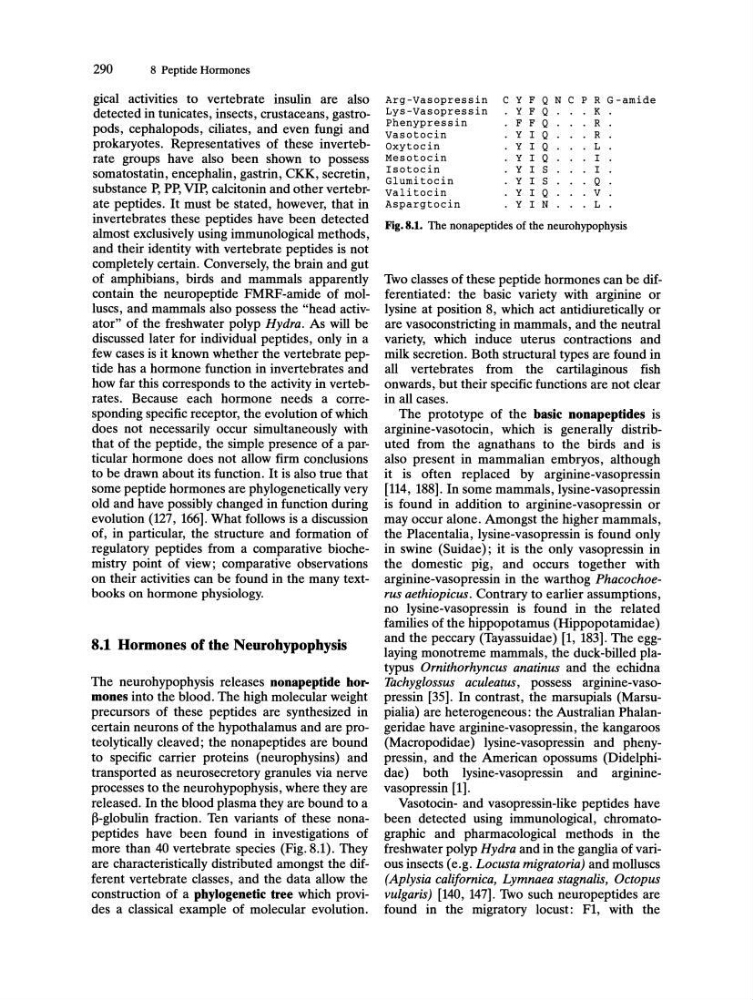
~-globulin fraction. Ten variants of these nonapeptides have been found in investigations of
more than 40 vertebrate species (Fig. 8.1). They
are characteristically distributed amongst the different vertebrate classes, and the data allow the
construction of a phylogenetic tree which provides a classical example of molecular evolution.
Arg-Vasopressin C Y F Q N C P R G -amide
Lys-Vasopressin
Y F Q
K
Phenypressin
F F Q
R
Vasotocin
Y I Q
R
Oxytocin
Y I Q
L
Mesotocin
Y I Q
I
Isotocin
Y I S
I
Glumitocin
Y I S
Q
Valitocin
Y I Q
V
Aspargtocin
Y I N
L
Fig. 8.1. The nonapeptides of the neurohypophysis
Two classes of these peptide hormones can be differentiated: the basic variety with arginine or
lysine at position 8, which act antidiuretically or
are vasoconstricting in mammals, and the neutral
variety, which induce uterus contractions and
milk secretion. Both structural types are found in
all vertebrates from the cartilaginous fish
onwards, but their specific functions are not clear
in all cases.
The prototype of the basic nonapeptides is
arginine-vasotocin, which is generally distributed from the agnathans to the birds and is
also present in mammalian embryos, although
it is often replaced by arginine-vasopressin
[114, 188]. In some mammals, lysine-vasopressin
is found in addition to arginine-vasopressin or
may occur alone. Amongst the higher mammals,
the Placentalia, lysine-vasopressin is found only
in swine (Suidae); it is the only vasopressin in
the domestic pig, and occurs together with
arginine-vasopressin in the warthog Phacochoerus aethiopicus. Contrary to earlier assumptions,
no lysine-vasopressin is found in the related
families of the hippopotamus (Hippopotamidae)
and the peccary (Tayassuidae) [1, 183]. The egglaying monotreme mammals, the duck-billed platypus Ornithorhyncus anatinus and the echidna
Tachyglossus aculeatus, possess arginine-vasopressin [35]. In contrast, the marsupials (Marsupialia) are heterogeneous: the Australian Phalangeridae have arginine-vasopressin, the kangaroos
(Macropodidae) lysine-vasopressin and phenypressin, and the American opossums (Didelphidae) both lysine-vasopressin and argininevasopressin [1].
Vasotocin- and vasopressin-like peptides have
been detected using immunological, chromatographic and pharmacological methods in the
freshwater polyp Hydra and in the ganglia of various insects (e.g. Locusta migratoria) and molluscs
(Aplysia californica, Lymnaea stagnalis, Octopus
vulgaris) [140, 147]. Two such neuropeptides are
found in the migratory locust: F1, with the
8 Peptide Hormones
gical activities to vertebrate insulin are also
detected in tunicates, insects, crustaceans, gastropods, cephalopods, ciliates, and even fungi and
prokaryotes. Representatives of these invertebrate groups have also been shown to possess
somatostatin, encephalin, gastrin, CKK, secretin,
substance P, PP, VIP, calcitonin and other vertebrate peptides. It must be stated, however, that in
invertebrates these peptides have been detected
almost exclusively using immunological methods,
and their identity with vertebrate peptides is not
completely certain. Conversely, the brain and gut
of amphibians, birds and mammals apparently
contain the neuropeptide FMRF-amide of molluscs, and mammals also possess the "head activator" of the freshwater polyp Hydra. As will be
discussed later for individual peptides, only in a
few cases is it known whether the vertebrate peptide has a hormone function in invertebrates and
how far this corresponds to the activity in vertebrates. Because each hormone needs a corresponding specific receptor, the evolution of which
does not necessarily occur simultaneously with
that of the peptide, the simple presence of a particular hormone does not allow firm conclusions
to be drawn about its function. It is also true that
some peptide hormones are phylogenetically very
old and have possibly changed in function during
evolution (127, 166]. What follows is a discussion
of, in particular, the structure and formation of
regulatory peptides from a comparative biochemistry point of view; comparative observations
on their activities can be found in the many textbooks on hormone physiology.
8.1 Hormones of the Neurohypophysis
The neurohypophysis releases nonapeptide hormones into the blood. The high molecular weight
precursors of these peptides are synthesized in
certain neurons of the hypothalamus and are proteolytically cleaved; the nonapeptides are bound
to specific carrier proteins (neurophysins) and
transported as neurosecretory granules via nerve
processes to the neurohypophysis, where they are
released. In the blood plasma they are bound to a
~-globulin fraction. Ten variants of these nonapeptides have been found in investigations of
more than 40 vertebrate species (Fig. 8.1). They
are characteristically distributed amongst the different vertebrate classes, and the data allow the
construction of a phylogenetic tree which provides a classical example of molecular evolution.
Arg-Vasopressin C Y F Q N C P R G -amide
Lys-Vasopressin
Y F Q
K
Phenypressin
F F Q
R
Vasotocin
Y I Q
R
Oxytocin
Y I Q
L
Mesotocin
Y I Q
I
Isotocin
Y I S
I
Glumitocin
Y I S
Q
Valitocin
Y I Q
V
Aspargtocin
Y I N
L
Fig. 8.1. The nonapeptides of the neurohypophysis
Two classes of these peptide hormones can be differentiated: the basic variety with arginine or
lysine at position 8, which act antidiuretically or
are vasoconstricting in mammals, and the neutral
variety, which induce uterus contractions and
milk secretion. Both structural types are found in
all vertebrates from the cartilaginous fish
onwards, but their specific functions are not clear
in all cases.
The prototype of the basic nonapeptides is
arginine-vasotocin, which is generally distributed from the agnathans to the birds and is
also present in mammalian embryos, although
it is often replaced by arginine-vasopressin
[114, 188]. In some mammals, lysine-vasopressin
is found in addition to arginine-vasopressin or
may occur alone. Amongst the higher mammals,
the Placentalia, lysine-vasopressin is found only
in swine (Suidae); it is the only vasopressin in
the domestic pig, and occurs together with
arginine-vasopressin in the warthog Phacochoerus aethiopicus. Contrary to earlier assumptions,
no lysine-vasopressin is found in the related
families of the hippopotamus (Hippopotamidae)
and the peccary (Tayassuidae) [1, 183]. The egglaying monotreme mammals, the duck-billed platypus Ornithorhyncus anatinus and the echidna
Tachyglossus aculeatus, possess arginine-vasopressin [35]. In contrast, the marsupials (Marsupialia) are heterogeneous: the Australian Phalangeridae have arginine-vasopressin, the kangaroos
(Macropodidae) lysine-vasopressin and phenypressin, and the American opossums (Didelphidae) both lysine-vasopressin and argininevasopressin [1].
Vasotocin- and vasopressin-like peptides have
been detected using immunological, chromatographic and pharmacological methods in the
freshwater polyp Hydra and in the ganglia of various insects (e.g. Locusta migratoria) and molluscs
(Aplysia californica, Lymnaea stagnalis, Octopus
vulgaris) [140, 147]. Two such neuropeptides are
found in the migratory locust: F1, with the